
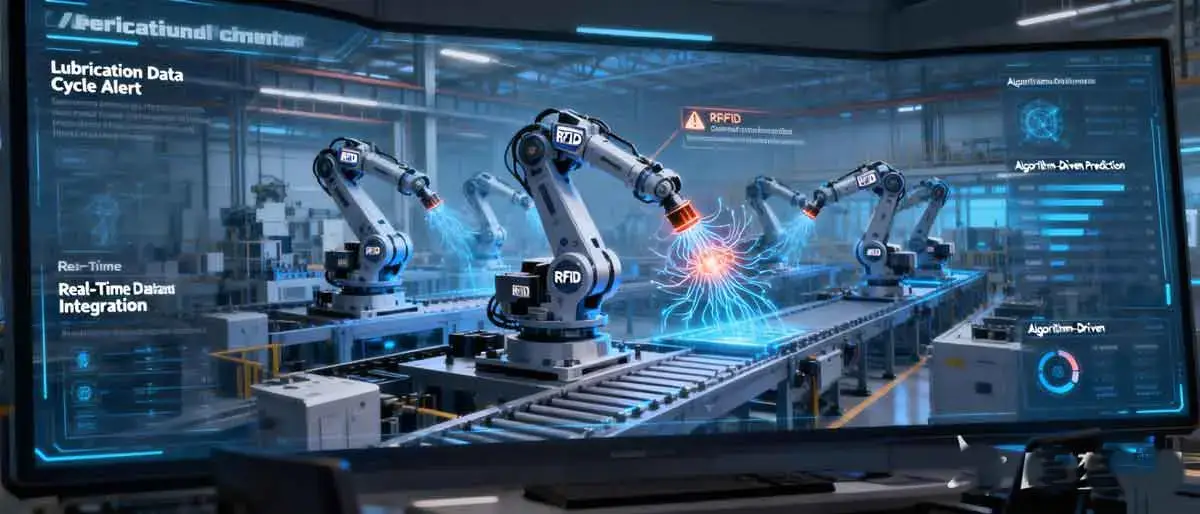
Smart Manufacturing Workshops Face Dilemmas in Tracking and Managing Robot Spare Parts and Maintenance Data
A Medium-Sized Automotive Welding Workshop Needs to Manage More Than 5,000 Replaceable Robot Components on Average
The rapid development of intelligent manufacturing has made industrial robots an indispensable core force in modern production workshops, especially in the automotive manufacturing field with high automation requirements. However, the complex composition of robot systems has brought enormous challenges to the tracking and management of spare parts and maintenance data. A typical medium-sized automotive welding workshop needs to manage more than 5,000 replaceable robot components on average, including high-precision parts such as reducers, servo motors, bearings, and welding guns, as well as conventional accessories like cables and connectors. These components vary in specifications, models, and service lives, and their storage locations and usage status need to be accurately recorded. The traditional manual management mode is far from meeting the efficiency and accuracy requirements of smart manufacturing. In this context, Anti-Metal RFID Tag has emerged as a key solution to solve the tracking and management dilemmas, laying a solid foundation for the smart operation of industrial robots.
The Time Spent on Finding and Verifying Parts in Manual Paper Ledgers Accounts for 35% of Unplanned Downtime on Average
Unplanned downtime of industrial robots is a major factor affecting the production efficiency of smart manufacturing workshops, and the backwardness of spare parts management is an important cause of such downtime. At present, many workshops still rely on manual paper ledgers to record the information of robot spare parts. When a robot fails, maintenance personnel need to search through a large number of paper records to confirm the storage location, inventory quantity, and compatibility of the required parts, and then go to the warehouse to find and verify the parts. This process is not only time-consuming but also prone to errors such as taking the wrong parts or missing inventory. Statistics show that the time spent on finding and verifying parts in manual paper ledgers accounts for 35% of unplanned downtime on average. This long-term unplanned downtime not only reduces the overall production capacity of the workshop but also increases the production cost due to delayed delivery. The inefficiency of manual management has become a bottleneck restricting the high-quality development of smart manufacturing, highlighting the urgent need for an intelligent and automated tracking and management solution based on technologies such as Anti-Metal RFID Tag.
The Reading Failure Rate of Traditional Barcodes or Ordinary RFID Tags on Metal Surfaces and in Oily Environments Reaches as High as 60%
Some workshops have attempted to use traditional barcodes or ordinary RFID tags to improve the efficiency of spare parts and maintenance data management, but they face severe limitations in the harsh industrial environment of robot operation. Industrial robots, especially those used in welding, painting, and assembly workshops, often work in environments with metal surfaces, oil stains, high temperatures, and high humidity. Traditional barcodes are easily contaminated by oil stains, difficult to read, and have poor durability. Ordinary RFID tags are severely affected by the metal surface due to electromagnetic interference, resulting in greatly reduced reading distance or even complete failure to read. Tests show that the reading failure rate of traditional barcodes or ordinary RFID tags on metal surfaces and in oily environments reaches as high as 60%. This high failure rate makes it impossible for these technologies to effectively play their role in robot spare parts and maintenance data tracking. In contrast, Anti-Metal RFID Tag is specially designed for harsh industrial environments, which can overcome the interference of metal surfaces and oil stains, ensuring stable and reliable data reading, and thus becoming the preferred technology for the smart operation of industrial robots.
UHF Anti-Metal Tags Designed Specifically for Industrial Robots Achieve Accurate Physical Binding
The Tag Adopts a Special Electromagnetic Isolation Material Layer, Enabling Stable Reading Distance of 10 Meters on Metal Surfaces
The core advantage of Anti-Metal RFID Tag lies in its excellent performance on metal surfaces, which is mainly attributed to its special material structure design. Unlike ordinary RFID tags, Anti-Metal RFID Tag adopts a special electromagnetic isolation material layer between the tag antenna and the metal surface. This material layer can effectively isolate the electromagnetic interference generated by the metal surface, prevent the metal from absorbing the radio frequency signal emitted by the tag, and thus ensure the normal transmission of the signal. Through precise material selection and structural optimization, the UHF Anti-Metal Tag designed specifically for industrial robots can achieve a stable reading distance of 10 meters on metal surfaces. This long-distance and stable reading performance allows maintenance personnel to quickly obtain the information of robot components without approaching the robot or disassembling the protective cover, greatly improving the efficiency of data collection. At the same time, the tag can also maintain stable performance in the presence of oil stains and dust, further ensuring the reliability of data tracking in harsh industrial environments.
Customized Design of Installation Positions and Fixing Buckles According to the Activity Range and Stress Distribution of the Six Joints of the Robot
Industrial robots have complex motion mechanisms, and their six joints need to perform frequent and large-angle rotations during operation, which puts forward high requirements for the installation stability and durability of Anti-Metal RFID Tag. To achieve accurate physical binding between the tag and the robot components, the tag’s installation positions and fixing buckles are customized according to the activity range and stress distribution of the six joints of the robot. First, through kinematic analysis of the robot, the positions with small motion interference, low stress, and convenient reading are selected as the installation points, avoiding the tags being damaged by collision or excessive stress during the robot’s movement. Second, the fixing buckles are designed with high-strength and wear-resistant materials, and the structure is optimized to ensure that the tags can be firmly fixed on the robot components without loosening even after long-term high-frequency motion. This customized design not only ensures the stability and reliability of the tags during the robot’s operation but also facilitates the installation and replacement of the tags, improving the practicality of the Anti-Metal RFID Tag in robot smart operation.
Passing 2 Million Times of Repeated Bending and 5,000 Hours of Continuous Vibration Tests to Ensure the Same Life Cycle as the Robot
The service life of industrial robots is usually 8-12 years, and during this period, they need to work continuously in harsh environments, which requires that the supporting Anti-Metal RFID Tag must have excellent durability and long service life to avoid frequent replacement and affect the normal operation of the robot. To meet this requirement, Anti-Metal RFID Tag has undergone strict reliability tests, including 2 million times of repeated bending tests and 5,000 hours of continuous vibration tests. The repeated bending test simulates the deformation of the tag caused by the robot’s joint movement, ensuring that the tag’s antenna and chip are not damaged and the performance is not degraded under repeated bending. The continuous vibration test simulates the vibration environment of the robot during operation, verifying the stability of the tag’s structure and the reliability of the data transmission. After passing these rigorous tests, the Anti-Metal RFID Tag can ensure the same life cycle as the robot, providing long-term and stable data tracking support for the robot’s entire service life. This long-life design not only reduces the maintenance cost of the tag itself but also ensures the continuity and completeness of the robot’s maintenance data, laying a solid foundation for the long-term smart operation of the robot.
Predictive Maintenance System Realizes the Transformation from Response to Prevention Based on Operating Data
The Tag Chip Continuously Records the Operating Hours, Peak Torque, and Temperature History of the Joint Motor
Anti-Metal RFID Tag is not only a tool for tracking spare parts but also a key data collection terminal for the predictive maintenance system of industrial robots. The tag chip has a large-capacity storage space, which can continuously record a variety of key operating data of the robot, including the operating hours of the joint motor, peak torque during operation, and real-time temperature history. During the robot’s operation, the tag collects these data in real time and stores them in the chip. Maintenance personnel can read the data through a handheld reader or a fixed reading device, obtaining an accurate understanding of the operating status of the robot components. For example, the operating hours of the joint motor can help determine the degree of wear of the motor; the peak torque data can reflect whether the motor is overloaded; and the temperature history can predict potential faults such as motor overheating. This continuous and detailed data collection enables the predictive maintenance system to have a comprehensive and real-time understanding of the robot’s health status, laying the foundation for the transformation from responsive maintenance to preventive maintenance.
Machine Learning Algorithms Analyze Data Trends and Issue Replacement Alerts 400 Hours Before the Expected Failure of Components
The core of the predictive maintenance system is the data analysis and fault prediction based on machine learning algorithms. After collecting the operating data of the robot through Anti-Metal RFID Tag, the system transmits the data to the background server. The machine learning algorithms built into the server analyze the data trends, establish a fault prediction model based on a large amount of historical operating data and fault records, and accurately predict the remaining service life of the robot components. When the algorithm predicts that a component may fail, it will issue a replacement alert 400 hours before the expected failure. This early warning gives maintenance personnel sufficient time to make maintenance plans, arrange maintenance schedules, and prepare spare parts, avoiding unplanned downtime caused by sudden component failures. Compared with the traditional responsive maintenance mode, which can only carry out maintenance after a fault occurs, the predictive maintenance based on Anti-Metal RFID Tag and machine learning algorithms can effectively improve the reliability of the robot’s operation and reduce the impact of faults on production. The 400-hour early warning window is a result of repeated verification through a large number of practical cases, which can balance the maintenance efficiency and cost, ensuring that the maintenance work can be carried out in an orderly manner.
Maintenance Work Orders Are Automatically Generated and Pushed to the MES System, Synchronously Preparing Required Spare Parts and Technical Personnel
When the predictive maintenance system issues a replacement alert based on the data analyzed by Anti-Metal RFID Tag, it will automatically generate a maintenance work order. The work order includes detailed information such as the robot number, the faulty component, the expected failure time, the required spare parts model and quantity, and the maintenance technical requirements. The system then pushes the work order to the Manufacturing Execution System (MES) in real time. After receiving the work order, the MES system synchronously triggers the preparation work of required spare parts and technical personnel: on the one hand, it checks the inventory of the required spare parts through the smart warehouse management system connected with the Anti-Metal RFID Tag, and if the inventory is insufficient, it automatically initiates a purchase application; on the other hand, it arranges the appropriate maintenance technical personnel according to the maintenance requirements and the personnel’s work schedule, and sends the work order to the personnel’s mobile terminal. This automated workflow from alert generation to work order pushing and preparation work greatly shortens the maintenance preparation time, improves the efficiency of maintenance work, and ensures that the maintenance work can be completed before the component fails. The seamless connection between the predictive maintenance system and the MES system relies on the accurate data support of Anti-Metal RFID Tag, forming a closed-loop management of robot maintenance, and further promoting the intelligent operation of the workshop.
Comprehensive Deployment in Tesla’s Berlin Gigafactory Verifies Significant Improvement in Operation and Maintenance Efficiency
More Than 2,000 KUKA and Fanuc Robots in the Gigafactory Have Completed Tag Deployment
The practical effect of Anti-Metal RFID Tag in improving the smart operation level of industrial robots has been fully verified in the comprehensive deployment of Tesla’s Berlin Gigafactory. As one of the most advanced smart manufacturing bases in the world, Tesla’s Berlin Gigafactory has a large number of industrial robots, mainly including KUKA and Fanuc robots, which are widely used in welding, assembly, painting, and other production processes. To solve the problems of robot spare parts management and maintenance efficiency, the gigafactory has carried out a full-scale deployment of Anti-Metal RFID Tag, with more than 2,000 KUKA and Fanuc robots completing tag installation. Each replaceable component of these robots is equipped with a dedicated Anti-Metal RFID Tag, which realizes the full-life-cycle tracking of components from production, storage, installation, operation to replacement. The deployment of the tags covers the entire production workshop, and a network of fixed reading devices is established at key positions such as robot workstations, warehouses, and maintenance stations, realizing the automatic collection and real-time transmission of robot operating data and spare parts information. This large-scale and comprehensive deployment provides a typical application case for the industry to apply Anti-Metal RFID Tag to robot smart operation.
Unplanned Downtime Decreased by 38% Compared with the Same Period Before Deployment, and Production Capacity Stability Was Significantly Improved
The comprehensive deployment of Anti-Metal RFID Tag in Tesla’s Berlin Gigafactory has achieved remarkable results in improving operation and maintenance efficiency and production capacity stability. Statistics show that after the deployment of the tags, the unplanned downtime of industrial robots in the gigafactory decreased by 38% compared with the same period before deployment. This significant reduction in unplanned downtime is mainly due to the realization of predictive maintenance based on Anti-Metal RFID Tag: the system can issue early warnings before components fail, allowing maintenance work to be carried out in advance, avoiding sudden failures that cause production interruptions. At the same time, the efficient tracking and management of spare parts based on the tags has shortened the time for finding and verifying parts during maintenance, further reducing the duration of unplanned downtime. The reduction in unplanned downtime has significantly improved the stability of the gigafactory’s production capacity, ensuring that the production line can operate continuously and stably according to the plan. For Tesla, which pursues high-efficiency production, this improvement in production capacity stability not only increases the output of electric vehicles but also reduces the production cost caused by production fluctuations, reflecting the significant economic value of Anti-Metal RFID Tag in smart manufacturing.
The Unplanned Replacement Rate of Key Reducers and Servo Motors Decreased by 72%, Saving More Than 10 Million Euros in Maintenance Costs Annually
In addition to reducing unplanned downtime, the deployment of Anti-Metal RFID Tag in Tesla’s Berlin Gigafactory has also achieved remarkable results in reducing the unplanned replacement rate of key components and saving maintenance costs. Key components such as reducers and servo motors are the core parts of industrial robots, with high value and high failure impact. Before the deployment of the tags, the unplanned replacement rate of these key components was relatively high due to the lack of effective predictive maintenance. After the deployment of Anti-Metal RFID Tag, the predictive maintenance system can accurately predict the failure of key components, and carry out planned replacement before failure, which significantly reduces the unplanned replacement rate. Statistics show that the unplanned replacement rate of key reducers and servo motors decreased by 72% after deployment. The reduction in unplanned replacement not only reduces the damage to other components caused by sudden failures of key components but also saves a lot of maintenance costs, including the cost of spare parts, maintenance labor costs, and the cost of production losses caused by unplanned replacement. It is estimated that the gigafactory saves more than 10 million euros in maintenance costs annually through the deployment of Anti-Metal RFID Tag. This data fully verifies the economic benefits of Anti-Metal RFID Tag in robot maintenance, providing a strong driving force for the industry to promote the application of this technology.
Adaptive Design for Extreme Industrial Environments Ensures Reliable Operation in All Scenarios
The Tag Encapsulation Material Uses Special Polyimide, Withstanding Low-Temperature Circulation Shocks from -40℃ to 150℃ High Temperature
Industrial robots often work in extreme environments such as high temperature, low temperature, humidity, and corrosion, which requires Anti-Metal RFID Tag to have excellent environmental adaptability. To ensure reliable operation in all scenarios, the tag’s encapsulation material uses special polyimide. Polyimide is a high-performance polymer material with excellent high-temperature resistance, low-temperature resistance, and chemical corrosion resistance. The Anti-Metal RFID Tag encapsulated with this material can withstand low-temperature circulation shocks from -40℃ to 150℃ high temperature. In high-temperature environments such as welding workshops, the tag will not deform or fail due to high temperature; in low-temperature environments such as cold storage or outdoor low-temperature operations, the tag can still maintain stable performance. This wide temperature adaptation range enables Anti-Metal RFID Tag to be applied to various types of industrial robot working environments, breaking the limitations of traditional tags in extreme temperature environments. At the same time, the polyimide encapsulation material also has good mechanical strength, which can protect the internal chip and antenna from physical damage, further improving the reliability of the tag.
The Surface Three-Layer Nano-Oleophobic Coating Prevents Common Cutting Fluids and Lubricants from Adhering and Affecting Reading
In machining workshops such as automotive parts manufacturing, industrial robots are often in contact with cutting fluids and lubricants, which are easy to adhere to the surface of the tags, affecting the reading performance of the tags. To solve this problem, Anti-Metal RFID Tag is designed with a three-layer nano-oleophobic coating on the surface. This nano-oleophobic coating has super strong oil repellency, which can prevent common cutting fluids, lubricants, and other oily substances from adhering to the surface of the tag. Even if the tag comes into contact with these substances, they can be easily washed away with water or a simple wipe, without leaving residues on the tag surface. This design effectively avoids the reading failure caused by oil contamination of the tag, ensuring that the tag can maintain stable reading performance in oily environments. The three-layer structure of the nano-oleophobic coating also enhances the wear resistance and durability of the coating, ensuring that the oil-repellent performance is not lost after long-term use. This adaptive design for oily environments makes Anti-Metal RFID Tag more suitable for the actual working conditions of industrial robots, further expanding its application scope.
Reaching IP69K Protection Level, Capable of Withstanding High-Pressure Water Gun Flushing and High-Concentration Dust Environments
Industrial workshops, especially those in the automotive, machinery, and other industries, often have high-concentration dust, and regular high-pressure water gun cleaning is required to maintain the cleanliness of the production environment. This puts forward high requirements for the dustproof and waterproof performance of Anti-Metal RFID Tag. The tag has reached the IP69K protection level, which is the highest level of protection in the IP protection standard. The IP69K protection level means that the tag is completely dust-tight, and can withstand high-pressure and high-temperature water flushing. In high-concentration dust environments, the tag will not be damaged by dust entering the internal structure; during high-pressure water gun cleaning, the tag can resist the impact of high-pressure water flow and prevent water from entering the chip and antenna, ensuring that the performance is not affected. This high-level protection performance enables Anti-Metal RFID Tag to operate reliably in harsh environments such as high dust and frequent cleaning, ensuring the continuity and stability of data collection and transmission. The IP69K protection level design is an important guarantee for the tag to adapt to extreme industrial environments, making it a reliable data collection tool for the smart operation of industrial robots.
Building a Data-Driven New Paradigm for Operation and Maintenance of the Next-Generation Smart Factories
Optimizing Preventive Maintenance Plans and Spare Parts Inventory Strategies Based on the Whole-Plant Equipment Health Big Data
Anti-Metal RFID Tag, as a key data collection terminal, collects a large amount of equipment health data during the operation of industrial robots. These data, together with the operating data of other equipment in the factory, form the whole-plant equipment health big data. Based on this big data, the next-generation smart factory can optimize preventive maintenance plans and spare parts inventory strategies. In terms of preventive maintenance plans, by analyzing the health data of different types of robots and components, the factory can formulate more targeted maintenance plans, adjusting the maintenance cycle and content according to the actual operating status of the equipment, avoiding over-maintenance or under-maintenance. In terms of spare parts inventory strategies, through the analysis of the usage frequency, failure rate, and lead time of spare parts based on the data collected by Anti-Metal RFID Tag, the factory can establish a dynamic inventory management model, optimizing the inventory quantity and storage location of spare parts. This not only reduces the inventory cost caused by excessive inventory but also avoids the shortage of spare parts affecting maintenance work. The data-driven optimization of maintenance plans and inventory strategies marks the transformation of the factory’s operation and maintenance mode from experience-driven to data-driven, building a new paradigm for the operation and maintenance of the next-generation smart factories.
Open API Supports Docking with Third-Party AI Predictive Algorithm Platforms to Continuously Optimize Early Warning Models
To continuously improve the accuracy and effectiveness of the predictive maintenance system, the Anti-Metal RFID Tag-based data collection and analysis system is designed with an open API (Application Programming Interface), which supports docking with third-party AI predictive algorithm platforms. The open API allows data to be shared between the system and third-party platforms, enabling the system to use more advanced and diverse AI predictive algorithms to analyze the equipment health data collected by the tags. Third-party AI algorithm providers can continuously optimize the fault early warning model by training on a large amount of real equipment operation data, improving the accuracy of fault prediction and the advance time of early warnings. This collaborative mode of opening and sharing not only promotes the continuous iteration and upgrading of the predictive maintenance system but also promotes the integration and innovation of the industrial robot operation and maintenance industry and the AI industry. By docking with third-party AI predictive algorithm platforms, the factory can keep the early warning model in the leading position, ensuring that the predictive maintenance system can always adapt to the changing operation status of the equipment, and further enhancing the intelligence level of the factory’s operation and maintenance.
Providing Real Working Conditions and Service Life Data for Robot Manufacturers to Feedback and Improve Product Design and Material Processes
The real working conditions and service life data of industrial robots collected by Anti-Metal RFID Tag not only have important value for the factory’s operation and maintenance but also can be provided to robot manufacturers to feedback and improve product design and material processes. Traditional robot product design and material selection are often based on laboratory tests and theoretical calculations, which may have deviations from the actual working conditions. By obtaining the real working condition data (such as temperature, pressure, vibration, etc.) and service life data of each component in the actual operation process through Anti-Metal RFID Tag, robot manufacturers can find out the weak links in the product design and material selection. For example, if a certain type of reducer has a shorter service life in the actual working conditions of high temperature and high load, the manufacturer can optimize the reducer’s structure design and select more high-temperature and wear-resistant materials to improve its service life. This feedback mechanism based on real data promotes the continuous improvement of robot product quality and performance, realizing a win-win situation between the factory and the robot manufacturer. At the same time, it also promotes the healthy development of the entire industrial robot industry, laying a solid foundation for the further popularization and application of smart manufacturing.
Why Choose Mytopband?
- Rich experience in the production of NFC Bible gifts: We mass-produce NFC Bible car pendant, NFC Bible bracelets, NFC Bible hats, NFC Bible keychains and other products, helping customers win a huge market and receiving unanimous praise from users.
- Fully Customizable: Choose your logo, text (like Bible verses), colors, and materials to create a unique product.
- Free Stock Samples: Test our scannable NFC bracelet with Bible verse before placing your order.
- Low MOQ as 500pcs: Perfect for startups and small businesses.

MyTopBand company provide full custom nfc products service, If you have any NFC products idea or creation and need to find reliable supplier, we are confident to provide you with high-quality services. Please find us: www.mytopband.com, or send message to info@mytopband.com, we will reply you within 24 hours.