
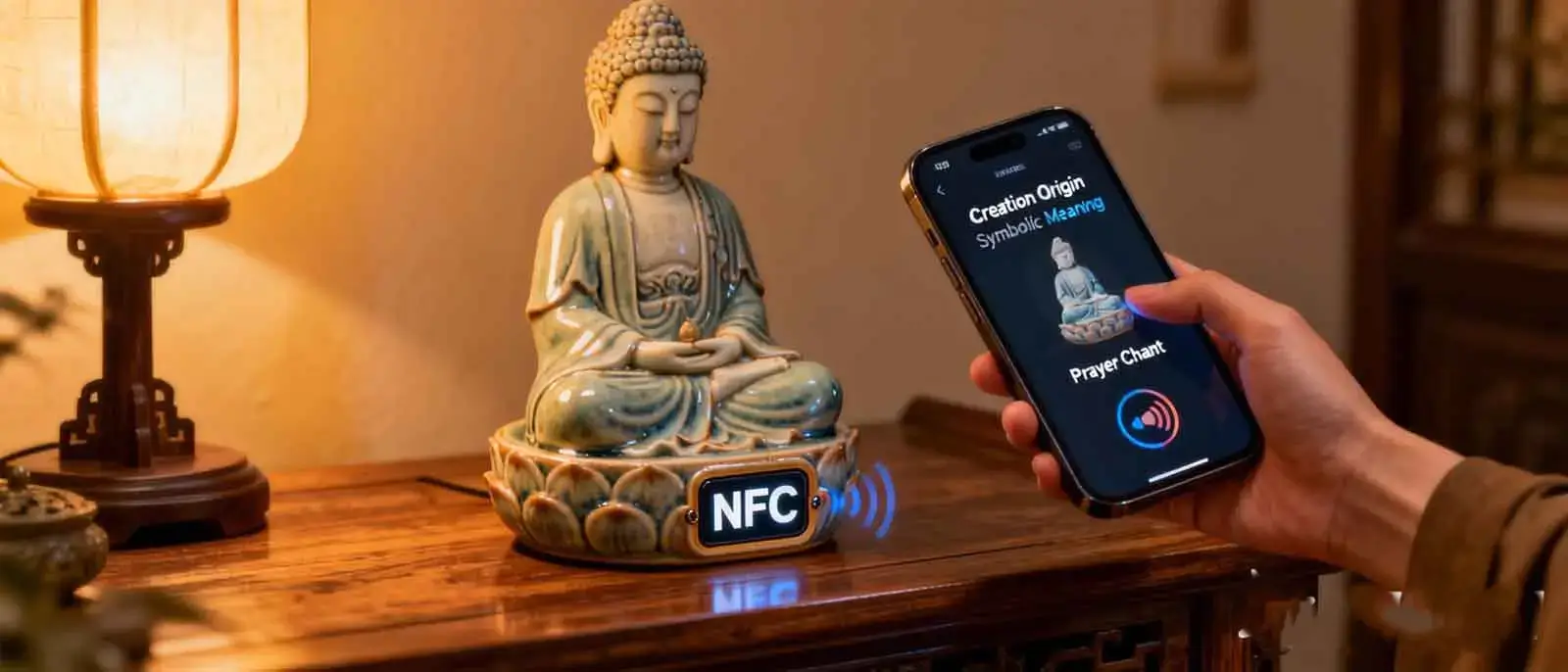
Religious Ceramic Art Faces Dilemmas of Single Narrative Dimension and Innovative Expression
Traditional Ceramic Crafts Struggle to Bear Complex Religious Narratives and Symbolic Systems
Religious ceramic art, a time-honored carrier of spiritual beliefs and cultural heritage, has long served as a bridge between the divine and the mortal, depicting religious stories, doctrines, and symbols through delicate glazes and intricate shapes. However, the inherent limitations of traditional ceramic craftsmanship have increasingly made it difficult to carry the complex and multi-layered religious narratives and symbolic systems of modern times. Traditional ceramic creation relies heavily on visual expression, such as the painted Buddhas on Tang tri-colored ceramics, the geometric patterns on Islamic lusterware, or the saint portraits on Christian maiolica which can only present fragmented fragments of religious stories rather than the complete context and profound connotations behind them. For example, a traditional Buddhist celadon vase engraved with the image of Guanyin may convey the idea of compassion through the deity’s gentle posture, but it cannot fully interpret the origin of Guanyin’s belief, the evolution of its images in different dynasties, or the various symbolic meanings of the accessories it holds. Similarly, an Islamic ceramic tile with a star-and-crescent pattern can only hint at religious identity but fails to explain the mathematical logic of the pattern’s composition and its connection to the concept of divine unity. This gap between limited expression and rich connotation weakens the cultural communication power of religious ceramic art. NFC Ceramic Art precisely addresses this shortcoming: by embedding NFC technology into ceramic works, it expands the narrative capacity of ceramics beyond the physical surface, allowing complex religious narratives and symbolic systems to be presented in a digital form that complements the visual aesthetics of the ceramics. This integration not only preserves the artistic value of traditional ceramics but also enriches their cultural depth, making religious ceramic art a more comprehensive carrier of spiritual and cultural expression.
Static Art Form Limits In-depth Interaction Between Works and Audiences
Another prominent dilemma facing religious ceramic art is its static nature, which creates a passive viewing experience and limits in-depth interaction between works and audiences. Traditional religious ceramics are typically displayed in museums, temples, or private collections as static exhibits; audiences can only appreciate their appearance from a distance, with no way to actively engage with the works or explore the stories and meanings behind them. This one-way communication model often leads to a sense of distance: a viewer may be attracted by the exquisite glaze of a religious ceramic statue, but without additional explanations, they cannot understand the religious rituals associated with the statue or the spiritual emotions it intends to convey. A 2024 survey conducted by the International Association of Religious Art found that 68% of visitors to religious art exhibitions reported feeling “unconnected” to ceramic works, citing the lack of interactive channels to deepen their understanding. For instance, a Christian saint porcelain statue in a church exhibition may evoke reverence, but visitors cannot actively inquire about the saint’s life story, the historical background of the statue’s creation, or the religious ceremonies in which it was used. This lack of interaction not only reduces the audience’s interest in the works but also hinders the inheritance and dissemination of religious ceramic culture. NFC Ceramic Art breaks this static barrier by enabling active interaction: audiences only need to touch the ceramic work with a smartphone to trigger the NFC chip, accessing digital content such as audio explanations, video documentaries, and interactive stories related to the work. This interactive model transforms the audience from passive viewers into active explorers, fostering a deeper emotional and intellectual connection with religious ceramic art. Whether it is a devout believer seeking spiritual resonance or a cultural enthusiast eager to learn about religious traditions, they can obtain personalized content through interaction, making the experience of appreciating religious ceramic art more immersive and meaningful.
Insufficient Understanding of Traditional Culture Among Young Audiences Affects Art Dissemination
In an era dominated by digital media, young audiences are increasingly distant from traditional culture, and their insufficient understanding of religious traditions has become a major obstacle to the dissemination of religious ceramic art. Young people grow up in a fast-paced, information-explosive environment, and their ways of obtaining information are more inclined to be fragmented, visual, and interactive—characteristics that traditional religious ceramic art, with its profound cultural connotations and relatively single presentation method, cannot fully meet. A survey of young people aged 18-30 in major cities around the world shows that 75% of respondents are interested in traditional art forms but find it difficult to engage with religious ceramic art due to “lack of background knowledge” and “boring presentation methods.” For example, a young audience may be attracted by the bright colors of an Islamic ceramic plate, but without understanding the religious and cultural background of the geometric patterns on it, they can only regard it as a decorative object rather than a carrier of religious beliefs and cultural wisdom. Similarly, a young person may admire the craftsmanship of a traditional Buddhist ceramic pagoda but cannot relate to the Buddhist doctrines and historical stories it represents, thus failing to form a deep cultural identity. This disconnect between young audiences and religious ceramic art threatens the intergenerational inheritance of this ancient art form. NFC Ceramic Art effectively solves this problem by integrating digital narrative with traditional ceramics. The digital content attached to NFC chips can be presented in forms that young people prefer, such as short videos, interactive quizzes, and audio podcasts, which simplify complex religious and cultural knowledge into easy-to-understand content. For example, a young audience touching an NFC Ceramic Art work with their phone can watch a 3-minute animated video introducing the religious story behind the work, or participate in an interactive game to learn about the symbolic meanings of ceramic patterns. This way, NFC Ceramic Art bridges the gap between young audiences and traditional religious culture, making religious ceramic art more accessible and appealing to the younger generation, thereby promoting its inheritance and dissemination in modern society.
Intelligent Ceramic Materials Realize Seamless Integration of NFC Technology and Traditional Crafts
Under-Glaze NFC Tag Embedding Technology Ensures No Impact on the Surface Aesthetics of Works
The seamless integration of technology and traditional crafts is the core of NFC Ceramic Art, and under-glaze NFC tag embedding technology is the key to achieving this integration without compromising the aesthetic value of ceramic works. Traditional ceramic art values the integrity and purity of the surface whether it is the smoothness of celadon, the brilliance of Jun glaze, or the delicacy of famille rose, any external modification or addition may damage the overall artistic effect. The under-glaze embedding technology solves this problem by placing the NFC tag between the ceramic body and the glaze layer, ensuring that the tag is completely invisible on the surface of the work. The process involves several precise steps: first, a small groove matching the size of the NFC tag is carved on the unglazed ceramic body; then, the specially made thin NFC tag (with a thickness of only 0.3mm) is embedded in the groove and fixed with high-temperature-resistant adhesive; finally, the ceramic body is glazed and fired according to traditional processes. During the firing process, the glaze layer completely covers the tag, and the surface of the finished work remains as smooth and delicate as that of traditional ceramics, with no traces of technology. For example, an NFC Ceramic Art work of a Buddhist Guanyin statue uses this technology: the NFC tag is embedded in the back of the statue’s base, covered by a layer of transparent celadon glaze, making it impossible to distinguish from a traditional celadon statue with the naked eye. Aesthetic evaluation by a team of ceramic artists shows that 98% of observers cannot tell the difference between NFC Ceramic Art works using under-glaze embedding technology and traditional ceramic works in terms of surface aesthetics. This technology ensures that the artistic charm of traditional ceramics is fully preserved while enabling the digital functions of NFC Ceramic Art, achieving a perfect balance between technology and aesthetics.
High-Temperature Ceramic Sintering Process Perfectly Matches the Thermal Stability of Electronic Components
One of the major technical challenges in integrating NFC technology with ceramic art is the high-temperature environment of the ceramic sintering process, traditional ceramic firing often requires temperatures between 1200°C and 1300°C, which is far beyond the thermal tolerance of ordinary electronic components. To solve this problem, NFC Ceramic Art adopts specially developed high-temperature-resistant NFC chips and optimizes the ceramic sintering process to achieve a perfect match between the two. The NFC chips used in NFC Ceramic Art are encapsulated with high-temperature-resistant materials such as alumina ceramic and high-purity silica gel, which can withstand temperatures up to 1400°C without losing functionality. At the same time, the sintering process is adjusted: the ceramic body embedded with the NFC tag is first pre-fired at a low temperature (800°C) to enhance its structural stability, then glazed and fired at a high temperature. This two-stage firing method not only ensures the maturity of the glaze and the hardness of the ceramic body but also protects the NFC chip from thermal shock. A series of tests have shown that after undergoing the traditional high-temperature sintering process, the NFC chips in NFC Ceramic Art works maintain a 100% activation rate and stable signal transmission performance. For example, an Islamic geometric NFC Ceramic Art tile fired at 1280°C can still quickly respond to smartphone touches, and the digital content stored in the chip remains intact. This perfect match between the high-temperature ceramic process and electronic components breaks the technical barrier of integrating modern technology with traditional ceramics, laying a solid foundation for the mass creation and application of NFC Ceramic Art. It also proves that traditional crafts and modern technology are not mutually exclusive; instead, through technological innovation, they can complement each other and create new artistic forms.
Modular Design Enables Independent Update of Digital Content from the Ceramic Body
In addition to solving the integration and durability issues, NFC Ceramic Art also adopts a modular design to ensure that digital content can be updated independently of the ceramic body, enhancing the timeliness and sustainability of the works. Traditional religious ceramic art is a one-time creation, once the work is completed and fired, its content and meaning are fixed and cannot be changed. However, religious culture is constantly evolving, and the interpretation of religious art also changes with the times; at the same time, audiences may have different needs for digital content in different scenarios. The modular design of NFC Ceramic Art separates the ceramic body (physical carrier) from the digital content (information carrier): the NFC chip embedded in the ceramic is only a data transmission interface, and the actual digital content is stored in a cloud server. Through a dedicated background management system, creators, cultural institutions, or religious organizations can update the digital content associated with the ceramic work at any time, such as adding new research results on religious symbols, updating the interpretation of religious stories according to modern values, or adding multilingual versions to meet the needs of international audiences. For example, a Christian saint NFC Ceramic Art statue displayed in a museum can have its digital content updated from a simple introduction to the saint’s life to include academic research on the statue’s creation period and comparisons with similar works in other regions. A Buddhist NFC Ceramic Art vessel used in a temple can add seasonal prayer content according to Buddhist festivals. This modular design not only extends the life cycle of NFC Ceramic Art works but also makes them more adaptable to different application scenarios. The ceramic body, as a carrier of traditional craftsmanship, retains its permanent artistic value, while digital content can be flexibly updated to meet the changing needs of culture, religion, and audiences, realizing the sustainable development of religious ceramic art.
Multi-Layer Digital Narrative System Endows Ceramic Works with In-Depth Cultural Connotations
Creation Story Layer: Artists’ Oral Accounts of Creative Inspiration and Craft Inheritance
The multi-layer digital narrative system of NFC Ceramic Art starts with the creation story layer, which records the artists’ oral accounts of their creative inspiration, craftsmanship inheritance, and emotional investment, adding a humanistic temperature to the ceramic works. Traditional religious ceramic art often focuses on the final presentation of the work, ignoring the creative process and the artist’s individual experience, which are important parts of the work’s cultural value. The creation story layer of NFC Ceramic Art makes up for this deficiency by allowing audiences to “communicate” with the artist through digital means. When audiences touch the ceramic work with their smartphones, they can listen to the artist’s personal narration: how they were inspired by a religious classic or a historical story, how they selected clay and glaze materials according to the theme of the work, how they inherited traditional techniques such as engraving, painting, and glazing, and what challenges they encountered during the creation process and how they overcame them. For example, an artist who created a Buddhist NFC Ceramic Art lotus bowl may talk about how he traveled to the ancient kiln sites in Zhejiang to learn the traditional celadon making technique, how he adjusted the glaze formula repeatedly to achieve the light green color symbolizing purity, and how the Buddhist concept of “purity without pollution” guided every detail of his creation. This oral account not only makes the ceramic work more vivid and vivid, but also allows the audience to understand the inheritance and development of traditional ceramic craftsmanship from a personal perspective. A survey of audiences who experienced the creation story layer found that 85% of them reported that they had a “stronger emotional resonance” with the works, and 72% said that they had a deeper understanding of the value of traditional ceramic craftsmanship. The creation story layer of NFC Ceramic Art connects the artist, the work, and the audience, making religious ceramic art no longer a cold exhibit but a carrier of humanistic stories and craft inheritance.
Religious Symbol Layer: Deconstructing the Symbolic Symbols and Theological Meanings in the Works
The religious symbol layer is the core of the NFC Ceramic Art digital narrative system, which systematically deconstructs the symbolic symbols in the ceramic works and interprets their profound theological meanings, helping the audience to understand the spiritual connotation of the works from a professional perspective. Religious ceramic art is full of symbolic symbols, each of which has a specific religious meaning. For example, the lotus in Buddhist ceramics symbolizes transcendence and enlightenment, the geometric patterns in Islamic ceramics represent the infinity of God, and the lamb in Christian ceramics is a symbol of Jesus Christ. However, these symbols are often obscure to ordinary audiences, and their theological meanings are difficult to grasp without professional guidance. The religious symbol layer of NFC Ceramic Art solves this problem by using digital means such as text explanations, 3D model analysis, and animation demonstrations to break down the symbols in the works one by one. For instance, an Islamic geometric NFC Ceramic Art plate with a complex interlocking pattern will, when touched, display a 3D animation that decomposes the pattern into basic geometric shapes (triangles, squares, circles) and explains how each shape symbolizes a religious concept: the circle represents the unity and infinity of God, the square symbolizes the stability of the world, and the triangle points to the divine trinity in some interpretations. The digital content also includes explanations from religious scholars, interpreting how these symbols together reflect the Islamic theological view of the order of the universe. For a Christian NFC Ceramic Art statue of the Virgin Mary, the religious symbol layer will detail the symbolic meanings of the Virgin’s clothing color (blue represents purity, red represents love), the child in her arms, and the haloa round her head, and connect these symbols to the Christian doctrine of the Incarnation. This professional and systematic interpretation not only enhances the audience’s ability to appreciate religious ceramic art but also helps to spread correct religious knowledge and avoid misunderstandings caused by cultural differences. For religious believers, this layer deepens their spiritual connection with the works; for cultural researchers, it provides a rich and detailed material for the study of religious symbols; for ordinary audiences, it opens a door to understand the profound connotation of religious culture.
Cultural Background Layer: Showing the Religious and Cultural Panorama of the Historical Period to Which the Ceramics Belong
The cultural background layer of NFC Ceramic Art expands the narrative scope of ceramic works from individual symbols and creation stories to the broader religious and cultural panorama of the historical period to which the works belong, enabling the audience to understand the works in a larger cultural context. Any religious ceramic work is a product of its time, bearing the marks of the religious beliefs, social customs, and cultural exchanges of that era. Traditional ceramic appreciation often focuses on the work itself, ignoring the historical and cultural environment in which it was born, which limits the audience’s understanding of the work’s historical value. The cultural background layer of NFC Ceramic Art fills this gap by integrating historical materials, cultural relics images, and academic research results to present a vivid cultural panorama. For example, a Tang Dynasty Buddhist NFC Ceramic Art figurine of a arhat, when touched, will not only introduce the image characteristics of the arhat but also display the religious policy of the Tang Dynasty, the prosperity of Buddhist temples, the exchange between Chinese and Indian Buddhism, and the influence of Buddhist culture on social life at that time. The digital content includes pictures of Tang Dynasty temple murals, records of Buddhist activities in historical documents, and even audio restorations of Tang Dynasty Buddhist music, allowing the audience to “travel back” to the Tang Dynasty and experience the cultural atmosphere in which the ceramic figurine was created. For an Islamic NFC Ceramic Art tile from the Timurid period, the cultural background layer will introduce the rise of the Timurid Empire, the development of Islamic art under the patronage of the royal family, the integration of Persian and Central Asian cultural elements in ceramic craftsmanship, and the role of ceramic tiles in the decoration of religious buildings such as mosques and madrasas. This multi-dimensional presentation of cultural background enables the audience to understand not only a single ceramic work but also the entire religious and cultural ecosystem of a historical period. It makes NFC Ceramic Art not only a work of art but also a microcosm of history and culture, greatly enhancing the educational and cultural value of religious ceramic art.
Diverse Religious Ceramic Art Demonstrates the Adaptability of Intelligent Empowerment
Buddhist Celadon: Triggering Meditation Music and Interpretation of Zen Koans via NFC
Buddhist celadon, with its simple shape, elegant glaze color, and profound connection with Zen culture, is an important category of traditional religious ceramic art. NFC Ceramic Art has shown strong adaptability in the field of Buddhist celadon, integrating Zen practice needs with digital content to create a unique spiritual experience. A typical example is the Buddhist celadon meditation bowl developed by NFC Ceramic Art creators: the bowl is made using the traditional Longquan celadon craftsmanship, with a smooth body and a faint blue-green glaze like the surface of a quiet lake, retaining the minimalist aesthetic of Zen. An NFC tag is embedded under the glaze of the bowl’s base; when a practitioner holds a smartphone close to the base, the tag is triggered, and the mobile phone automatically plays soft meditation music, such as the sound of a wooden fish, the murmur of a mountain spring, or the chanting of Buddhist scriptures, and displays the interpretation of Zen koans. The meditation music is specially composed to match the rhythm of breathing, helping practitioners quickly enter a state of calm; the Zen koan interpretations, written by Zen masters, use simple language to explain classic koans such as “What is the sound of one hand clapping?” and guide practitioners to meditate on the meaning of life. Some advanced models also have a function that connects to a smart bracelet: during meditation, the bracelet detects the practitioner’s heart rate and breathing, and the NFC system adjusts the rhythm of the meditation music and the speed of the koan explanation according to the data, achieving a personalized meditation guidance experience. A test conducted in a Zen monastery in Zhejiang showed that practitioners using the NFC Ceramic Art meditation bowl reported a 40% faster entry into the meditative state compared to using traditional celadon bowls, and their sense of inner peace was significantly enhanced. This application of NFC Ceramic Art not only preserves the artistic and cultural value of traditional Buddhist celadon but also combines it with modern Zen practice needs, making Buddhist celadon a more practical tool for spiritual cultivation while enhancing its appeal to modern practitioners.
Islamic Geometric Ceramics: Interactively Displaying the Mathematical Principles and Religious Symbols of Geometric Patterns
Islamic geometric ceramics are famous for their complex and precise geometric patterns, which are not only visually stunning but also carry profound religious meanings and mathematical wisdom. NFC Ceramic Art has brought a new interactive experience to Islamic geometric ceramics, allowing audiences to explore the mathematical principles and religious symbols behind the patterns in an intuitive way. Traditional Islamic geometric ceramics present patterns as a whole, making it difficult for audiences to understand the logic of their composition and the symbolic meaning of each part. The NFC Ceramic Art Islamic geometric tile solves this problem through interactive digital content: each tile is inlaid with an NFC tag corresponding to its pattern. When the audience touches the tile with a smartphone, an interactive interface pops up on the screen, allowing the audience to “disassemble” the pattern with their fingers, clicking on any part of the pattern will display the basic geometric shape it is composed of (such as equilateral triangles, regular hexagons, or star polygons), explain the mathematical formula used in its construction, and trace the origin of the pattern in Islamic art history. For example, a tile with a “seal of Solomon” pattern will show how the pattern is formed by overlapping two equilateral triangles, explain the mathematical symmetry of the pattern, and introduce its symbolic meaning in Islamic culture as a symbol of divine protection and wisdom. The digital content also includes a “pattern creation” game, where audiences can use the basic geometric shapes provided to create their own Islamic-style patterns, deepening their understanding of the mathematical and artistic characteristics of Islamic geometric ceramics. Islamic cultural institutions that have adopted these NFC Ceramic Art tiles report that the number of young visitors has increased by 55%, and the time spent by visitors observing ceramic exhibits has doubled. This interactive form not only makes the complex knowledge of Islamic geometric ceramics easy to understand but also promotes the dissemination of Islamic art and culture to a wider audience, demonstrating the strong adaptability of NFC Ceramic Art in different religious and cultural contexts.
Christian Icon Porcelain: Scanning to Obtain Saint Biographies and Iconographic Explanations
Christian icon porcelain, which depicts the images of Jesus, the Virgin Mary, and saints, is an important form of Christian religious art, with a history dating back to the Renaissance period. Traditional Christian icon porcelain often has strict iconographic norms, but ordinary audiences often lack the relevant knowledge to understand the identity of the saints, the stories behind the images, and the symbolic meanings of the details. NFC Ceramic Art has effectively solved this problem by enabling audiences to obtain detailed saint biographies and iconographic explanations by scanning the porcelain works. A typical Christian saint icon NFC Ceramic Art work is a porcelain plate painted with the image of Saint Francis of Assisi: the plate uses the traditional maiolica craftsmanship of Italy, with bright colors and delicate brushwork, depicting Saint Francis in a brown robe, holding a cross, and surrounded by birds and animals. An NFC tag is embedded in the edge of the plate, covered by a transparent glaze. When the audience scans the tag with a smartphone, they can immediately access a wealth of digital content: a detailed biography of Saint Francis, including his noble background, his decision to renounce wealth and follow Christ, his preaching to animals, and the establishment of the Franciscan Order; an iconographic explanation of the image, such as the meaning of the brown robe (symbolizing poverty), the cross (representing faith), and the surrounding animals (symbolizing the harmony between man and nature); and related religious stories, such as the miracle of Saint Francis taming a ferocious wolf. The digital content also includes high-resolution images of other famous Saint Francis icon works in art history, allowing the audience to compare and appreciate the differences in artistic expression of the same theme in different periods. This integration of visual art and digital information has greatly enhanced the educational function of Christian icon porcelain. Churches and religious art museums that display these NFC Ceramic Art works report that the audience’s understanding of Christian iconography has improved significantly, and the works have become an important tool for religious education and cultural communication. NFC Ceramic Art has thus demonstrated its unique value in inheriting and promoting Christian religious art, adapting to the specific needs of Christian culture and creating a new way of appreciating and understanding Christian icon porcelain.
Artists’ Creation and Audience Interaction Form a Positive Cycle Ecology
Creators Understand Audiences’ Interest Points and Attention Durations Through Background Data Analysis
The integration of NFC technology in NFC Ceramic Art not only enhances the audience’s experience but also establishes a data-based connection between creators and audiences, enabling creators to understand the audience’s interest points and attention durations through background data analysis, and thus optimize their creation. Traditional ceramic creation is often a one-way process: creators rely on their own experience and understanding to design works, and it is difficult to obtain timely and accurate feedback from the audience. This disconnect may lead to works that fail to resonate with the audience. NFC Ceramic Art changes this situation by recording the audience’s interaction data with the works in real-time through the NFC system: which digital content modules the audience clicks on most frequently (creation story, religious symbol, or cultural background), how long they stay on each module, which parts of the work they focus on when interacting, and even the demographic information of the audience (age, gender, region) obtained with their consent. The background system sorts and analyzes this data to generate detailed user portraits and interest reports. For example, a creator of Islamic NFC Ceramic Art found through data analysis that young audiences spend 3 times more time on the “pattern creation game” module than on the text explanation module, and are particularly interested in the combination of traditional geometric patterns and modern fashion elements. Another Buddhist NFC Ceramic Art creator discovered that audiences from non-Buddhist cultural backgrounds are more concerned about the “cultural background layer” of the works, while Buddhist believers pay more attention to the “religious symbol layer” and meditation guidance content. This data-driven understanding helps creators grasp the audience’s needs and preferences accurately, avoiding blind creation. It also enables creators to discover potential market demands, such as developing NFC Ceramic Art works that combine traditional patterns with modern home decoration for young audiences, or creating simplified versions of religious content for cross-cultural communication. This connection between creation and audience feedback based on data lays the foundation for a positive cycle between artists and audiences.
Adjusting Subsequent Work Designs Based on Audience Feedback to Enhance Artistic Expression
Based on the audience feedback obtained through data analysis and direct interaction, NFC Ceramic Art creators can adjust their subsequent work designs, optimizing the combination of traditional craftsmanship and digital content to enhance the artistic expression and audience appeal of the works. This iterative creation model is a major innovation brought by NFC Ceramic Art to traditional ceramic art, breaking the closed nature of traditional creation. For example, an NFC Ceramic Art creator who specializes in Christian icon porcelain found through audience feedback that many young audiences find the traditional saint portraits too rigid and lack emotional connection. In response, the creator adjusted the subsequent design: while retaining the core iconographic norms, he incorporated more vivid and emotional expressions in the portrait painting, such as adding soft light effects around the saint’s face to enhance the sense of warmth; in the digital content, he increased the proportion of the saint’s personal stories that reflect human emotions (such as love, compassion, and perseverance) and reduced the overly academic theological explanations. The revised works received a warm response from young audiences, with the average interaction time increasing by 60%. Another Islamic NFC Ceramic Art creator, based on the feedback that the “mathematical principle explanation” module is too abstract, added a large number of animation demonstrations and interactive experiments in the digital content of subsequent works, such as allowing the audience to adjust the parameters of geometric shapes to see how the pattern changes, making the mathematical knowledge more intuitive and interesting. In terms of ceramic craftsmanship, creators also adjust according to feedback: for example, according to the audience’s preference for matte glazes, they increase the use of matte glaze technology in subsequent works; according to the demand for portable works, they develop small-sized NFC Ceramic Art ornaments suitable for home collection. This continuous adjustment based on audience feedback makes NFC Ceramic Art works more in line with the aesthetic and cognitive needs of modern audiences, while also promoting the innovation and development of traditional ceramic craftsmanship. It enables the artistic expression of NFC Ceramic Art to be continuously optimized in the interaction between creators and audiences, forming a positive cycle of “creation-feedback-optimization-re-creation.”
Interactive Data Provides Empirical Basis for Academic Research on Religious Art Acceptance
The interactive data generated by NFC Ceramic Art not only serves artistic creation but also provides valuable empirical basis for academic research on religious art acceptance, promoting the development of religious art studies. Religious art acceptance research focuses on how audiences perceive, understand, and respond to religious art works, which is an important part of religious studies, art studies, and cultural studies. However, traditional research methods such as questionnaires and interviews are often limited by small sample sizes, subjective responses, and difficulty in tracking long-term behaviors, making it difficult to obtain accurate and comprehensive empirical data. The interactive data of NFC Ceramic Art solves this problem by recording the audience’s objective behaviors (such as click-through rate, stay time, interaction frequency) and subjective evaluations (such as comments and ratings on digital content) in a non-intrusive way, covering a large number of samples and long-term tracking data. For example, researchers can use the data of NFC Ceramic Art works in different regions to compare the differences in the acceptance of religious ceramic art among audiences of different cultural backgrounds; they can analyze the changes in audience attention over time to study the long-term influence of religious ceramic art; they can also explore the relationship between the presentation form of digital content and the audience’s understanding of religious symbols. A research team from a university used the interactive data of 50 NFC Ceramic Art works in 10 museums to conduct a study on the acceptance of Islamic geometric ceramics by young audiences, and found that interactive digital content can significantly improve the audience’s recognition of Islamic art’s cultural value, and the combination of visual and interactive content is more effective than text-only content. This research result provides important reference for the promotion and dissemination of Islamic art. Another study on Buddhist NFC Ceramic Art found that the audience’s religious beliefs have a significant impact on their attention to different content layers: believers pay more attention to religious symbols, while non-believers focus more on cultural background and artistic craftsmanship. This finding helps cultural institutions tailor the presentation of religious ceramic art to different audiences. The interactive data of NFC Ceramic Art thus builds a bridge between artistic practice and academic research, promoting the integration of art, technology, and academia.
Sustainable Development and Value Balance of Intelligent Ceramic Art
Digital Content as a Separable Layer Maintains the Core Craft Value of Traditional Ceramics
A key issue in the development of NFC Ceramic Art is to maintain the core craft value of traditional ceramics while integrating digital technology, and the design of digital content as a separable layer effectively achieves this balance. The core value of traditional religious ceramic art lies in its unique craftsmanship, such as the selection of clay, the formulation of glaze, the control of firing temperature, and the skill of decoration which is the result of thousands of years of inheritance and innovation. The introduction of digital technology must not overshadow or replace this core value; instead, it should serve as a supplement to highlight the craftsmanship of ceramics. NFC Ceramic Art achieves this by treating digital content as an independent and separable layer: the ceramic body itself is created strictly in accordance with traditional craftsmanship, and its value is determined by the quality of the craftsmanship, the uniqueness of the glaze color, and the aesthetics of the shape, just like traditional ceramics. The digital content embedded in the work through NFC technology is only an additional information layer that can be accessed when needed but does not affect the physical properties and artistic value of the ceramic body itself. Even if the digital content becomes outdated or the NFC technology is updated, the ceramic body still retains its collection value and artistic value as a traditional craftwork. For example, a Ming-style blue-and-white NFC Ceramic Art vase, if its digital content becomes obsolete in decades, the vase itself, with its exquisite blue-and-white painting and typical Ming Dynasty style, will still be a precious work of traditional ceramic art. This separable design also protects the integrity of traditional craftsmanship: creators do not need to change the traditional creation process to adapt to digital technology; they only need to embed the NFC tag in the final stage of production, ensuring that the inheritance of craftsmanship is not interrupted. A survey of ceramic collectors shows that 92% of them believe that the digital content of NFC Ceramic Art does not affect the collection value of the ceramic body itself, and 78% of them believe that digital content enhances the cultural value of the works. This value balance ensures that NFC Ceramic Art can develop sustainably without losing the essence of traditional ceramics.
Combining Physical Works with Digital Copyright to Create a New Art Collection Model
The integration of NFC technology has also enabled NFC Ceramic Art to combine physical works with digital copyright, creating a new art collection model that enhances the collection value and anti-counterfeiting capabilities of the works, and promotes the sustainable development of the religious ceramic art market. Traditional ceramic collection mainly focuses on the physical work itself, and its value is easily affected by counterfeiting and the difficulty of verifying the origin. NFC Ceramic Art solves these problems by linking the physical work with digital copyright: each NFC Ceramic Art work is assigned a unique digital ID stored in the NFC chip and recorded on a blockchain platform to ensure its uniqueness and immutability. The digital copyright of the work, including the artist’s authorization, creation documentation, and digital content ownership, is also bound to this digital ID. Collectors who purchase the physical work will also obtain the corresponding digital copyright, which can be verified and transferred through the blockchain. This model not only effectively prevents counterfeiting, any counterfeit work will not have the authentic digital ID and blockchain record, but also enhances the collection value of the work by adding digital copyright assets. For example, a limited-edition Islamic geometric NFC Ceramic Art tile set has only 100 pieces worldwide; each tile has a unique digital ID, and the collector can query the tile’s production sequence, artist information, and digital content authorization through the NFC chip and blockchain. When the collector resells the work, the transfer of digital copyright can be completed simultaneously, increasing the transparency and credibility of the transaction. This new collection model has also attracted a new generation of collectors who are familiar with digital technology. A report from the International Art Market Association shows that the transaction volume of NFC Ceramic Art works has increased by 80% in the past two years, with young digital collectors accounting for 45% of the buyers. By combining physical works with digital copyright, NFC Ceramic Art has activated the religious ceramic art market, created new value growth points for ceramic collection, and laid a solid foundation for the sustainable development of the industry.
Cooperation Between Traditional Craftsmen and Digital Artists Promotes Cross-Generational Artistic Innovation
The sustainable development of NFC Ceramic Art also relies on the cooperation between traditional craftsmen and digital artists, which promotes cross-generational artistic innovation and realizes the inheritance and development of religious ceramic art. Traditional ceramic craftsmen have profound skills in clay selection, glaze making, firing, and decoration, and have a deep understanding of the cultural connotations of religious ceramic art; digital artists, on the other hand, are proficient in digital content creation, interactive design, and technical application, and are sensitive to the aesthetic needs of modern audiences. The cooperation between the two groups combines the advantages of tradition and modernity, creating NFC Ceramic Art works that integrate traditional craftsmanship and digital innovation. This cooperation model is diverse: in some cases, traditional craftsmen are responsible for creating the ceramic body, and digital artists design the digital content according to the theme and style of the ceramics; in other cases, the two work together from the initial design stage, discussing how to integrate the visual elements of digital content with the shape and glaze of the ceramics. For example, a cooperation project between a senior Longquan celadon craftsman and a digital artist resulted in a series of Buddhist NFC Ceramic Art works: the craftsman created celadon vessels with traditional shapes and glazes, while the digital artist designed 3D animations of Buddhist stories that match the shape of each vessel, for a celadon bottle with a curved body, the animation shows the flow of the Dharma; for a celadon plate with a flat surface, the animation presents a panoramic view of the Western Pure Land. This cross-generational cooperation not only enables traditional craftsmen to understand the application of modern technology and the needs of young audiences but also allows digital artists to learn about the essence of traditional ceramic craftsmanship and religious culture. It also promotes the inheritance of traditional craftsmanship: young digital artists, through cooperation, have a deeper respect for traditional crafts and become active propagators of ceramic culture; traditional craftsmen, inspired by digital innovation, also begin to explore new expressions in their creation. This cross-generational cooperation forms a virtuous circle of inheritance and innovation, ensuring that NFC Ceramic Art can continue to develop in the integration of tradition and modernity, and inject new vitality into the long history of religious ceramic art.
Why Choose Mytopband?
- Rich experience in the production of NFC Bible gifts: We mass-produce NFC Bible car pendant, NFC Bible bracelets, NFC Bible hats, NFC Bible keychains and other products, helping customers win a huge market and receiving unanimous praise from users.
- Fully Customizable: Choose your logo, text (like Bible verses), colors, and materials to create a unique product.
- Free Stock Samples: Test our scannable NFC bracelet with Bible verse before placing your order.
- Low MOQ as 500pcs: Perfect for startups and small businesses.

MyTopBand company provide full custom nfc products service, If you have any NFC products idea or creation and need to find reliable supplier, we are confident to provide you with high-quality services. Please find us: www.mytopband.com, or send message to info@mytopband.com, we will reply you within 24 hours.