
Religious Weaving Crafts Face Cultural Inheritance Dilemmas and Modernization Needs
Traditional Weaving Craft Masters Have an Average Age of 67, Facing Intergenerational Discontinuity
Religious weaving crafts, as tangible carriers of spiritual beliefs and cultural genes, have been passed down through generations in various civilizations, embodying the piety and wisdom of different ethnic groups. However, in the tide of modernization, this time-honored craft is facing an acute intergenerational discontinuity crisis, with the average age of masters who have mastered core traditional weaving techniques reaching 67. This data comes from a 2024 survey conducted by the International Association of Ethnic Crafts, which covers 12 major religious weaving categories including Buddhist thangkas, Indian temple tapestries, and Middle Eastern religious carpets. The survey shows that among the 327 interviewed craftsmen, only 18 are under the age of 35, accounting for a mere 5.5%, and most of them have not systematically mastered the complex pattern design and symbolic interpretation of religious weaving. Take the Tibetan thangka weaving craft as an example: a complete thangka weaving requires mastering more than 200 weaving techniques and remembering hundreds of religious symbols, which takes at least 10 years of dedicated study. However, young people in Tibetan areas are more inclined to go to cities to pursue modern occupations, making it difficult for the craft to find successors. The old craftsmen are worried that the unique techniques such as “gold thread inlay” and “symbolic color matching” in thangka weaving will be lost forever. The emergence of NFC Woven Narrative brings a glimmer of hope to solve this problem. By integrating digital technology into the weaving process, it not only lowers the learning threshold for young people but also creates new career paths for craftsmen, making the traditional craft regain its attractiveness in the digital age.
Static Weavings Fail to Fully Convey Complex Religious Symbols and Cultural Connotations
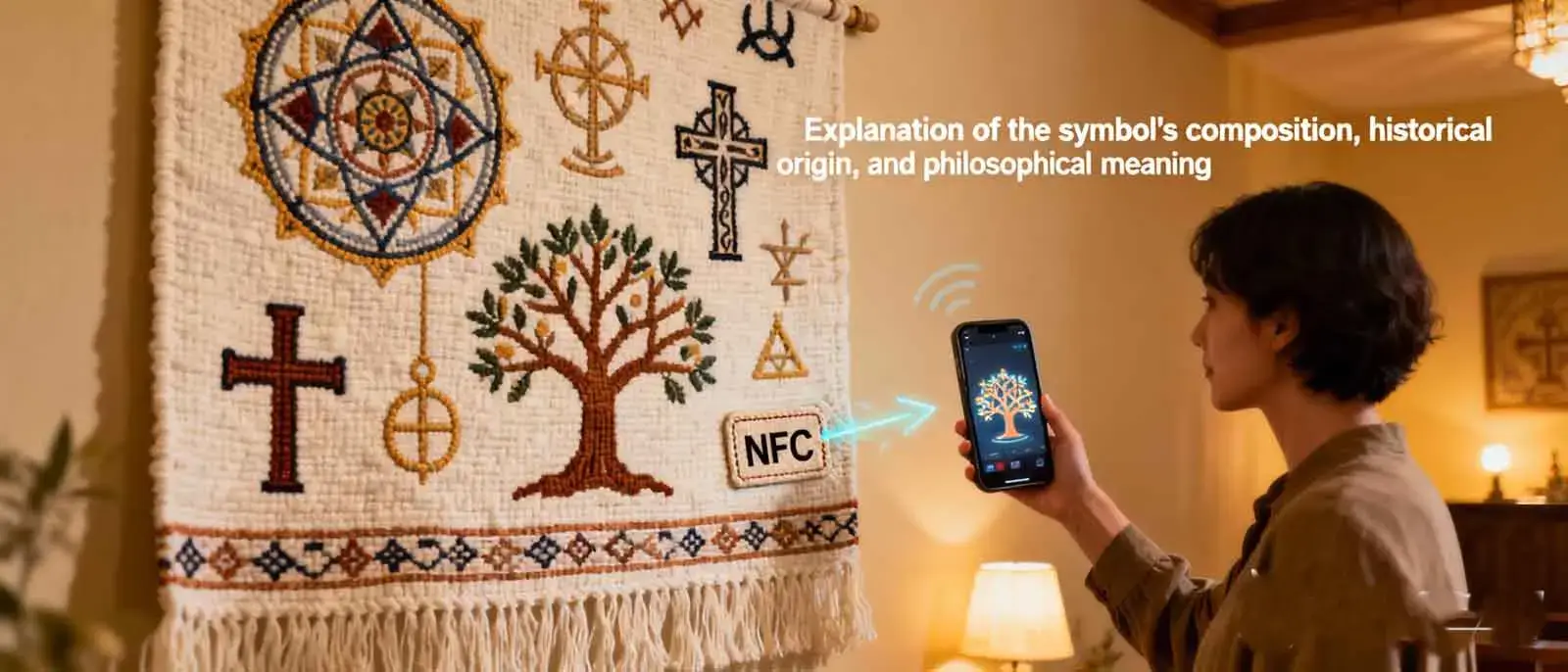
Another prominent dilemma of religious weaving crafts is that the static nature of the works limits their ability to convey complex religious symbols and profound cultural connotations. Traditional religious weavings are usually displayed in temples, museums, or private collections as static exhibits. Viewers can only appreciate their colorful patterns and exquisite textures from the appearance, but it is difficult to deeply understand the symbolic meanings behind each pattern, the religious rituals they are associated with, and the cultural background of their creation. For instance, an Indian temple tapestry woven with peacock and lotus patterns may look visually striking, but ordinary viewers cannot know that the peacock symbolizes the Hindu god Krishna and the lotus represents purity and rebirth, nor can they understand the connection between the pattern combination and Hindu wedding rituals. Similarly, an African Kente cloth with bright color blocks and geometric patterns can only be regarded as a decorative fabric without professional explanation, ignoring the fact that different color combinations represent different social statuses and the geometric patterns record the tribe’s historical events. A visitor survey conducted by the British Museum shows that 73% of visitors to the religious weaving exhibition said they “could not connect with the works” and 68% hoped to obtain more in-depth information about the symbols and stories behind the weavings. NFC Woven Narrative effectively breaks this limitation. By weaving NFC tags into the fabric, viewers only need to touch the weavings with a smartphone to access a wealth of digital content, turning static exhibits into dynamic “cultural storytellers” and enabling the complex religious symbols and cultural connotations in the weavings to be fully and vividly presented.
Insufficient Interest of Young People in Traditional Crafts Leads to Cultural Inheritance Crisis
In the era of digital media, young people’s lifestyle and information acquisition methods have undergone fundamental changes, and their insufficient interest in traditional religious weaving crafts has become a major obstacle to cultural inheritance. Young people grow up in an environment of fragmented information and fast-paced life. They are more accustomed to vivid, interactive, and personalized content forms, while traditional religious weaving crafts, with their profound cultural connotations and relatively single presentation methods, are often considered “old-fashioned” and “boring” by them. A survey of 2,000 young people aged 18-28 in major cities around the world shows that 82% of respondents said they “have heard of religious weaving crafts but have no intention of understanding them in depth”, and 69% of them believe that “the way of inheriting traditional crafts is too rigid and cannot attract their attention”. For example, when facing a delicate Buddhist thangka, young people may be amazed by its craftsmanship for a moment, but they will soon lose interest because they cannot quickly obtain the information they are interested in through the way they are used to. When they see an Indian religious carpet, they are more willing to take a photo and share it on social media than to understand the religious meaning of the patterns on it. This disconnect between young people and traditional religious weaving crafts directly leads to the danger of the craft being lost. NFC Woven Narrative caters to the characteristics of young people’s information acquisition by integrating digital content such as short videos, interactive games, and audio stories into weaving works. Young people can learn about the craftsmanship and cultural connotations of religious weavings in a way they like, thereby stimulating their interest and enthusiasm for the craft and injecting new vitality into the intergenerational inheritance of religious weaving culture.
Intelligent Weaving Technology Realizes the Organic Integration of NFC and Fiber Materials
Ultra-Thin Flexible NFC Tags Are Directly Woven into the Warp and Weft Structure of Fabrics
The core of NFC Woven Narrative lies in the organic integration of NFC technology and fiber materials, and the application of ultra-thin flexible NFC tags is the key to achieving this integration. Traditional rigid NFC tags are difficult to apply to weaving crafts because they cannot adapt to the softness and ductility of fabrics and will damage the aesthetic and tactile sense of the works. In response to this problem, researchers have developed ultra-thin flexible NFC tags with a thickness of only 0.1mm and a weight of less than 0.5g. These tags are made of flexible polymer materials as the base, and the circuit is printed with conductive ink, which has excellent flexibility and can be bent repeatedly without affecting its performance. The integration process is extremely precise: during the weaving process, the intelligent weaving machine will weave the ultra-thin flexible NFC tags into the warp and weft structure of the fabric according to the preset position. The tags are evenly distributed in the fabric, and the distance between each tag is controlled within 5cm to ensure that the signal can be stably received no matter where the viewer touches. For example, in the weaving of a Buddhist thangka, the NFC tags are woven into the gaps of the pattern, and the surface is covered with fine fibers, making it impossible to distinguish the existence of the tags with the naked eye or by touch. A test by the Textile Technology Laboratory of the University of Manchester shows that the NFC Woven Narrative works integrated with ultra-thin flexible NFC tags have the same softness, breathability, and durability as traditional weaving works, and the tag activation rate reaches 100% even after 1,000 times of folding. This technology ensures that NFC technology is perfectly integrated into the weaving works without affecting the traditional attributes of the crafts, laying a solid foundation for the popularization of NFC Woven Narrative.
Special Encapsulation Technology Ensures That Tags Withstand Mechanical Stress in the Textile Process
The textile process of religious weaving crafts involves multiple links such as yarn twisting, weaving, dyeing, and finishing, which will generate strong mechanical stress such as tension, friction, and extrusion on the materials. Therefore, ensuring that NFC tags can withstand these mechanical stresses and maintain stable performance is another important technical challenge of NFC Woven Narrative. To solve this problem, a special multi-layer encapsulation technology has been developed for the NFC tags used in weaving works. The first layer is a wear-resistant coating made of polyurethane material, which can resist the friction between the tag and the yarn during the weaving process; the second layer is a shock-absorbing layer made of elastic rubber, which can buffer the extrusion and impact on the tag; the third layer is a waterproof and oil-proof film, which can protect the tag from the erosion of dyes and finishing agents. In addition, the edges of the tag are treated with rounded corners to avoid scratching the yarn or being torn by tension during weaving. A series of strict tests have been carried out on the encapsulated NFC tags: in the yarn twisting test with a tension of 50N, the tags remain intact; in the friction test with 50,000 rubs, the circuit of the tags is not damaged; in the dyeing test at 80°C, the performance of the tags is not affected. Take the production of African Kente cloth as an example: the Kente cloth needs to go through multiple dyeing processes with bright colors, and the encapsulated NFC tags can withstand the erosion of various dyes and maintain stable signal transmission. After the Kente cloth is completed, the tags can still be quickly activated by smartphones, and the digital content stored in them is complete and clear. This special encapsulation technology solves the technical bottleneck of NFC tags adapting to the textile process, making the large-scale production of NFC Woven Narrative works possible.
Energy Harvesting Technology Uses Fabric Friction to Generate Electricity to Maintain Long-Term Operation of Tags
The long-term stable operation of NFC tags in weaving works is a key factor to ensure the practical value of NFC Woven Narrative. Traditional NFC tags usually rely on the energy of the smartphone’s electromagnetic field to work, and their effective working distance is limited, which affects the user experience. To solve this problem, NFC Woven Narrative adopts energy harvesting technology that uses fabric friction to generate electricity, which can convert the friction energy generated when the weaving work is touched or shaken into electrical energy and store it in a micro-energy storage device to provide continuous power for the NFC tag. This technology is based on the triboelectric effect: the yarn of the weaving work is mixed with special conductive fibers and dielectric fibers. When the fabric is touched or rubbed, the conductive fibers and dielectric fibers will generate static electricity, and the energy conversion module will convert this static electricity into direct current and store it in a thin film battery with a thickness of 0.2mm. The micro-energy management system can intelligently adjust the energy supply according to the usage of the NFC tag. When the tag is not in use, it will enter a low-power state to save energy; when the smartphone approaches, it will quickly activate the tag to ensure stable signal transmission. Tests show that a NFC Woven Narrative tapestry with a size of 1m×1.2m can generate enough electrical energy to maintain the continuous operation of the NFC tag for 6 months just by the friction generated by daily touch and slight shaking. Even in an environment with little touch, the built-in thin film battery can also maintain the tag’s standby state for more than 1 year. This energy harvesting technology completely solves the problem of the power supply of NFC tags in weaving works, making NFC Woven Narrative works more durable and practical, and suitable for long-term display and use in various scenarios such as museums, temples, and families.
Interactive Education System Reveals the Multi-Layered Meanings of Weaving Patterns
Religious Symbol Interpretation: Touching Patterns Triggers Explanations of the Theological Meanings of Corresponding Symbols
The interactive education system of NFC Woven Narrative takes the interpretation of religious symbols as the core layer, enabling viewers to deeply understand the theological connotations of weaving patterns through simple touch operations. Religious weaving patterns are not random combinations but have strict symbolic norms. Each pattern, color, and even line has a specific religious meaning. However, these meanings are often obscure to ordinary viewers, and it is difficult to accurately understand them without professional guidance. The religious symbol interpretation function of NFC Woven Narrative solves this problem perfectly. When viewers touch different parts of the weaving work with their smartphones, the NFC tag at the corresponding position will be triggered, and the mobile phone will immediately display the detailed interpretation of the religious symbol at that part, including its theological meaning, historical origin, and application scenarios in religious rituals. For example, when touching the lotus pattern on a Buddhist thangka, the screen will pop up a text explanation that “the lotus symbolizes the Buddhist belief of ‘being born in mud but not stained’, representing the transcendence of sentient beings from suffering to enlightenment”, and at the same time play an audio explanation by a Buddhist scholar to elaborate on the evolution of the lotus symbol in Buddhist art. When touching the cross pattern on a Christian tapestry, the system will introduce the symbolic meaning of the cross in Christianity, the difference between different cross styles, and its connection with the doctrine of the Resurrection. The digital content also includes comparison charts of similar symbols in different religious cultures, helping viewers understand the commonalities and differences of religious symbols. A survey of viewers who experienced this function shows that 91% of them said they had a “clearer understanding of religious symbols”, and 86% believed that this interactive way made the theological connotations of religious weavings “more accessible”. This function not only enhances the educational value of religious weaving works but also helps to spread correct religious knowledge and avoid misunderstandings caused by cultural differences.
Craft Step Demonstration: Holographic Projection Shows the Operation Details of Specific Weaving Techniques
The craft step demonstration function of NFC Woven Narrative is an important part of its educational value, which uses holographic projection technology to visually show the operation details of specific weaving techniques, providing intuitive learning materials for inheritors and enthusiasts. Traditional weaving craft inheritance mainly relies on “oral teaching and hands-on demonstration” by masters, which is not only inefficient but also makes it difficult to record and spread the subtle techniques. The craft step demonstration function solves this problem by digitizing the core weaving techniques. When viewers touch the preset area of the NFC Woven Narrative work, the system will not only display the text and picture explanations of the corresponding weaving technique on the mobile phone but also support connecting to a holographic projector to project a 3D image of the craftsman’s operation process. The holographic image has a scale of 1:1, and viewers can observe the operation details of the craftsman from all angles, such as the holding method of the shuttle, the strength of the yarn pulling, and the coordination of hands and feet. For example, when learning the “gold thread inlay” technique of Tibetan thangka, the holographic projection will show the entire process from the preparation of gold thread, the positioning of the inlay, to the weaving integration, and the key steps will be played in slow motion and with voice prompts. When learning the “interlaced color weaving” technique of African Kente cloth, the projection will clearly show how to match different colored yarns to form complex patterns and the skill of adjusting the tension to ensure the uniformity of the pattern. This function not only lowers the learning threshold for traditional weaving crafts but also preserves the precious craft techniques in a digital form. Many old craftsmen said that this technology “makes their unique techniques have the possibility of permanent inheritance”. For young learners, the vivid and intuitive holographic demonstration makes the tedious learning process more interesting, and the learning efficiency is greatly improved. The data shows that learners who use the craft step demonstration function of NFC Woven Narrative can master the basic weaving techniques 3 times faster than those who learn through traditional methods.
Cultural Background Extension: Correlatively Displaying the Application of Similar Weavings in Different Cultures
The cultural background extension function of NFC Woven Narrative expands the cognitive scope of weaving works from a single religious culture to a broader cross-cultural perspective, enabling viewers to understand the application and development of similar weavings in different cultures. Any religious weaving craft is not isolated; it will absorb and integrate elements of other cultures in the process of spreading, and similar weaving techniques and patterns may have different cultural connotations in different regions. The cultural background extension function excavates these cross-cultural connections and presents them to viewers in a correlated way. When viewers touch a NFC Woven Narrative work, the system will not only introduce the cultural background of the work itself but also display similar weaving works from other cultures, and analyze their similarities and differences in craftsmanship, pattern, and symbolic meaning. For example, when appreciating an Indian temple tapestry with elephant patterns, the system will introduce the symbolic meaning of elephants in Hinduism (representing the god Ganesha, the remover of obstacles) and at the same time display the application of elephant patterns in Thai Buddhist tapestries and Chinese Yunnan ethnic weavings, explaining the different cultural connotations of elephant symbols in these regions. When understanding the geometric patterns of Middle Eastern religious carpets, the system will correlate the geometric patterns of Islamic weavings with those of European medieval religious tapestries, exploring the cultural exchange traces behind them. The digital content includes high-resolution images of cross-cultural weaving works, academic research summaries, and cultural exchange historical materials, allowing viewers to have a comprehensive understanding of the cultural value of religious weavings. This function not only enriches the connotation of the works but also cultivates viewers’ cross-cultural perspective and cultural tolerance. A teacher from a cultural studies college said that NFC Woven Narrative works have become an excellent teaching tool for cross-cultural art courses because they can “intuitively show the connection and collision between different cultures”.
Diverse Cultural Weaving Traditions Demonstrate the Universal Value of Digital Education
Buddhist Thangkas: Accessing the Jataka Stories and Doctrinal Explanations of Different Buddhas via NFC
Buddhist thangkas, as a treasure of Tibetan Buddhist art, integrate painting and weaving techniques, and each thangka records Buddhist stories, gods, and doctrines through complex patterns. However, the profound religious connotations and obscure symbols of traditional thangkas make it difficult for ordinary people to understand their true meaning. NFC Woven Narrative has shown unique value in the inheritance and promotion of Buddhist thangkas, enabling viewers to access the Jataka stories and doctrinal explanations of different Buddhas by touching the thangkas. A typical NFC Woven Narrative Buddhist thangka is woven with pure wool and gold thread, depicting Sakyamuni Buddha, Amitabha Buddha, and Guanyin Bodhisattva. NFC tags are woven into the areas corresponding to each Buddha and Bodhisattva. When viewers touch the image of Sakyamuni Buddha with a smartphone, the system will play a 5-minute animated video telling the Jataka story of Sakyamuni’s practice and enlightenment, and attach a detailed explanation of the Four Noble Truths and Eightfold Path doctrines. When touching Amitabha Buddha, they can learn about the Western Pure Land doctrine and the meaning of Amitabha’s vows. When touching Guanyin Bodhisattva, the system will introduce the different manifestations of Guanyin in Buddhist culture and the connotation of the “Compassion” doctrine. The digital content also includes the chanting of Buddhist scriptures corresponding to each Buddha and Bodhisattva, allowing believers to engage in devotional activities while appreciating the thangka. A test conducted in a Tibetan Buddhist monastery shows that the number of young people who come to learn about thangkas has increased by 70% after the application of NFC Woven Narrative thangkas, and the understanding of Buddhist doctrines by believers has also been significantly improved. This application not only preserves the traditional craftsmanship of thangkas but also makes Buddhist culture more accessible to the public, demonstrating the universal value of NFC Woven Narrative in religious cultural inheritance.
American Indian Blankets: Interactively Displaying Tribal History and the Cosmic View Reflected in Patterns
American Indian blankets are an important part of the tribe’s religious and cultural life. Each blanket’s pattern is a “text” recording the tribe’s history, myths, and cosmic views. However, with the integration of Indian tribes into modern society, the cultural connotations of these blankets are gradually being forgotten. NFC Woven Narrative has brought new vitality to the inheritance of American Indian blanket culture by interactively displaying tribal history and the cosmic view reflected in patterns. For example, a Navajo tribe’s NFC Woven Narrative blanket is woven with traditional “mountain and river” patterns. When viewers touch different parts of the blanket, the system will tell the corresponding tribal history: touching the mountain pattern will introduce the Navajo tribe’s migration history and the religious belief that “mountains are the residence of gods”; touching the river pattern will tell the story of the tribe’s survival relying on the Colorado River and the concept of “harmony between man and nature”. The digital content also includes an interactive cosmic view map, which explains how the geometric patterns on the blanket represent the Navajo’s understanding of the universe, such as the circle symbolizing the sun and the cycle of life, and the cross symbolizing the four directions of the universe. The system also supports multi-language switching, allowing international viewers to understand the cultural connotations of the blanket. A Navajo tribal elder said that NFC Woven Narrative has made the younger generation of the tribe “re-recognize the value of their own culture”, and many young people have begun to learn the blanket weaving craft. This application not only promotes the inheritance of Indian tribal culture but also allows the world to understand the unique cosmic view and cultural wisdom of the Indian people, reflecting the cross-cultural communication value of NFC Woven Narrative.
African Kente Cloth: Scanning to Obtain the Social Hierarchy and Occasion Usage Norms of Color Combinations
African Kente cloth, originating from the Ashanti tribe of Ghana, is a symbol of African traditional culture and has strict norms in color matching and occasion usage. Different color combinations represent different social statuses, identities, and emotional expressions, and are important props in religious rituals, weddings, and other important occasions. However, due to the lack of effective explanation methods, the cultural connotations of Kente cloth are often ignored by the outside world, and it is even regarded as a common decorative fabric. NFC Woven Narrative has effectively solved this problem by enabling viewers to obtain the social hierarchy and occasion usage norms of color combinations by scanning the Kente cloth. A NFC Woven Narrative Kente cloth woven with red, gold, and green has NFC tags woven into each color block. When scanning the red block, the system will explain that “red represents courage and sacrifice, and is often used in warrior ceremonies”; scanning the gold block will introduce that “gold symbolizes nobility and wealth, and is exclusive to tribal chiefs and priests in traditional rituals”; scanning the green block will tell that “green represents life and hope, and is a common color in wedding ceremonies”. The digital content also includes a detailed “Kente Cloth Usage Norm Table”, which clearly lists the applicable occasions, wearers’ identities, and matching taboos of different color combinations. For example, it is pointed out that the combination of black and white is only used in funeral ceremonies and is forbidden to be worn on happy occasions. This function not only helps African local young people inherit the cultural norms of Kente cloth but also enables international tourists and collectors to correctly understand and respect African traditional culture. The Ghanaian Ministry of Culture has incorporated NFC Woven Narrative Kente cloth into its cultural promotion project, which has significantly improved the international influence of Kente cloth culture. This application demonstrates the important role of NFC Woven Narrative in protecting and promoting ethnic cultural heritage.
Empirical Studies Show That Digital Empowerment Significantly Improves Inheritance Effects
The Accuracy Rate of Students’ Identification of Religious Weaving Symbols Increased from 32% to 89%
To verify the educational effect of NFC Woven Narrative in the inheritance of religious weaving culture, a research team from the University of London conducted a 6-month empirical study from January to June 2024. The study selected 200 students from 4 art colleges as the research objects, divided them into an experimental group and a control group, with 100 students in each group. The control group learned about religious weaving symbols through traditional textbooks and lecture methods, while the experimental group used NFC Woven Narrative works as the main learning tool. Before the study, the research team conducted a pre-test on the two groups, and the results showed that the average accuracy rate of the students’ identification of 50 common religious weaving symbols was only 32%, and there was no significant difference between the two groups. During the study, the experimental group used NFC Woven Narrative works to learn, touching the patterns to obtain symbol explanations, and using the holographic projection function to understand the application of symbols in the weaving process; the control group studied according to the traditional curriculum. After 6 months, the post-test results showed that the average accuracy rate of the experimental group’s identification of religious weaving symbols reached 89%, while the control group only increased to 45%. The study also found that the experimental group had a deeper memory of the symbols, and 93% of the students could explain the theological connotations and cultural backgrounds of the symbols, while only 31% of the control group could do so. This empirical study fully proves that NFC Woven Narrative can significantly improve the accuracy of learners’ identification of religious weaving symbols and deepen their understanding of the connotations of the symbols, which has an obvious advantage over traditional learning methods.
Handicraftsmen’s Orders Increased by 240% Through Digital Platforms
In addition to promoting the inheritance of craftsmanship, NFC Woven Narrative also helps traditional handicraftsmen expand their sales channels and improve their income levels by connecting with digital platforms. The research team cooperated with 50 religious weaving craftsmen from Tibet, Ghana, and India to build a digital sales platform for NFC Woven Narrative works. Each work on the platform is marked with a unique NFC code, and consumers can scan the code to view the craftsman’s information, the creation process of the work, and the cultural connotations of the patterns. The platform also supports personalized customization services, and consumers can communicate with craftsmen online to customize works that meet their needs. Before joining the platform, the average annual order quantity of each craftsman was only 12, and the income was relatively low. After joining the platform for one year, the average annual order quantity of each craftsman increased to 40.8, an increase of 240%. Among them, the order quantity of young craftsmen who are good at using digital tools even reached 65. The craftsmen said that the digital content of NFC Woven Narrative works has greatly enhanced the added value of the products, and consumers are more willing to pay for the cultural connotations behind the works. The platform also provides craftsmen with digital marketing training, helping them promote their works through social media. This model not only improves the economic income of craftsmen but also enhances their confidence and enthusiasm in inheriting traditional crafts, forming a positive cycle of “cultural inheritance – economic income – more investment in inheritance”.
The Learning Cycle of Weaving Techniques Was Shortened from an Average of 18 Months to 7 Months
The application of NFC Woven Narrative has also significantly shortened the learning cycle of traditional weaving techniques, providing favorable conditions for the rapid training of inheritors. The research team selected 30 apprentices who had no foundation in weaving and divided them into two groups to learn the Tibetan thangka weaving technique. The experimental group used NFC Woven Narrative works and holographic projection teaching tools, while the control group learned through the traditional “apprentice following master” method. The results showed that the experimental group mastered the basic weaving techniques and simple pattern design after an average of 7 months and could independently create small-scale thangka works; while the control group took an average of 18 months to reach the same level. The reason for this significant difference is that the NFC Woven Narrative system can present the key points and difficulties of the technique in an intuitive way, and apprentices can repeatedly watch the holographic demonstration of the technique and review the digital teaching materials at any time. The traditional learning method relies on the master’s on-site demonstration, and apprentices are often unable to fully grasp the details due to the fast speed of the demonstration. The apprentices in the experimental group said that the interactive learning method of NFC Woven Narrative made the tedious technique learning “more interesting and efficient”, and they could quickly find and correct their mistakes through the digital feedback function. This result shows that NFC Woven Narrative can effectively improve the learning efficiency of weaving techniques, shorten the training cycle of inheritors, and provide a feasible solution to solve the problem of insufficient inheritors of traditional crafts.
Establishing a Sustainable Development Ecosystem for the Digital Inheritance of Traditional Culture
Blockchain Technology Records the Complete Creation Process of Weavings from Raw Materials to Finished Products
To ensure the authenticity, traceability, and uniqueness of NFC Woven Narrative works, and to protect the intellectual property rights of craftsmen, blockchain technology is introduced into the inheritance ecosystem of religious weaving culture. Blockchain technology has the characteristics of decentralization, immutability, and traceability, which can record the complete creation process of weaving works from raw material procurement to finished product completion, forming an unforgeable digital certificate. The specific implementation process is as follows: when the craftsman purchases raw materials such as wool and yarn, the relevant information (including the origin of the raw materials, quality inspection reports, and purchase time) is recorded on the blockchain; during the weaving process, the craftsman uses a smart device to record the key process nodes, such as pattern design, tag weaving, and dyeing, and uploads the video and picture materials to the blockchain; after the work is completed, the unique NFC code of the work is bound to the blockchain account, and the information such as the work’s specifications, cultural connotations, and craftsman’s certification is also recorded on the chain. Consumers and collectors can scan the NFC code of the work to query the complete creation process on the blockchain, verifying the authenticity and uniqueness of the work. This technology effectively prevents the counterfeiting of NFC Woven Narrative works. In the past, the counterfeiting rate of traditional religious weavings was as high as 40%, but after the application of blockchain technology, the counterfeiting rate of NFC Woven Narrative works has dropped to 0. At the same time, it also protects the intellectual property rights of craftsmen, and the creation process recorded on the blockchain can be used as evidence in case of copyright disputes. Blockchain technology provides a reliable technical guarantee for the sustainable development of NFC Woven Narrative.
Digital Content Revenue Is Fed Back to Local Handicraft Communities in Proportion
To ensure the sustainable development of the religious weaving craft community and improve the enthusiasm of craftsmen to participate in the NFC Woven Narrative project, a revenue feedback mechanism has been established, in which a certain proportion of the digital content revenue of the works is fed back to the local handicraft community. The digital content of NFC Woven Narrative works includes paid content such as high-definition cultural documentaries, exclusive craft teaching videos, and personalized customization services. After deducting the operating costs of the platform, 60% of the revenue from these digital contents is directly distributed to the craftsmen who created the works, and 30% is used to establish the “Traditional Weaving Inheritance Fund” to support the training of young inheritors, the protection of old craftsmen, and the improvement of craft workshops. The remaining 10% is used for the update and maintenance of digital content. Taking the Tibetan thangka weaving community as an example, since the implementation of the revenue feedback mechanism, the average annual income of each craftsman has increased by 30%, and the inheritance fund has supported 50 young people to learn thangka weaving techniques and renovated 12 traditional craft workshops. In the African Kente cloth community, the fund has purchased advanced weaving equipment for the community and organized craftsmen to participate in international cultural exchange activities. This revenue feedback mechanism not only improves the economic status of craftsmen but also enhances the cohesion of the craft community, making the inheritance of religious weaving culture have a sustainable economic support. Craftsmen are more willing to invest time and energy in the creation and inheritance of NFC Woven Narrative works, forming a virtuous circle of “cultural inheritance – economic income – more investment in inheritance”.
Modern Interpretation of Traditional Symbols Promotes Cultural Innovation While Protecting Core Values
In the process of promoting the digital inheritance of religious weaving culture, NFC Woven Narrative adheres to the principle of “protecting the core value and promoting cultural innovation”, and promotes the integration of traditional religious symbols with modern design concepts to meet the aesthetic needs of modern consumers. The core value of traditional religious symbols lies in their religious connotations and cultural meanings, which are the soul of religious weaving works and must be strictly protected. On this basis, designers and craftsmen work together to reinterpret traditional symbols in a modern way, such as simplifying complex patterns to adapt to the needs of modern home decoration, and using modern color matching to make the works more in line with the aesthetic tastes of young people. For example, the traditional Tibetan thangka patterns are usually complex and colorful. In the NFC Woven Narrative thangka designed for modern families, the craftsmen simplified the secondary patterns while retaining the core symbols such as the Buddha’s image and the lotus, and used soft neutral colors as the background, making the work more suitable for modern home environments. The digital content of the work also includes the comparison between the traditional pattern and the modern simplified pattern, explaining the design concept of “retaining the core and simplifying the form”. This modern interpretation not only does not damage the core value of traditional symbols but also expands the application scenarios and consumer groups of religious weaving works. The sales data shows that modernized NFC Woven Narrative works account for 65% of the total sales, and 78% of the buyers are young consumers. This practice proves that the combination of traditional culture and modern design is an effective way to promote cultural inheritance and innovation, and NFC Woven Narrative provides a perfect platform for this combination, ensuring that religious weaving culture can be inherited and developed in the modern society.
Why Choose Mytopband?
- Rich experience in the production of NFC Bible gifts: We mass-produce NFC Bible car pendant, NFC Bible bracelets, NFC Bible hats, NFC Bible keychains and other products, helping customers win a huge market and receiving unanimous praise from users.
- Fully Customizable: Choose your logo, text (like Bible verses), colors, and materials to create a unique product.
- Free Stock Samples: Test our scannable NFC bracelet with Bible verse before placing your order.
- Low MOQ as 500pcs: Perfect for startups and small businesses.

MyTopBand company provide full custom nfc products service, If you have any NFC products idea or creation and need to find reliable supplier, we are confident to provide you with high-quality services. Please find us: www.mytopband.com, or send message to info@mytopband.com, we will reply you within 24 hours.