
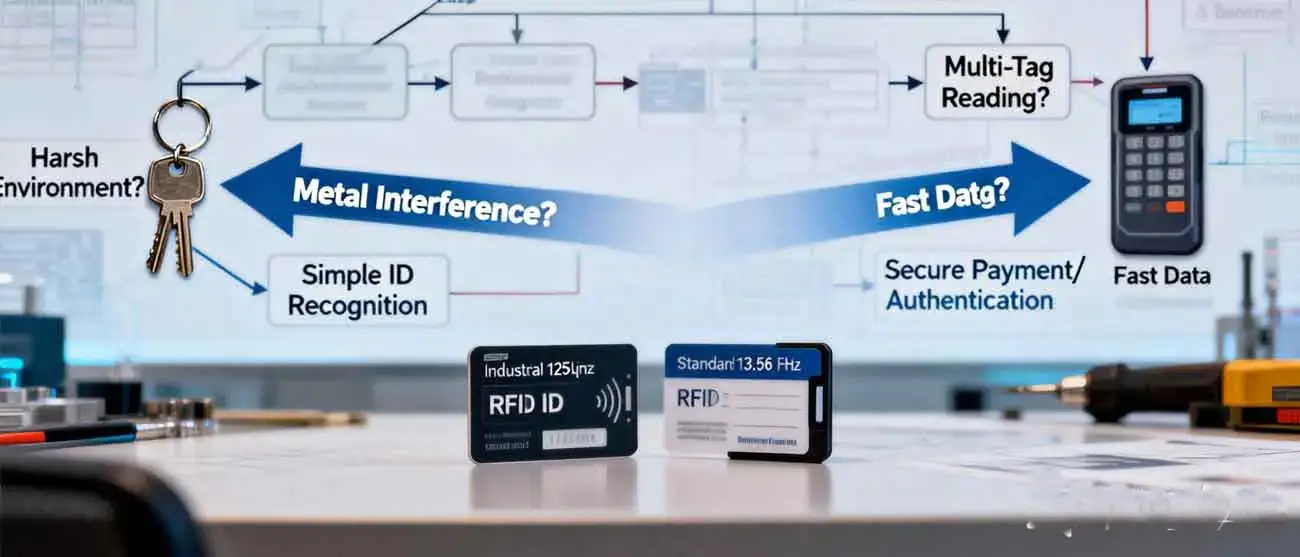
Selection Confusion and Performance Differences of RFID Technologies with Different Frequencies
13.56MHz (High Frequency) and 125KHz (Low Frequency) Are the Current Mainstream Standards for RFID Applications
Radio Frequency Identification (RFID) technology has become an indispensable part of modern automation, identification, and data collection systems, with 13.56MHz RFID Cards and 125KHz RFID Cards dominating the market as the two mainstream frequency standards. These two technologies cater to distinct application scenarios due to their inherent performance characteristics, yet their coexistence often leads to selection confusion for enterprises and project developers. 13.56MHz, classified as high-frequency (HF) RFID, operates within the globally unified industrial, scientific, and medical (ISM) band, ensuring wide compatibility and compliance with international standards such as ISO 14443 and ISO 15693. On the other hand, 125KHz, a low-frequency (LF) RFID standard, adheres to different protocols and is favored for its simplicity and robustness in harsh environments. Understanding the core differences between 13.56MHz RFID Cards and 125KHz RFID Cards is critical for making optimal technical decisions, as improper frequency selection can result in reduced system efficiency, increased costs, and failure to meet business requirements. This article provides a comprehensive comparison of the two technologies, focusing on performance, application fields, costs, and future trends to guide practical选型 (selection).
13.56MHz Has Advantages in Transmission Speed and Security, Suitable for Complex Data Interaction Scenarios
13.56MHz RFID Cards excel in data transmission speed and security, making them the preferred choice for scenarios requiring complex data interaction and reliable information protection. Compared to 125KHz RFID Cards, 13.56MHz technology offers significantly higher data transfer rates, enabling the rapid reading and writing of large volumes of data—such as product details, batch numbers, expiration dates, and logistics information. This capability is particularly valuable in applications where real-time data synchronization is essential. Additionally, 13.56MHz RFID Cards support advanced encryption algorithms and anti-collision mechanisms, which prevent data tampering, unauthorized access, and signal interference when multiple tags are present simultaneously. The encryption feature ensures that sensitive information stored on the card remains confidential, a critical requirement in industries such as finance, healthcare, and high-value asset management. Furthermore, the anti-collision technology allows 13.56MHz RFID readers to identify and process dozens or even hundreds of tags simultaneously, eliminating bottlenecks in high-throughput scenarios. These advantages make 13.56MHz RFID Cards ideal for complex environments that demand speed, security, and multi-tag processing capabilities.
125KHz Has Obvious Advantages in Penetrability and Cost, Suitable for Basic Identification Scenarios in Complex Environments
While 13.56MHz RFID Cards dominate complex data scenarios, 125KHz RFID Cards hold a competitive edge in penetrability and cost-effectiveness, making them suitable for basic identification tasks in harsh or complex environments. 125KHz radio waves have strong penetration capabilities through non-metallic materials, including water, wood, plastic, and even certain types of soil, which is a significant advantage over 13.56MHz signals that are easily attenuated by such obstacles. This makes 125KHz RFID Cards ideal for applications where tags may be embedded in objects, covered by materials, or exposed to wet conditions. Moreover, 125KHz RFID Cards and readers are significantly cheaper to manufacture than their 13.56MHz counterparts, as the technology is more mature, components are simpler, and production scales are larger. The low cost makes 125KHz an attractive option for large-scale deployment scenarios where only basic identification (such as presence detection or ID verification) is required, and budget constraints are a primary consideration. Additionally, 125KHz systems are less sensitive to electromagnetic interference from nearby electronic devices, ensuring stable performance in industrial environments with high electromagnetic noise. These characteristics position 125KHz RFID Cards as the go-to solution for cost-sensitive, basic identification tasks in challenging environments.
Laboratory Test Data on Communication Distance/Data Transmission Rate/Anti-Interference Capability
Communication Distance: 13.56MHz Has a Theoretical Maximum Distance of 1.5 Meters (0.5-1 Meter in Practice), While 125KHz Only Reaches 10 Centimeters
Communication distance is a key performance indicator that differentiates 13.56MHz RFID Cards from 125KHz RFID Cards, with significant variations observed in both theoretical and practical scenarios. Laboratory tests show that 13.56MHz RFID Cards have a theoretical maximum communication distance of 1.5 meters when paired with high-performance readers and under ideal environmental conditions (no obstacles, minimal interference). However, in real-world applications—where factors such as tag size, reader power, environmental obstacles, and signal interference come into play—the effective communication distance of 13.56MHz RFID Cards typically ranges from 0.5 to 1 meter. This range is sufficient for most medium-range identification scenarios, such as inventory management, access control with hands-free operation, and logistics sorting. In contrast, 125KHz RFID Cards have a much shorter communication distance, with a theoretical maximum of only 30 centimeters and a practical effective range of just 10 centimeters. This ultra-short distance requires the reader to be in very close proximity to the tag for successful identification, which limits their application to scenarios where physical contact or near-contact is acceptable, such as animal identification via implanted chips, key fobs for door access, and basic asset tracking where tags are easily accessible. The limited range of 125KHz RFID Cards is a trade-off for their superior penetration capabilities and cost advantages.
Data Transmission Rate: 13.56MHz Can Reach 106kbps, While 125KHz Is Only 1-2kbps, a Difference of About 50 Times
The data transmission rate is another critical performance gap between 13.56MHz RFID Cards and 125KHz RFID Cards, with 13.56MHz technology outperforming 125KHz by a significant margin. Laboratory measurements confirm that 13.56MHz RFID Cards support a standard data transmission rate of 106kbps, with some high-performance variants capable of reaching higher speeds (up to 848kbps) for specialized applications. This high rate enables the rapid exchange of large data packets, such as detailed product information, transaction records, or configuration settings, between the tag and reader. For example, a 13.56MHz RFID Card can transmit a 1KB data file in less than 0.1 seconds, making it suitable for scenarios requiring real-time data updates and high-throughput processing. In contrast, 125KHz RFID Cards have an extremely low data transmission rate of only 1-2kbps, which is approximately 50 times slower than 13.56MHz. At this speed, transmitting the same 1KB data file would take over 4 seconds, making 125KHz RFID Cards impractical for applications requiring large data transfers. Instead, 125KHz technology is limited to transmitting small amounts of data, such as unique identifiers (UIDs), simple IDs, or basic status information. This slow rate is acceptable for basic identification tasks but becomes a bottleneck in any scenario requiring complex data interaction.
Anti-Interference Capability: 125KHz Has Better Penetration Through Metal/Liquid, While 13.56MHz Is More Sensitive to Electromagnetic Interference
Anti-interference capability and material penetration are key factors influencing the performance of RFID systems in real-world environments, with 13.56MHz RFID Cards and 125KHz RFID Cards demonstrating distinct strengths. 125KHz RFID Cards exhibit superior penetration capabilities through metal and liquid materials, which are common obstacles in many industrial and commercial settings. Laboratory tests show that 125KHz signals can penetrate thin metal sheets (up to 2mm) and liquid substances (such as water or oil) without significant signal attenuation, allowing tags to be embedded in metal components, attached to liquid-filled containers, or used in wet environments. This makes 125KHz RFID Cards ideal for applications such as tracking metal tools, monitoring liquid inventory, and animal identification where tags may be implanted under the skin (surrounded by bodily fluids). However, 125KHz systems are not entirely immune to interference, as strong magnetic fields can disrupt signal transmission. On the other hand, 13.56MHz RFID Cards have poor penetration through metal and liquid, as these materials reflect and absorb high-frequency signals, leading to signal loss or distortion. Additionally, 13.56MHz signals are more sensitive to electromagnetic interference (EMI) from nearby electronic devices, such as motors, generators, and Wi-Fi routers, which can cause reading errors or signal dropouts. To mitigate these issues, 13.56MHz systems often require shielding, directional antennas, or careful placement away from interference sources, adding complexity and cost to the deployment. Despite these limitations, 13.56MHz RFID Cards remain the preferred choice for scenarios where data speed and security are prioritized over material penetration.
Optimal Frequency Selection Guide for Warehousing & Logistics vs. Access Control Systems
Warehousing & Logistics (Recommended: 13.56MHz): Requires Rapid Batch Reading (100+ Tags Per Second), Data Writing, and Dynamic Inventory Management
Warehousing and logistics operations demand high efficiency, real-time data visibility, and rapid processing capabilities, making 13.56MHz RFID Cards the optimal choice for this sector. The high data transmission rate of 13.56MHz technology enables rapid batch reading of tags, with advanced readers capable of identifying over 100 13.56MHz RFID Cards per second. This is critical for logistics sorting lines, where pallets or containers loaded with dozens of items need to be scanned simultaneously as they pass through a reader checkpoint. Additionally, 13.56MHz RFID Cards support read-write functionality, allowing warehouse managers to update inventory data, record movement history, and assign new statuses (such as “in stock,” “shipped,” or “damaged”) directly on the tag. This dynamic data management capability ensures real-time inventory visibility, reducing errors associated with manual data entry and enabling accurate demand forecasting. The medium communication distance of 13.56MHz RFID Cards (0.5-1 meter) also facilitates hands-free operation, allowing workers to move pallets or packages past readers without stopping to align tags, further improving operational efficiency. Furthermore, the anti-collision technology of 13.56MHz systems prevents signal interference when multiple tags are present, ensuring accurate reading even in dense inventory environments. For these reasons, 13.56MHz RFID Cards are widely adopted in warehousing and logistics for tasks such as pallet tracking, order fulfillment, and inventory reconciliation.
Access Control Systems (Recommended: 125KHz): Short-Range Stable Identification, Cost Sensitivity, and Complex Environments (Metal Doors, Humid Conditions)
Access control systems have distinct requirements that align with the strengths of 125KHz RFID Cards, making them the preferred solution for most access control applications. Access control typically requires short-range, stable identification, with tags often used as key fobs, ID cards, or badges that are presented near a reader. The 10-centimeter effective range of 125KHz RFID Cards is well-suited for this scenario, as it ensures that only authorized individuals in close proximity to the reader can gain access, enhancing security. Cost sensitivity is another key factor in access control, especially for large-scale deployments (such as office buildings, schools, or industrial facilities) where hundreds or thousands of tags are needed. 125KHz RFID Cards are significantly cheaper than 13.56MHz alternatives, reducing overall system costs without compromising basic functionality. Additionally, access control environments are often complex, with metal doors, humid conditions (such as outdoor entrances or swimming pools), and electromagnetic interference from security cameras or electronic locks. 125KHz RFID Cards’ superior penetration through metal and liquid, combined with their resistance to EMI, ensures stable performance in these challenging environments. Unlike 13.56MHz signals, which are easily disrupted by metal surfaces, 125KHz signals can penetrate metal door frames or be attached to metal key fobs without signal loss. This reliability makes 125KHz RFID Cards the ideal choice for access control systems where cost, stability, and compatibility with complex environments are prioritized.
Special Scenarios: Animal Management (125KHz Implanted Chips), Library Management (13.56MHz Multi-Tag Reading)
Beyond warehousing, logistics, and access control, 13.56MHz RFID Cards and 125KHz RFID Cards are tailored to specific special scenarios based on their unique characteristics. Animal management, including pet identification, livestock tracking, and wildlife monitoring, relies heavily on 125KHz RFID Cards in the form of implanted microchips. The ultra-short communication distance of 125KHz is irrelevant here, as readers are designed to scan the chip directly through the animal’s skin and tissue. The superior penetration of 125KHz signals through bodily fluids ensures reliable identification, even in large animals or those with thick fur. Additionally, 125KHz implanted chips are small, durable, and cost-effective, making them suitable for mass deployment in livestock farms or pet registration programs. In contrast, library management is a classic application for 13.56MHz RFID Cards, leveraging their multi-tag reading capability and high data transmission rate. Libraries need to scan multiple books simultaneously (such as during check-out or inventory) and store detailed information (such as book title, author, and borrowing history) on each tag. 13.56MHz RFID readers can quickly identify dozens of books at once, significantly reducing check-out time and inventory management labor costs. The read-write functionality also allows libraries to update borrowing statuses in real time, preventing theft and ensuring accurate inventory records. Other special scenarios include healthcare (13.56MHz for patient wristbands with medical data) and retail (125KHz for low-cost product tagging), further demonstrating the versatility of both technologies.
Frequency Application Cases of Walmart Supply Chain and Disney Access Control
Walmart Supply Chain (13.56MHz): Pallet-Level Cargo Tracking, Automated Sorting Systems, and Real-Time Inventory Visualization
Walmart, one of the world’s largest retailers, has adopted 13.56MHz RFID Cards across its global supply chain to optimize operations, improve efficiency, and enhance inventory visibility. The company uses 13.56MHz RFID tags on pallets and large containers to enable real-time tracking of goods from distribution centers to stores. The high data transmission rate of 13.56MHz technology allows Walmart’s systems to capture detailed information about each pallet, including product type, quantity, batch number, and expiration date, ensuring accurate inventory management. Additionally, 13.56MHz RFID Cards support rapid batch reading, which is critical for Walmart’s automated sorting systems—where pallets move along conveyor belts and are scanned by readers at high speeds, enabling automatic routing to the correct destination. This automation reduces manual labor costs and minimizes sorting errors, improving the overall efficiency of the supply chain. Real-time inventory visualization, powered by 13.56MHz RFID data, allows Walmart to monitor stock levels across its network, predict demand, and avoid stockouts or overstocking. The security features of 13.56MHz RFID Cards also prevent counterfeiting and theft, protecting high-value goods. Walmart’s successful deployment of 13.56MHz RFID Cards demonstrates the technology’s ability to scale to large, complex supply chain environments and deliver tangible operational benefits.
Disney Access Control (125KHz): Ticket Identification, Fast Entry, and All-Weather Stable Operation (Rain or Shine)
Disney theme parks around the world rely on 125KHz RFID Cards for their access control systems, leveraging the technology’s stability, cost-effectiveness, and compatibility with harsh environments. Disney uses 125KHz RFID tags embedded in tickets, annual passes, and MagicBands (wearable devices) to enable fast, secure entry for millions of visitors each year. The short communication distance of 125KHz ensures that only visitors with valid tags can enter, while the technology’s resistance to electromagnetic interference and water makes it suitable for all-weather operation—whether rain, snow, or intense sunlight. Disney’s 125KHz access control system processes thousands of visitors per hour, with readers placed at turnstiles to quickly verify tag validity and grant entry. The low cost of 125KHz RFID Cards allows Disney to deploy millions of tags annually without exceeding budget constraints, a critical factor for a business handling high visitor volumes. Additionally, 125KHz tags are durable and can withstand repeated use, making them ideal for annual passes and MagicBands that are worn daily. Disney’s use of 125KHz RFID Cards highlights the technology’s ability to deliver reliable, cost-effective access control in high-traffic, outdoor environments.
Hybrid Application: Some Logistics Enterprises Adopt Dual-Frequency Solutions, Using 125KHz for Warehousing Inbound and 13.56MHz for Outbound
To leverage the strengths of both technologies, some logistics enterprises have adopted hybrid dual-frequency solutions that use 125KHz RFID Cards for warehousing inbound operations and 13.56MHz RFID Cards for outbound processes. Inbound operations typically involve receiving goods from suppliers, where tags may be attached to individual items or small packages and stored in environments with metal shelves, pallets, or humid conditions. 125KHz RFID Cards’ superior penetration through metal and liquid, combined with their low cost, makes them ideal for this stage—ensuring reliable identification even when tags are hidden or exposed to harsh conditions. Additionally, inbound processing often requires only basic identification (such as verifying supplier ID or product type), which aligns with 125KHz’s capabilities. On the other hand, outbound operations involve sorting, packing, and shipping goods to customers, requiring rapid batch reading, real-time data updates, and multi-tag processing. 13.56MHz RFID Cards’ high data transmission rate and anti-collision technology excel in this stage, enabling efficient sorting and accurate tracking of outgoing shipments. By combining both technologies, logistics enterprises can optimize costs while ensuring optimal performance across different stages of the supply chain. Dual-frequency readers, which support both 125KHz and 13.56MHz, are used to integrate the two systems, allowing seamless data flow between inbound and outbound processes. This hybrid approach demonstrates the flexibility of RFID technology and its ability to adapt to complex operational requirements.
Cost Analysis and Future Technology Evolution Forecast
Cost Comparison: 125KHz Tags Cost Approximately 0.3 Yuan Each, While 13.56MHz Tags Cost About 1.2 Yuan (a 4-Fold Price Difference)
Cost is a primary consideration for enterprises selecting RFID technology, with significant differences in tag prices between 125KHz RFID Cards and 13.56MHz RFID Cards. Mass-produced 125KHz RFID tags have an average unit cost of approximately 0.3 yuan, making them highly cost-effective for large-scale deployments. The low cost is attributed to the simplicity of 125KHz tag design—they require fewer components, use less complex chips, and benefit from mature production processes with high economies of scale. In contrast, 13.56MHz RFID tags have an average unit cost of about 1.2 yuan, representing a 4-fold price difference compared to 125KHz tags. The higher cost of 13.56MHz tags stems from their more advanced chips (supporting encryption, high data rates, and anti-collision technology), complex antenna designs, and compliance with stricter international standards. For enterprises deploying millions of tags (such as in retail or livestock farming), this price difference can result in significant cost savings when choosing 125KHz. However, for applications requiring advanced functionality (such as data writing or security), the higher cost of 13.56MHz RFID Cards is often justified by the operational benefits they deliver, such as reduced labor costs and improved data accuracy.
Reader Cost: 125KHz Devices Cost About 800 Yuan, While 13.56MHz Devices Cost Approximately 2000 Yuan (a 2.5-Fold Price Difference)
In addition to tag costs, reader prices further widen the cost gap between 125KHz and 13.56MHz RFID systems. Basic 125KHz RFID readers have an average cost of about 800 yuan per unit, with industrial-grade models (designed for harsh environments) priced at around 1500 yuan. These readers are simple in design, with limited functionality focused on basic identification and low data rates. In contrast, 13.56MHz RFID readers have an average cost of approximately 2000 yuan for basic models, with high-performance industrial readers (supporting multi-tag reading, high data rates, and encryption) priced at 3000 yuan or more—representing a 2.5-fold price difference compared to 125KHz readers. The higher cost of 13.56MHz readers is due to their advanced hardware components, including high-frequency antennas, powerful processors (to handle multi-tag processing), and built-in security features. For small-scale deployments (such as a single office access control system), the lower cost of 125KHz readers makes them the preferred choice. However, for large-scale systems (such as warehouse logistics or retail inventory management), the higher cost of 13.56MHz readers is offset by their ability to process more tags quickly, reduce labor costs, and support complex data interactions.
Future Trends: 13.56MHz Costs Will Continue to Decline, While 125KHz Will Maintain a Stable Share in Specific Fields
The future of RFID technology will see evolving cost dynamics and market share distribution between 13.56MHz RFID Cards and 125KHz RFID Cards. As 13.56MHz technology becomes more widely adopted and production scales increase, economies of scale will drive down the cost of 13.56MHz tags and readers. It is expected that the price gap between 13.56MHz and 125KHz RFID Cards will narrow to 2-3 times within the next 5 years, making 13.56MHz more accessible for cost-sensitive applications. Additionally, advancements in chip design and manufacturing technology will reduce the cost of 13.56MHz components while improving performance, further enhancing its competitiveness. Despite these trends, 125KHz RFID Cards will maintain a stable market share in specific fields where their unique strengths are irreplaceable. These fields include animal management (implanted chips), basic access control, low-cost asset tracking, and industrial environments with harsh conditions (metal, liquid, high EMI). In these scenarios, the cost advantage and penetration capabilities of 125KHz will continue to outweigh the benefits of 13.56MHz. Overall, the market will see coexistence rather than replacement, with 13.56MHz dominating complex data scenarios and 125KHz retaining its position in basic, cost-sensitive applications.
Development Prospects of Multi-Frequency Compatible RFID Readers
Technical Feasibility: Mature Solutions Already Support Dual-Frequency Reading of 125KHz/13.56MHz (with a Cost Increase of Approximately 30%)
Multi-frequency compatible RFID readers, which support both 125KHz and 13.56MHz, have become technically feasible with the development of advanced chipset and antenna technology. Mature solutions are already available in the market, enabling seamless reading of tags operating at both frequencies with a single device. These dual-frequency readers integrate two separate radio modules (one for 125KHz and one for 13.56MHz) and use intelligent signal processing to switch between frequencies automatically or on demand. The cost of dual-frequency readers is approximately 30% higher than that of single-frequency 13.56MHz readers, primarily due to the additional hardware components and complex signal processing algorithms required. However, this cost increase is often justified for applications that require compatibility with both technologies, as it eliminates the need to deploy separate readers for each frequency, reducing overall system complexity and installation costs. Additionally, dual-frequency readers support backward compatibility, allowing enterprises to transition gradually from 125KHz to 13.56MHz without replacing existing tags or readers immediately. The technical maturity of dual-frequency solutions paves the way for their wider adoption in hybrid RFID environments.
Application Scenarios: Logistics Hubs, Smart Parks, and Hybrid Management Environments Require Cross-Frequency Compatibility
Multi-frequency compatible readers are particularly well-suited for scenarios that require cross-frequency compatibility, such as logistics hubs, smart parks, and hybrid management environments. Logistics hubs, which handle inbound, outbound, and transit operations, often use 125KHz for inbound (harsh environments, low cost) and 13.56MHz for outbound (high speed, multi-tag reading). Dual-frequency readers allow a single device to handle both processes, streamlining operations and reducing equipment costs. Smart parks, which integrate access control, asset tracking, and environmental monitoring, may use 125KHz for access control (cost, stability) and 13.56MHz for asset tracking (data speed, multi-tag reading). Multi-frequency readers enable centralized management of these systems, ensuring seamless data integration and reducing the number of devices needed. Hybrid management environments, such as manufacturing facilities with both basic identification (125KHz) and complex data processing (13.56MHz) requirements, also benefit from dual-frequency readers. For example, a factory may use 125KHz tags for tracking metal tools and 13.56MHz tags for monitoring production batches, with dual-frequency readers providing a unified view of both assets. These scenarios highlight the value of multi-frequency compatible readers in simplifying hybrid RFID deployments.
Market Prospects: It Is Expected That Compatible Readers Will Account for 35% of the Market by 2027, Becoming an Industry Standard
The market prospects for multi-frequency compatible RFID readers are promising, driven by the growing adoption of hybrid RFID solutions and the need for cross-frequency compatibility. Industry forecasts predict that multi-frequency compatible readers will account for 35% of the global RFID reader market by 2027, up from less than 10% in 2023. This growth will be fueled by increasing demand from logistics, manufacturing, and smart city sectors, where hybrid frequency deployments are becoming more common. As enterprises seek to optimize their RFID systems and avoid vendor lock-in, multi-frequency readers will become an industry standard, offering flexibility and scalability. Additionally, the declining cost of dual-frequency technology (as production scales increase) will make it more accessible for small and medium-sized enterprises, further driving market penetration. By 2030, it is expected that over 50% of new RFID reader deployments will be multi-frequency compatible, as enterprises prioritize systems that can adapt to evolving technology requirements and support both 125KHz and 13.56MHz tags. This trend will reshape the RFID market, shifting the focus from single-frequency to multi-frequency solutions.
Why Choose Mytopband?
- Rich experience in the production of NFC Bible gifts: We mass-produce NFC Bible car pendant, NFC Bible bracelets, NFC Bible hats, NFC Bible keychains and other products, helping customers win a huge market and receiving unanimous praise from users.
- Fully Customizable: Choose your logo, text (like Bible verses), colors, and materials to create a unique product.
- Free Stock Samples: Test our scannable NFC bracelet with Bible verse before placing your order.
- Low MOQ as 500pcs: Perfect for startups and small businesses.

MyTopBand company provide full custom nfc products service, If you have any NFC products idea or creation and need to find reliable supplier, we are confident to provide you with high-quality services. Please find us: www.mytopband.com, or send message to info@mytopband.com, we will reply you within 24 hours.