
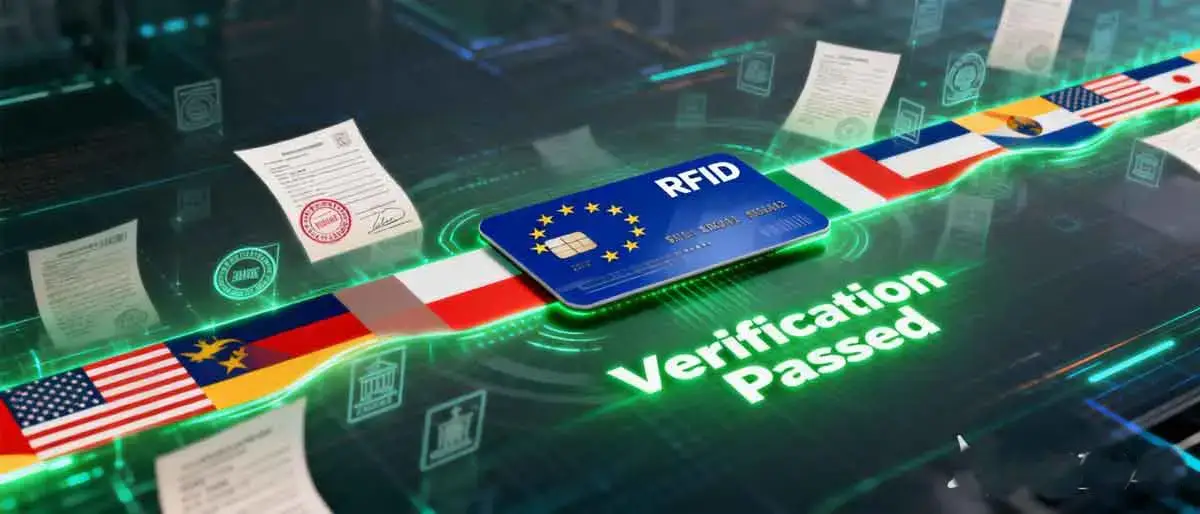
Cross-border Public Services Within the EU Face Severe Identity Authentication Barriers and Efficiency Bottlenecks
EU Citizens Moving Between 27 Member States Need to Manage More Than 12 Different National Digital Identity Credentials on Average
The free movement of people is one of the core pillars of the European Union, enabling EU citizens to live, work, study, and travel freely across the 27 member states. However, this freedom is severely hampered by the fragmentation of digital identity systems across the EU. RFID Smart Cards have emerged as a potential game-changer to address this fragmentation, but currently, EU citizens moving between member states need to manage more than 12 different national digital identity credentials on average. These credentials include national eIDs, digital driving licenses, electronic health insurance cards, student IDs, and various other service-specific digital certificates. Each member state has developed its own digital identity system based on its unique administrative and technical requirements, leading to a lack of uniformity. Citizens often find themselves having to register for new digital identities in each country they reside in or use services from, resulting in a cumbersome and confusing experience. This proliferation of digital credentials not only increases the cognitive burden on citizens but also raises security risks, as managing multiple accounts and credentials increases the likelihood of data breaches or identity theft. The need for a unified solution that can streamline these credentials has become increasingly urgent, and RFID Smart Cards, with their secure and portable characteristics, are well-positioned to play a key role in realizing the integration of EU digital identity.
The Identity Verification Process Takes More Than 8 Working Days on Average When Applying for Cross-border Medical, Educational, or Financial Services
Beyond the burden of managing multiple credentials, the inefficiency of cross-border identity verification has become a major obstacle to the smooth provision of public services. When EU citizens apply for cross-border medical treatment, educational enrollment, or financial services such as opening a bank account, the identity verification process takes more than 8 working days on average. This lengthy process stems from the lack of interoperability between national identity systems. For example, when a citizen from Germany seeks medical treatment in France, the French medical institution must verify the authenticity of the citizen’s German identity credentials and medical insurance information through cumbersome cross-border communication channels. This often involves manual verification by multiple administrative departments, leading to delays. Such inefficiencies not only affect the user experience of citizens but also impose additional operational costs on service providers and government agencies. In the case of urgent medical needs, delayed identity verification can even jeopardize the health and safety of citizens. The current situation stands in stark contrast to the EU’s commitment to building a seamless single market, highlighting the urgent need for an efficient, unified cross-border identity verification solution. RFID Smart Cards, with their fast reading and secure authentication capabilities, can significantly shorten the verification process and improve the efficiency of cross-border service provision.
Inconsistent Technical Standards of National Identity Systems Prevent Seamless Mutual Recognition and Data Interoperability of Cross-border Services
The root cause of the aforementioned barriers lies in the inconsistent technical standards of national identity systems across the EU, which prevent seamless mutual recognition and data interoperability of cross-border services. Each member state has adopted different technical architectures, encryption algorithms, data formats, and authentication protocols for its digital identity system. For instance, some countries use symmetric encryption algorithms for their eID systems, while others use asymmetric encryption; some store identity data in centralized databases, while others adopt distributed storage solutions. These technical differences make it extremely difficult for identity systems between member states to communicate and interact with each other. Even when two countries attempt to establish cross-border data exchange mechanisms, the need to address technical incompatibilities often leads to high integration costs and long implementation cycles. This lack of interoperability not only affects public services but also hinders the development of cross-border digital commerce and the free movement of labor. It undermines the EU’s efforts to build a unified digital single market and limits the potential economic and social benefits of digitalization. To overcome this challenge, the EU needs to establish a set of unified technical standards and frameworks, and RFID Smart Cards, which can be standardized according to EU-wide criteria, offer a viable path to achieving cross-border data interoperability and mutual recognition of digital identities.
A Unified Authentication Architecture Based on the eIDAS Framework Builds a Secure and Convenient Dual Trust Foundation
The Card Adopts RFID Chips and Encryption Algorithms That Meet the EU eIDAS Medium/High-level Security Standards
To address the fragmentation of digital identity systems, the EU has introduced the electronic Identification, Authentication and Trust Services (eIDAS) Regulation, which aims to establish a unified framework for electronic identification and trust services across the Union. At the core of this framework, RFID Smart Cards play a crucial role by adopting RFID chips and encryption algorithms that meet the EU eIDAS medium/high-level security standards. These high-security RFID chips are designed to store sensitive identity data securely, with built-in anti-tampering mechanisms that prevent unauthorized access or modification of data. The encryption algorithms used, such as Advanced Encryption Standard (AES) and Rivest-Shamir-Adleman (RSA), are recognized and approved by the EU, ensuring that data transmitted between the card and authentication terminals is protected from interception and decryption. Meeting eIDAS medium/high-level security standards means that RFID Smart Cards can be used for a wide range of applications, from simple identity verification to high-value transactions such as cross-border financial services. This high level of security is essential for building trust among citizens, service providers, and member states, as it ensures the integrity and confidentiality of digital identity data. By adhering to eIDAS standards, RFID Smart Cards provide a secure and standardized foundation for the integration of EU digital identity.
Citizens Can Use Physical RFID Cards or Certified NFC Modules in Mobile Phones for Identity Verification
In addition to high security, convenience is another key advantage of RFID Smart Cards in the EU digital identity system. Citizens can use physical RFID Cards or certified Near Field Communication (NFC) modules in mobile phones for identity verification, providing flexible and user-friendly authentication options. Physical RFID Cards are portable and easy to use, requiring only a simple tap on a compatible reader to complete authentication. This is particularly beneficial for citizens who prefer traditional physical credentials or do not have access to smartphones. For those who are more tech-savvy, the option to use certified NFC modules in mobile phones allows for a more seamless and digital experience. Citizens can store their digital identity information on their mobile phones, enabling them to complete identity verification anytime, anywhere, without the need to carry a physical card. This dual option caters to the diverse needs of different citizen groups, ensuring that the EU digital identity system is inclusive and accessible. Moreover, both physical RFID Cards and mobile NFC authentication use the same secure communication protocols and encryption standards, ensuring consistency in security and user experience across different authentication methods. This flexibility and convenience are critical for promoting the widespread adoption of EU digital identity among citizens.
Dual Authentication Verifies Not Only “Who You Are” (Electronic Identity eID) But Also “What You Possess” (Secure Chip)
RFID Smart Cards implement a dual authentication mechanism that builds a strong trust foundation for cross-border services by verifying not only “who you are” (electronic identity eID) but also “what you possess” (secure chip). This dual verification approach significantly enhances the security and reliability of identity authentication compared to single-factor authentication methods. The first factor, verifying “who you are,” involves the authentication of the electronic identity eID stored on the RFID chip, which includes unique personal identifiers such as name, date of birth, and national identification number. The second factor, verifying “what you possess,” confirms that the user is in physical possession of the RFID Smart Card or the mobile device with the certified NFC module. This is achieved through the secure communication between the card/device and the authentication terminal, which requires the physical presence of the credential. By combining these two factors, dual authentication effectively mitigates the risks of identity theft and fraudulent use. Even if an attacker obtains a user’s personal information, they cannot complete the authentication without possessing the physical RFID Smart Card or the authorized mobile device. This dual trust foundation is essential for gaining the confidence of citizens and service providers in cross-border transactions, as it ensures that only authorized individuals can access sensitive services and data. RFID Smart Cards, with their inherent support for dual authentication, are a key enabler of this secure and trusted cross-border identity verification system.
Controllable Data Sharing Mechanisms Enable Authorized Circulation of Key Livelihood Information
Citizens Can Authorize Medical Institutions in Specific Countries to Access Their Core Electronic Health Records Through a Standardized Consent Management Platform
One of the most important applications of EU digital identity empowered by RFID Smart Cards is the controllable sharing of key livelihood information, particularly in the field of healthcare. Citizens can authorize medical institutions in specific countries to access their core electronic health records through a standardized consent management platform. This platform is integrated with the RFID Smart Card system, allowing citizens to manage their data sharing permissions in a transparent and user-friendly manner. When a citizen needs medical treatment in another EU member state, they can use their RFID Smart Card to log into the consent management platform and grant temporary or permanent access to their electronic health records to the receiving medical institution. The authorization process is secure and traceable, with all access logs recorded for audit purposes. This controllable data sharing mechanism ensures that citizens retain full control over their personal health data, while enabling medical institutions to obtain the necessary information to provide accurate and timely treatment. For example, a citizen from Italy who suffers a medical emergency in Spain can quickly authorize the Spanish hospital to access their medical history, allergies, and current medications, ensuring that the treatment provided is safe and effective. By eliminating the need for manual transfer of medical records and reducing the risk of data loss or errors, RFID Smart Cards and the associated consent management platform significantly improve the quality and efficiency of cross-border medical services.
Verified Academic Certificates and Professional Qualifications Can Be Automatically Converted into Formats Recognized by the Destination Country Through the System
In addition to healthcare, RFID Smart Cards also facilitate the cross-border recognition of academic certificates and professional qualifications, a key enabler for the free movement of labor and education within the EU. Through the EU digital identity system powered by RFID Smart Cards, verified academic certificates and professional qualifications can be automatically converted into formats recognized by the destination country. This is achieved by integrating the RFID Smart Card system with national qualification frameworks and European Qualifications Framework (EQF). When a citizen applies for a job or further education in another member state, they can use their RFID Smart Card to present their verified academic and professional credentials. The system then automatically maps these credentials to the corresponding qualifications in the destination country, eliminating the need for time-consuming and costly manual verification processes. For example, a software engineer from Poland with a verified professional qualification can use their RFID Smart Card to apply for a job in Germany, and the system will automatically convert their Polish qualification into a format recognized by German employers. This not only saves time and resources for both citizens and employers but also promotes the mobility of skilled labor across the EU. RFID Smart Cards play a crucial role in this process by providing a secure and reliable means of storing and transmitting verified qualification data, ensuring the authenticity and integrity of the information.
Digital Driving License Information Can Be Directly Used for Car Rental Services in Other Countries/Regions After Verification and Authorization Without Additional Authentication
Another practical application of controllable data sharing enabled by RFID Smart Cards is the cross-border use of digital driving licenses. After verification and authorization through the EU digital identity system, digital driving license information stored on RFID Smart Cards can be directly used for car rental services in other EU countries/regions without the need for additional authentication. This eliminates the inconvenience of carrying a physical driving license and the need for international driving permit conversions in many cases. When a citizen rents a car in another member state, they simply need to tap their RFID Smart Card on the car rental company’s reader, and the system will verify the authenticity of their digital driving license and their authorization to use it cross-border. The car rental company can quickly confirm the driver’s eligibility, including their license category and validity period, through the secure connection to the EU digital identity system. This not only improves the user experience for citizens traveling or working across borders but also streamlines the operations of car rental companies by reducing the time and cost associated with manual license verification. Moreover, the use of RFID Smart Cards ensures that the digital driving license information is secure and cannot be tampered with, reducing the risk of fraudulent license use. This application demonstrates how RFID Smart Cards can make everyday cross-border activities more convenient and efficient, enhancing the practical value of EU digital identity.
The Success of Estonia’s e-Residency Program Provides a Key Model for the EU System
As the World’s First Country to Provide Digital Citizenship, Its System Has Provided Cross-border Services to More Than 70,000 Non-residents
Estonia has long been a pioneer in digital identity and e-governance, and its e-Residency program has provided a key model for the development of the EU digital identity system empowered by RFID Smart Cards. As the world’s first country to provide digital citizenship, Estonia’s e-Residency system has provided cross-border services to more than 70,000 non-residents from over 170 countries. The e-Residency program allows non-residents to obtain a digital identity that enables them to access a range of Estonian e-services, including company registration, banking, and legal document signing, entirely online. At the core of this program is the use of secure RFID Smart Cards that store the e-Resident’s digital identity and enable secure authentication. These RFID Smart Cards comply with high security standards, ensuring the confidentiality and integrity of the e-Resident’s data. The success of Estonia’s e-Residency program demonstrates the feasibility and benefits of a digital identity system based on RFID Smart Cards, including increased access to services, reduced administrative burdens, and enhanced cross-border economic activity. For the EU, this model provides valuable insights into how to design a unified digital identity system that can serve both residents and non-residents, promoting inclusion and economic integration across the Union.
eID-based Digital Identity Is Used to Remotely Establish Businesses, Sign Contracts, and Pay Taxes in 27 EU Countries
One of the most significant achievements of Estonia’s e-Residency program is that eID-based digital identity, stored on RFID Smart Cards, can be used to remotely establish businesses, sign contracts, and pay taxes in 27 EU countries. This is made possible through Estonia’s integration with the EU eIDAS framework, which ensures that its digital identity is recognized across the Union. E-Residents can use their RFID Smart Cards to authenticate their identity remotely when establishing a company in any EU member state, eliminating the need for physical presence. They can also sign legal contracts digitally using the secure electronic signature functionality of the RFID Smart Card, which is legally binding across the EU. Additionally, the digital identity enables e-Residents to pay taxes online in the country where their business is registered, streamlining the tax compliance process. This level of cross-border service accessibility has attracted a large number of entrepreneurs and businesses to use Estonia’s e-Residency program, contributing to the country’s economic growth. For the EU, this demonstrates the potential of RFID Smart Cards and eID-based digital identity to promote cross-border entrepreneurship and economic activity, supporting the development of the EU’s single market. The Estonian model shows that a unified digital identity system can break down administrative barriers and create a more favorable environment for businesses and individuals.
Estonia’s X-Road Data Exchange Platform Architecture Has Become a Reference Model for the EU to Build a Unified Digital Identity Infrastructure
Beyond the e-Residency program itself, Estonia’s X-Road data exchange platform architecture has become a reference model for the EU to build a unified digital identity infrastructure. X-Road is a distributed, secure data exchange platform that enables different government agencies, businesses, and other organizations to share data and services in a secure and privacy-preserving manner. The platform is integrated with Estonia’s RFID Smart Card-based digital identity system, ensuring that all data exchanges are authenticated and authorized. X-Road uses advanced encryption and security protocols to protect data in transit and at rest, and it operates on a peer-to-peer basis, eliminating the need for a central data repository. This architecture ensures that data remains under the control of the data owner, promoting trust and privacy. The EU has recognized the value of X-Road and has adopted elements of its architecture in the development of its own digital identity infrastructure. By leveraging the X-Road model, the EU can build a unified, secure, and interoperable digital identity system that connects the various national systems of member states. RFID Smart Cards play a key role in this infrastructure by providing the secure authentication mechanism needed to access and exchange data across the platform. The success of X-Road demonstrates that a decentralized, secure data exchange architecture is a viable approach for the EU to achieve seamless cross-border digital identity integration.
Inclusive Design Provides Legal Digital Channels for Temporary Cross-border Activities of Non-EU Citizens
Third-Country Nationals Working, Studying, or Visiting Relatives in the EU for a Long Term Can Apply for Temporary Digital Identities with Clear Validity Periods and Permissions
The EU digital identity system empowered by RFID Smart Cards adopts an inclusive design that extends beyond EU citizens to include non-EU citizens engaged in temporary cross-border activities. Third-country nationals working, studying, or visiting relatives in the EU for a long term can apply for temporary digital identities with clear validity periods and permissions. These temporary digital identities are stored on RFID Smart Cards, ensuring secure and convenient authentication. The validity period of the temporary digital identity is linked to the duration of the non-EU citizen’s visa or residence permit, ensuring that the identity is only valid for the authorized period. The permissions associated with the temporary digital identity are tailored to the purpose of the individual’s stay, ensuring that they only have access to the services necessary for their specific activity. For example, a third-country national studying at a university in the EU may have permissions to access educational services, public transportation, and basic healthcare, while a temporary worker may have additional permissions related to their employment. This inclusive design ensures that non-EU citizens can fully participate in the EU’s digital single market during their stay, improving their quality of life and facilitating their integration into EU society. RFID Smart Cards are essential for this inclusive approach, as they provide a secure and standardized means of issuing and managing temporary digital identities.
Temporary Identities Allow Access to Specific Public Services Directly Related to the Purpose of Their Stay, Such as Enrollment Registration or Basic Medical Security
Temporary digital identities stored on RFID Smart Cards allow non-EU citizens to access specific public services directly related to the purpose of their stay, such as enrollment registration or basic medical security. This eliminates the need for non-EU citizens to navigate complex and fragmented service access processes in each member state. For example, a third-country national studying in France can use their temporary RFID Smart Card to complete enrollment registration at their university, access the university’s digital resources, and register for basic medical security. Similarly, a temporary worker in Germany can use their RFID Smart Card to access workplace-related services and social security benefits. The specific services accessible with the temporary digital identity are determined by the purpose of the stay and are authorized by the host member state. The use of RFID Smart Cards ensures that access to these services is secure and controlled, with only authorized individuals able to access the services. This not only improves the experience of non-EU citizens but also reduces the administrative burden on member states, as the temporary digital identity system streamlines the verification and authorization process. By providing access to essential services, the inclusive design of the EU digital identity system promotes social inclusion and ensures that non-EU citizens can fully participate in the activities for which they are in the EU.
Blockchain-based Smart Contracts Can Automatically Manage and Update Permissions and Automatically Revoke Corresponding Access Rights When the Visa Expires
To enhance the security and efficiency of managing temporary digital identities, the EU digital identity system empowered by RFID Smart Cards leverages blockchain-based smart contracts. These smart contracts can automatically manage and update permissions and automatically revoke corresponding access rights when the non-EU citizen’s visa expires. The blockchain technology provides a secure, transparent, and tamper-proof platform for recording the terms of the temporary digital identity, including its validity period and associated permissions. When the temporary digital identity is issued, a smart contract is created that encodes these terms. The smart contract then automatically monitors the validity period of the visa and updates the permissions accordingly. For example, if a non-EU citizen’s visa is extended, the smart contract can automatically update the validity period of the temporary digital identity. When the visa expires, the smart contract automatically revokes the access rights associated with the temporary digital identity, ensuring that the individual can no longer access EU public services. This automated management process eliminates the need for manual intervention by administrative authorities, reducing the risk of human error and ensuring timely revocation of access rights. The integration of blockchain-based smart contracts with RFID Smart Cards enhances the security and reliability of the temporary digital identity system, providing a robust legal digital channel for non-EU citizens’ temporary cross-border activities.
Building a Multi-level and Scalable Future Blueprint for the EU Digital Identity Ecosystem
Future Plans to Integrate a Wider Range of Public and Commercial Services to Form the Vision of “One Identity, Free Movement Across the EU”
Looking to the future, the EU aims to build a multi-level and scalable digital identity ecosystem empowered by RFID Smart Cards, with the vision of “One Identity, Free Movement Across the EU”. A key part of this blueprint is the plan to integrate a wider range of public and commercial services into the digital identity system. Currently, the system focuses primarily on essential public services such as healthcare, education, and administrative services. In the future, it will be expanded to include commercial services such as online shopping, banking, insurance, and travel booking. This integration will enable citizens to use their RFID Smart Cards for a wide range of daily activities, both public and private, across the EU. For example, a citizen could use their digital identity to book a flight, check into a hotel, open a bank account, and access medical services, all with a single RFID Smart Card. This seamless integration will not only improve the user experience but also promote the development of the digital single market by reducing barriers to cross-border commerce. RFID Smart Cards will play a central role in this integrated ecosystem, providing a secure and convenient authentication mechanism that works across all types of services. The vision of “One Identity, Free Movement Across the EU” will bring the EU closer to its goal of a truly seamless single market, benefiting both citizens and businesses.
Promoting the Internationalization of Standards to Align with Global Digital Identity Initiatives and Enhance the Global Convenience of EU Citizens
Another key component of the future blueprint is the promotion of the internationalization of EU digital identity standards to align with global digital identity initiatives. As digitalization becomes increasingly global, there is a growing need for cross-border digital identity recognition beyond the EU. The EU aims to work with other countries and international organizations to promote the adoption of its digital identity standards, which are based on RFID Smart Cards and the eIDAS framework. By aligning with global digital identity initiatives, the EU can enhance the global convenience of EU citizens, enabling them to use their RFID Smart Cards for identity verification when traveling, working, or accessing services outside the EU. For example, an EU citizen traveling to a country that has adopted compatible digital identity standards could use their RFID Smart Card to access airport fast-track services, rent a car, or check into a hotel without the need for additional documentation. This internationalization of standards will also promote global digital trade and cooperation, positioning the EU as a leader in digital identity governance. The use of RFID Smart Cards, which can be easily standardized and adapted to different global contexts, will facilitate this international alignment. By promoting the internationalization of its standards, the EU can extend the benefits of its digital identity system beyond its borders, enhancing the global mobility and convenience of its citizens.
Continuously Strengthening Investment in Security and Privacy Technologies to Ensure the Long-term Resilience and Credibility of the System in the Face of Emerging Cyber Threats
To ensure the long-term success of the EU digital identity ecosystem, the EU plans to continuously strengthen investment in security and privacy technologies. As cyber threats become increasingly sophisticated, it is essential to ensure that the system remains resilient and credible. This includes investing in advanced encryption technologies, artificial intelligence (AI)-powered threat detection systems, and continuous security testing and auditing of RFID Smart Cards and the underlying infrastructure. The EU will also focus on enhancing privacy protection by implementing privacy-by-design principles and ensuring that citizens retain full control over their personal data. This includes strengthening data minimization practices, ensuring that only the necessary data is collected and shared, and providing citizens with transparent and user-friendly tools to manage their data permissions. Additionally, the EU will invest in research and development to address emerging security and privacy challenges, such as quantum computing threats to current encryption algorithms. By continuously strengthening security and privacy technologies, the EU can ensure that the digital identity system empowered by RFID Smart Cards remains secure, reliable, and trustworthy in the face of evolving cyber threats. This will be critical for maintaining the confidence of citizens, service providers, and international partners, ensuring the long-term sustainability and success of the EU digital identity ecosystem.
Why Choose Mytopband?
- Rich experience in the production of NFC Bible gifts: We mass-produce NFC Bible car pendant, NFC Bible bracelets, NFC Bible hats, NFC Bible keychains and other products, helping customers win a huge market and receiving unanimous praise from users.
- Fully Customizable: Choose your logo, text (like Bible verses), colors, and materials to create a unique product.
- Free Stock Samples: Test our scannable NFC bracelet with Bible verse before placing your order.
- Low MOQ as 500pcs: Perfect for startups and small businesses.

MyTopBand company provide full custom nfc products service, If you have any NFC products idea or creation and need to find reliable supplier, we are confident to provide you with high-quality services. Please find us: www.mytopband.com, or send message to info@mytopband.com, we will reply you within 24 hours.