
Analysis of Core Principle Differences Between NFC and RFID Technologies
Working Principle and Core Characteristics of NFC Technology
Near Field Communication (NFC) is a short-range wireless communication technology that operates at a frequency of 13.56 MHz, enabling seamless data exchange between devices within a very close distance, typically 4 centimeters or less. The working principle of NFC is based on electromagnetic induction, where two NFC-enabled devices (such as a smartphone and a consumer product tag) create a mutual inductive coupling when brought close together. This coupling allows for bidirectional data transmission, meaning both devices can send and receive data, which distinguishes NFC from many other short-range communication technologies. NFC technology has three core operational modes: card emulation mode, reader/writer mode, and peer-to-peer mode. Card emulation mode allows an NFC device to act as a contactless card, such as a payment card or access badge, which is widely used in consumer-grade products like mobile payment tags and smart access cards. Reader/writer mode enables an NFC device (like a smartphone) to read and write data to passive NFC tags embedded in consumer products, such as product information labels or smart packaging. Peer-to-peer mode allows two NFC-enabled devices to exchange data directly, such as sharing photos, contacts, or app links between smartphones. The core characteristics of NFC include its short reading distance, bidirectional communication, low power consumption, and easy integration with smartphones and other consumer devices. These characteristics make NFC highly suitable for consumer-grade products that require simple, secure, and convenient data interaction, as it leverages the widespread use of smartphones to enhance user experience. NFC vs RFID is a key comparison in consumer technology, as their different principles directly impact their applicability in consumer-grade products.
Working Principle and Core Characteristics of RFID Technology
Radio Frequency Identification (RFID) is a wireless communication technology that uses radio frequency signals to identify and track objects, operating across a range of frequencies including low frequency (LF, 125-134.2 kHz), high frequency (HF, 13.56 MHz), and ultra-high frequency (UHF, 860-960 MHz). Unlike NFC, RFID operates on a one-way or semi-two-way communication principle, where an RFID reader transmits radio frequency signals to an RFID tag, which then responds with its stored data. RFID tags can be either passive (without a built-in power source, relying on the reader’s signal for power) or active (with a built-in battery, enabling longer reading distances). The core characteristics of RFID include its variable reading distance, which can range from a few centimeters (for HF tags) to several meters (for UHF tags), high scalability, and the ability to read multiple tags simultaneously. Passive RFID tags are widely used in consumer-grade products due to their low cost and small size, while active RFID tags are more commonly used in scenarios requiring longer-range tracking, such as inventory management for consumer goods. RFID technology also offers high durability, as tags can be designed to withstand harsh environments, making them suitable for consumer products that may be exposed to moisture, dust, or physical wear. Another key characteristic of RFID is its ability to store and transmit data without requiring line of sight between the reader and the tag, which simplifies the tracking and identification process for consumer-grade products in large-scale applications. Understanding these core characteristics is essential for comparing NFC vs RFID in the context of consumer-grade products, as it helps identify which technology best fits specific consumer application needs.
Core Principle Differences Determine Different Application Scenarios
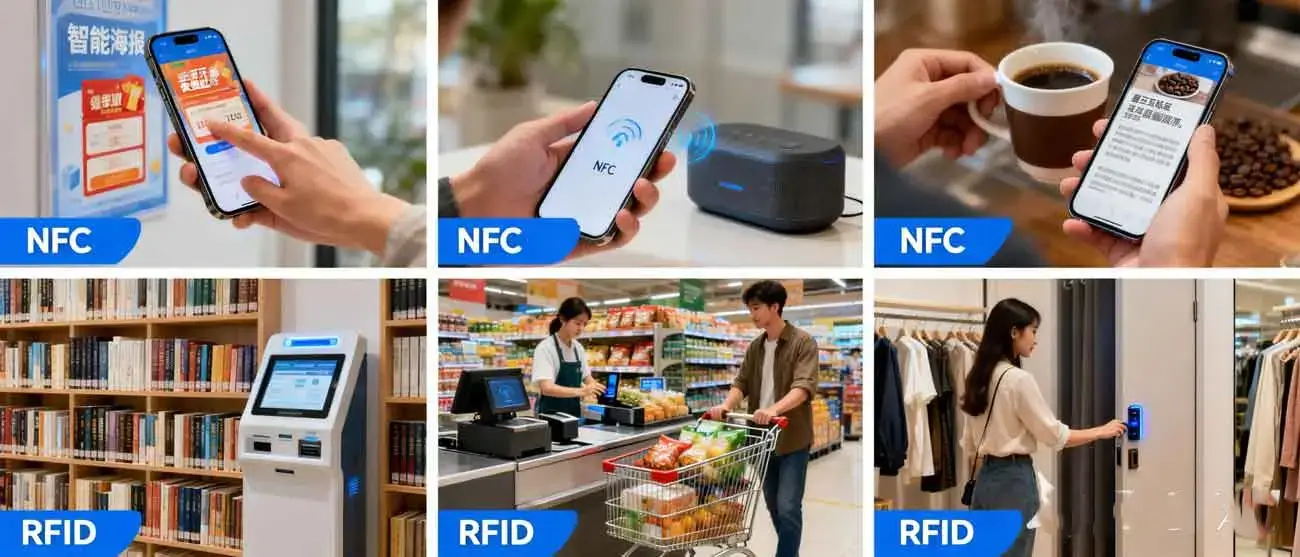
The core principle differences between NFC and RFID directly determine their distinct application scenarios in consumer-grade products, as each technology is optimized for specific use cases based on its communication mode, reading distance, and power requirements. The most fundamental difference lies in their communication direction and range: NFC supports bidirectional communication over very short distances (up to 4 cm), while RFID primarily supports one-way communication over variable distances (from a few centimeters to several meters). This difference makes NFC ideal for consumer-grade products that require direct, user-initiated interaction, such as mobile payments, smart access, and product information retrieval. For example, when a consumer taps their smartphone on an NFC-enabled product tag, the bidirectional communication allows the phone to read product details and the tag to update its data (if needed), creating a seamless user experience. In contrast, RFID’s one-way, longer-range communication makes it suitable for consumer-grade products that require automated tracking and identification without direct user interaction, such as inventory management for retail goods, asset tracking for consumer electronics, and anti-theft systems in stores. Another key principle difference is power consumption: NFC tags are typically passive and rely on the reader’s signal for power, similar to passive RFID tags, but NFC’s short range means it consumes less power overall, making it more suitable for battery-powered consumer devices like smartphones and wearables. Additionally, NFC’s compatibility with existing smartphone technologies (most modern smartphones have built-in NFC chips) gives it a significant advantage in consumer-facing applications, while RFID’s scalability and long-range capabilities make it better suited for backend operations in consumer supply chains. These core principle differences ensure that NFC vs RFID each have unique roles in consumer-grade products, with neither technology being universally superior but rather complementary in meeting different consumer and business needs.
Cost Differences and Procurement Recommendations of NFC and RFID in Consumer-Grade Products
Procurement Cost Differences Between NFC and RFID in Consumer-Grade Products
Cost is a critical factor in the selection of NFC and RFID technologies for consumer-grade products, as consumer goods manufacturers often operate on tight profit margins and need cost-effective solutions that do not compromise performance. There are significant procurement cost differences between NFC and RFID, primarily driven by their chip complexity, manufacturing processes, and market demand. In general, passive NFC tags are slightly more expensive than passive HF RFID tags (which operate at the same 13.56 MHz frequency) due to their bidirectional communication capabilities and compatibility with smartphone NFC readers. On average, a passive NFC tag for consumer-grade products costs between $0.05 and $0.20 per unit, while a passive HF RFID tag costs between $0.03 and $0.15 per unit. The cost difference widens when comparing NFC tags to UHF RFID tags, which are often cheaper in large quantities (ranging from $0.02 to $0.10 per unit) due to their simpler design and widespread use in supply chain management. Active NFC tags are relatively rare in consumer-grade products due to their high cost (ranging from $2 to $10 per unit) and larger size, while active RFID tags are more common but still more expensive than passive options, costing between $1 and $8 per unit. Another cost factor is the reader equipment: NFC readers are often integrated into existing consumer devices (such as smartphones), eliminating the need for additional hardware investment, while RFID readers (especially UHF readers) can cost between $100 and $1,000 or more, which may be a barrier for small to medium-sized consumer goods manufacturers. These cost differences are crucial for consumer-grade products, as they directly impact the overall production cost and pricing strategy. When evaluating NFC vs RFID for consumer-grade products, manufacturers must balance cost with performance to ensure they select the most cost-effective solution for their specific application.
NFC and RFID Selection Recommendations Under Different Procurement Volumes
The procurement volume of consumer-grade products plays a key role in determining whether NFC or RFID is the more suitable and cost-effective choice, as economies of scale significantly impact the per-unit cost of tags and related equipment. For small procurement volumes (fewer than 10,000 units), NFC is often the preferred choice for consumer-grade products, especially those that require direct user interaction. This is because the higher per-unit cost of NFC tags is offset by the elimination of additional reader hardware costs—since most consumers already own NFC-enabled smartphones, manufacturers do not need to invest in separate readers. For example, a small batch of premium consumer products (such as high-end cosmetics or luxury accessories) that use NFC tags for product authentication or information retrieval would benefit from NFC, as it provides a seamless user experience without adding significant hardware costs. For medium procurement volumes (10,000 to 100,000 units), the choice between NFC and RFID depends on the application scenario. If the consumer-grade product requires short-range user interaction (e.g., mobile payments, smart packaging), NFC remains a strong choice, as the per-unit cost of NFC tags decreases with volume, making it more competitive. If the product requires longer-range tracking (e.g., inventory management for clothing or electronics), UHF RFID tags become more cost-effective, as their per-unit cost drops significantly in medium to large volumes, and the investment in RFID readers is justified by the efficiency gains in tracking and inventory management. For large procurement volumes (more than 100,000 units), RFID (especially UHF RFID) is often the more cost-effective option for consumer-grade products that require large-scale tracking, such as retail inventory, consumer electronics, and logistics. The economies of scale for UHF RFID tags are more pronounced, with per-unit costs dropping to as low as $0.02, making them ideal for mass-produced consumer goods. However, if the large-volume consumer product requires user-facing interaction (e.g., smart toys, wearable devices), NFC may still be preferred, as its compatibility with smartphones enhances the user experience. When comparing NFC vs RFID for different procurement volumes, manufacturers must align their selection with both cost considerations and application requirements to maximize value.
Selection Ideas for Matching Cost and Demand in Consumer-Grade Products
Selecting between NFC and RFID for consumer-grade products requires a strategic approach that balances cost and demand, ensuring that the chosen technology meets the product’s functional requirements without exceeding the budget. The first step in this selection process is to clearly define the product’s core requirements: does it need user-initiated interaction (e.g., product authentication, mobile payments) or automated tracking (e.g., inventory management, anti-theft)? If user interaction is a key requirement, NFC is likely the better choice, as it leverages smartphone compatibility to provide a convenient user experience, even if the per-unit tag cost is slightly higher. For example, consumer-grade products like smart labels for food packaging (which allow users to check expiration dates or nutritional information via their phones) benefit from NFC’s bidirectional communication and short-range interaction. If automated tracking is the primary need, RFID (especially UHF RFID) is more suitable, as its longer reading distance and multi-tag reading capability enable efficient inventory management and supply chain tracking, with lower per-unit costs in large volumes. The second step is to evaluate the total cost of ownership (TCO), not just the per-unit tag cost. For NFC, the TCO is often lower because it does not require additional reader hardware—consumers use their own smartphones. For RFID, the TCO includes the cost of tags, readers, and software, which may be higher upfront but can lead to long-term savings through improved efficiency. The third step is to consider the target market and user expectations: if the consumer-grade product is targeted at tech-savvy users who value convenience, NFC is more appealing; if the product is focused on backend efficiency (e.g., retail inventory), RFID is more practical. Finally, manufacturers should consider future scalability: if the product line is expected to expand, RFID’s scalability (ability to track large volumes of products) may be more valuable, while NFC’s compatibility with evolving smartphone technologies ensures long-term relevance. By aligning cost with demand, manufacturers can select between NFC vs RFID in a way that optimizes both performance and profitability for consumer-grade products.
Impact of Reading Distance and Data Capacity on Consumer-Grade Application
Scenarios
Reading Distance Differences Between NFC and RFID and Scenario Adaptation
Reading distance is one of the most significant differences between NFC and RFID, and it directly impacts their adaptation to different consumer-grade application scenarios. NFC technology has a very short reading distance, typically between 0 and 4 centimeters, which is intentional—this short range ensures security and requires user intent, making it ideal for consumer-grade products that require direct, controlled interaction. For example, mobile payment applications use NFC’s short range to prevent unauthorized transactions, as the user must physically tap their smartphone on the payment terminal. Similarly, NFC-enabled product tags in consumer goods (such as cosmetics, electronics, or clothing) require the user to bring their phone close to the tag to access product information, creating a deliberate and engaging user experience. This short reading distance also makes NFC suitable for consumer-grade products that require secure data transmission, such as smart access cards for homes or offices, where proximity ensures that only authorized users can access the data. In contrast, RFID technology has a variable reading distance, depending on the frequency: HF RFID (13.56 MHz) has a reading distance of up to 1 meter, while UHF RFID has a reading distance of up to 10 meters or more. This longer reading distance makes RFID ideal for consumer-grade application scenarios that require automated, non-contact tracking without user intervention. For example, retail stores use UHF RFID tags on clothing to track inventory automatically—employees can scan an entire rack of clothes from a distance, reducing the time and labor required for inventory checks. Similarly, consumer electronics manufacturers use RFID tags to track products through the supply chain, from production to retail, ensuring that inventory levels are accurate and products are not lost or misplaced. The reading distance difference between NFC and RFID means that NFC is best suited for user-facing, interactive consumer-grade products, while RFID is better suited for backend, automated tracking scenarios. When comparing NFC vs RFID for consumer-grade products, understanding their reading distance capabilities is essential to ensuring the technology aligns with the application’s needs.
The Difference in Data Capacity Affects the Adaptation of Information Transmission Requirements
Data capacity is another key difference between NFC and RFID that impacts their suitability for consumer-grade application scenarios, as it determines how much information can be stored and transmitted by the tags. NFC tags typically have a data capacity ranging from 48 bytes to 8 kilobytes, with most consumer-grade NFC tags having a capacity of 1 kilobyte or less. This limited data capacity is sufficient for consumer applications that require storing basic information, such as product IDs, URLs (though URLs are not included per requirements), product details, or authentication codes. For example, an NFC tag on a consumer-grade skincare product might store the product’s ingredients, expiration date, and batch number—information that is concise and easy to transmit to a smartphone. NFC’s data capacity is also sufficient for contactless payments, where only a small amount of data (such as the user’s payment information) needs to be transmitted. In contrast, RFID tags have a wider range of data capacities: passive HF RFID tags typically have a capacity of 128 bytes to 4 kilobytes, while UHF RFID tags can have a capacity of up to 64 kilobytes or more. Active RFID tags can have even larger data capacities, up to several megabytes, but they are less common in consumer-grade products due to their cost and size. This larger data capacity makes RFID suitable for consumer-grade application scenarios that require storing more detailed information, such as product specifications, maintenance records, or supply chain data. For example, an RFID tag on a consumer electronic device (such as a laptop or smartphone) might store the device’s serial number, manufacturing date, component details, and shipping information—data that is too large for an NFC tag to handle. The difference in data capacity means that NFC is ideal for consumer-grade products that require basic information transmission, while RFID is better suited for products that need to store and transmit more detailed data. When evaluating NFC vs RFID for consumer-grade products, manufacturers must consider the amount of information they need to store and transmit to ensure the technology can meet their requirements.
Reading Performance Determines the Application Scenario Boundaries of Consumer-Grade Products
Reading performance—including reading speed, multi-tag reading capability, and reliability—determines the application scenario boundaries of NFC and RFID in consumer-grade products, as it directly impacts the efficiency and user experience of the technology. NFC technology has a relatively slow reading speed, typically taking 0.1 to 0.5 seconds to read a single tag, and it can only read one tag at a time. This slow reading speed and single-tag capability are acceptable for consumer-grade products that require user-initiated interaction, such as mobile payments, product information retrieval, or smart access, where the user expects a deliberate, controlled interaction. For example, when a consumer taps their smartphone on an NFC tag to access product details, the slight delay is negligible and even reinforces the sense of intentional interaction. However, this reading performance limits NFC’s application in scenarios that require fast, multi-tag reading, such as retail inventory management, where employees need to scan dozens of products quickly. In contrast, RFID technology offers superior reading performance: UHF RFID readers can read hundreds of tags per second, making them ideal for large-scale consumer-grade application scenarios like retail inventory, logistics, and warehouse management. HF RFID readers have a slower reading speed (similar to NFC) but can still read multiple tags simultaneously, making them suitable for smaller-scale tracking scenarios, such as tracking a batch of consumer goods in a store. RFID also offers better reliability in harsh environments, as it does not require line of sight and can withstand moisture, dust, and physical wear—making it suitable for consumer-grade products that are exposed to harsh conditions, such as outdoor gear or industrial consumer products. NFC, on the other hand, is more sensitive to environmental factors and requires close proximity and a clear line of sight between the reader and the tag, limiting its use in harsh or messy consumer environments. The reading performance differences between NFC and RFID clearly define their application boundaries: NFC is limited to user-facing, single-tag interaction scenarios, while RFID is capable of handling large-scale, fast, and reliable tracking scenarios. Understanding these boundaries is crucial for selecting between NFC vs RFID in consumer-grade products.
Technology Preferences for NFC and RFID in Different Consumer Fields
Application Preferences and Characteristics of NFC and RFID in the Retail Field
The retail field is one of the largest consumers of both NFC and RFID technologies, but their application preferences and characteristics differ significantly based on the specific needs of retail operations. RFID (especially UHF RFID) is the preferred technology for backend retail operations, such as inventory management, supply chain tracking, and anti-theft systems. Retailers use UHF RFID tags on clothing, electronics, and other consumer goods to track inventory levels in real time, reducing the time and labor required for manual inventory checks. For example, a large retail chain can scan an entire store’s inventory in a few hours using UHF RFID readers, compared to days of manual scanning. RFID also helps retailers reduce out-of-stock situations and shrinkage (theft or loss), as it provides real-time visibility into the location of every product. In contrast, NFC is preferred for consumer-facing retail applications, such as product authentication, interactive marketing, and contactless payments. Many retailers use NFC tags on product packaging to allow consumers to access additional information, such as product reviews, usage instructions, or promotional offers, by tapping their smartphones on the tag. NFC is also widely used for contactless payments at checkout, as it provides a fast, secure, and convenient payment experience for consumers. The characteristics of NFC in retail include its user-centric design, which enhances customer engagement and satisfaction, while RFID’s characteristics include its efficiency and scalability, which improve backend operations. Some retailers even use both technologies in tandem: RFID for inventory management and NFC for consumer engagement. For example, a clothing retailer might use UHF RFID tags to track inventory and NFC tags on hangtags to allow consumers to check product availability in other sizes or colors via their smartphones. This combination leverages the strengths of both NFC vs RFID to optimize both backend efficiency and consumer experience in the retail field.
Selection Tendency of the Two Technologies in the Wearable Device Field
The wearable device field has specific requirements for wireless communication technologies, including small size, low power consumption, and seamless integration with smartphones, which makes NFC the preferred technology for most consumer-grade wearable devices. Wearable devices such as smartwatches, fitness trackers, and smart bracelets often use NFC for pairing with smartphones, contactless payments, and access control. NFC’s small tag size and low power consumption make it ideal for integration into compact wearable devices, which have limited space and battery capacity. For example, a smartwatch with NFC can be easily paired with a smartphone by tapping the two devices together, eliminating the need for complex Bluetooth pairing processes. NFC also enables wearable devices to support contactless payments, allowing users to make purchases without carrying a wallet or smartphone—this is a key feature for fitness trackers and smartwatches, which are often used during exercise or daily activities. While RFID is less commonly used in consumer-grade wearable devices, it does have niche applications, such as in wearable tags for children or pets, where long-range tracking is required. For example, a pet collar with an RFID tag can be tracked using an RFID reader, allowing pet owners to locate their pets if they get lost. However, these applications are less common in mainstream consumer wearable devices, as they require additional reader hardware and do not leverage the smartphone compatibility that consumers value. The selection tendency in the wearable device field is clear: NFC is the primary technology for mainstream consumer wearables, due to its small size, low power consumption, and smartphone compatibility, while RFID is used for niche tracking applications. When comparing NFC vs RFID in wearable devices, NFC aligns better with the core needs of consumer-grade wearables, which prioritize convenience, user experience, and integration with existing devices.
Application Scenario Differences Between NFC and RFID in the Home Field
The home field is a growing market for consumer-grade smart devices, and NFC and RFID are used in distinct application scenarios based on their core capabilities. NFC is primarily used in consumer-grade smart home devices that require user interaction and seamless pairing with smartphones. For example, smart light bulbs, smart locks, and smart speakers often use NFC for quick pairing—users can tap their smartphone on the device to connect it to their home network, eliminating the need for complex setup processes. NFC is also used in smart home access control, such as NFC-enabled door locks, which allow users to unlock their doors using their smartphone or an NFC card. Additionally, NFC is used in smart home appliances, such as refrigerators or washing machines, to allow users to access maintenance information, settings, or recipes by tapping their smartphone on the appliance. In contrast, RFID is used in smart home scenarios that require automated tracking and identification without user interaction. For example, RFID tags can be attached to household items (such as tools, toys, or groceries) to track their location within the home, helping users avoid losing or misplacing items. RFID is also used in smart pet feeders, where an RFID tag on a pet’s collar triggers the feeder to dispense food when the pet approaches. Another application of RFID in the home field is in smart inventory management for pantries or refrigerators—RFID tags on food items can track expiration dates and inventory levels, sending alerts to the user when items are running low or expiring. The application scenario differences between NFC and RFID in the home field are clear: NFC is for user-initiated interaction and setup, while RFID is for automated tracking and convenience. Both technologies enhance the smart home experience, but they serve different purposes, making NFC vs RFID complementary in the consumer-grade smart home market.
Comparison of Consumer User Experience Between the Two in Consumer-Grade Products
Comparison of Operation Complexity Differences Between NFC and RFID
Operation complexity is a key factor in consumer user experience, and there are significant differences between NFC and RFID in this regard, which directly impact their adoption in consumer-grade products. NFC offers an extremely simple and intuitive user experience, as it requires minimal user interaction—users only need to bring their NFC-enabled smartphone close to an NFC tag (typically within 4 centimeters) to initiate data transmission. There is no need for complex setup, pairing, or app installation in most cases; many NFC tags can be read by smartphones without requiring a dedicated app, making the experience seamless and user-friendly. For example, a consumer can tap their smartphone on an NFC-enabled product tag to access product information instantly, without downloading any additional software. This simplicity makes NFC ideal for consumer-grade products that target a wide range of users, including those who are not tech-savvy. In contrast, RFID typically requires more complex operation, as it often involves dedicated reader hardware and software. For consumer-grade products that use RFID, users may need to interact with a dedicated RFID reader (such as a retail inventory scanner or a pet tracking device), which requires setup and training. Even when RFID is used in consumer-facing applications, it often requires the user to learn how to use the reader, which can be a barrier to adoption. For example, a consumer using an RFID-based pet tracker would need to set up the reader, register the tag, and learn how to use the tracking software—this added complexity can reduce user satisfaction. Additionally, RFID’s longer reading distance can sometimes lead to accidental reads, which can be frustrating for users. The operation complexity difference between NFC and RFID means that NFC provides a superior user experience for consumer-facing applications, while RFID is better suited for backend operations where user interaction is minimal. When evaluating NFC vs RFID for consumer-grade products, operation complexity is a critical factor to consider, as it directly impacts user adoption and satisfaction.
Compatibility Performance of the Two on Consumer-Grade Devices
Compatibility with existing consumer-grade devices is another key aspect of user experience, and NFC has a significant advantage over RFID in this regard, which drives its widespread adoption in consumer products. NFC is widely integrated into modern consumer devices, including smartphones, tablets, smartwatches, and even some laptops. According to industry data, over 90% of smartphones sold globally in recent years are NFC-enabled, meaning that the vast majority of consumers already have access to an NFC reader in their pocket. This widespread compatibility eliminates the need for consumers to purchase additional hardware to use NFC-enabled consumer-grade products, making the experience convenient and accessible. For example, a consumer can use their existing smartphone to read NFC tags on products, make contactless payments, or pair smart home devices, without needing to buy a separate reader. In contrast, RFID compatibility is more limited in consumer-grade devices. Most consumer devices do not have built-in RFID readers, especially for UHF RFID, which requires specialized hardware. This means that consumers who want to use RFID-enabled consumer products (such as RFID-based pet trackers or inventory management tools) must purchase a dedicated RFID reader, which adds cost and complexity to the user experience. While some consumer electronics (such as certain tablets or laptops) may have built-in HF RFID readers, this is not common, and UHF RFID readers are almost always separate devices. Additionally, RFID tags are not compatible with NFC readers, and vice versa, which means that consumers cannot use their NFC-enabled smartphones to read RFID tags. This lack of cross-compatibility further limits the user experience of RFID in consumer-grade products. The compatibility performance difference between NFC and RFID is a key factor in their adoption: NFC’s widespread compatibility with existing consumer devices makes it more user-friendly, while RFID’s limited compatibility creates barriers for consumers. When comparing NFC vs RFID for consumer-grade products, compatibility is a critical consideration for ensuring a positive user experience.
User Experience Differences Affect the Technology Selection of Consumer-Grade Products
User experience differences between NFC and RFID have a direct impact on the technology selection of consumer-grade products, as manufacturers prioritize technologies that deliver a positive, convenient, and accessible experience to drive consumer adoption. NFC’s simple operation, widespread compatibility, and user-centric design make it the preferred choice for consumer-grade products that require direct user interaction, such as smart packaging, contactless payments, wearable devices, and smart home products. Consumers value the convenience of NFC—being able to tap their smartphone to access information, make payments, or pair devices without complex setup or additional hardware. This positive user experience leads to higher consumer engagement and satisfaction, which in turn drives sales and brand loyalty. For example, a consumer is more likely to purchase a skincare product with an NFC tag that allows them to access ingredient information and reviews via their phone, compared to a product with a traditional barcode that requires scanning with a dedicated app. In contrast, RFID’s more complex operation and limited compatibility make it less suitable for consumer-facing products but ideal for backend operations where user experience is not a primary concern, such as inventory management and supply chain tracking. Manufacturers of consumer-grade products must balance the functional requirements of the technology with the user experience, as a poor user experience can lead to low adoption rates, even if the technology meets the functional needs. For example, a consumer-grade pet tracker that uses RFID may have excellent tracking capabilities, but if it requires the user to purchase a dedicated reader and learn complex software, many consumers will choose a simpler NFC-enabled alternative. The user experience differences between NFC vs RFID mean that NFC is the preferred choice for consumer-facing products, while RFID is better suited for backend operations. Manufacturers must carefully evaluate the user experience of each technology to ensure they select the one that aligns with consumer expectations and drives adoption.
The Integrated Development Trend of NFC and RFID in Future Consumer-Grade Products
Iteration and Application Expansion of NFC Technology in Consumer-Grade Products
NFC technology is continuously evolving, with ongoing iterations focused on improving performance, expanding functionality, and enhancing its application in consumer-grade products. One key area of iteration is data capacity: future NFC tags are expected to have larger storage capacities, up to 32 kilobytes or more, which will allow them to store more detailed information, such as high-resolution product images, video links (though URLs are not included per requirements), and personalized content. This expansion will enable new consumer-grade applications, such as interactive product packaging that provides immersive content, or smart labels that store personalized recommendations based on the user’s preferences. Another area of iteration is power consumption: future NFC tags will be more energy-efficient, allowing them to be integrated into smaller, battery-powered consumer devices such as smart jewelry or disposable products. Additionally, NFC technology is expanding into new consumer application areas, such as healthcare (e.g., NFC-enabled medical devices that store patient information), automotive (e.g., NFC-enabled car keys or infotainment systems), and education (e.g., NFC-enabled textbooks that provide interactive content). NFC is also being integrated with other technologies, such as Bluetooth and Wi-Fi, to create hybrid solutions that combine NFC’s simple pairing with the longer-range capabilities of Bluetooth or Wi-Fi. For example, a consumer-grade smart speaker could use NFC for quick pairing with a smartphone and Bluetooth for ongoing audio streaming. This integration enhances the user experience by combining the best features of multiple technologies. As NFC technology continues to iterate, its application in consumer-grade products will expand, solidifying its position as a key technology for user-facing interaction. When considering the future of NFC vs RFID in consumer-grade products, NFC’s ongoing innovation and application expansion will make it an even more versatile and valuable technology.
Upgrade and Innovation Direction of RFID Technology in Consumer-Grade Scenarios
RFID technology is also undergoing significant upgrades and innovations, with a focus on improving its suitability for consumer-grade scenarios and addressing its current limitations. One key upgrade direction is miniaturization: future RFID tags will be smaller and thinner, making them easier to integrate into a wider range of consumer-grade products, such as small electronics, clothing, and even food packaging. This miniaturization will also reduce the cost of RFID tags, making them more competitive with NFC tags for consumer-facing applications. Another upgrade direction is improved compatibility: manufacturers are working to develop RFID tags that are compatible with NFC readers, which would eliminate the cross-compatibility barrier and allow consumers to use their smartphones to read RFID tags. This would significantly enhance the user experience of RFID in consumer-grade products, as it would eliminate the need for dedicated readers. Additionally, RFID technology is innovating in terms of data security: future RFID tags will have enhanced encryption capabilities, making them suitable for consumer applications that require secure data transmission, such as product authentication and anti-counterfeiting. Another innovation direction is the integration of RFID with Internet of Things (IoT) technology, creating smart RFID tags that can collect and transmit real-time data, such as temperature, humidity, or location. For example, an RFID tag on a consumer food product could track the product’s temperature during transportation and storage, providing consumers with information about product freshness. These upgrades and innovations will expand the application of RFID in consumer-grade scenarios, making it more competitive with NFC and enabling new use cases. While RFID will still be primarily used for backend operations, its improved user experience and expanded functionality will make it a more viable option for consumer-facing applications in the future. The future of NFC vs RFID in consumer-grade products will see RFID become more versatile and user-friendly, complementing NFC’s strengths in user interaction.
Integrated Development to Adapt to New Needs of Consumer-Grade Products
The future of consumer-grade products will see the integrated development of NFC and RFID technologies, as manufacturers seek to leverage the strengths of both to meet the evolving needs of consumers and businesses. Integrated solutions that combine NFC and RFID will address the limitations of each technology, creating more versatile and efficient systems for consumer-grade products. For example, a retail product could use an RFID tag for backend inventory tracking and an NFC tag for consumer-facing interaction—this combination would allow retailers to track the product through the supply chain using RFID and provide consumers with interactive content using NFC. Another example is a consumer electronic device that uses NFC for pairing with smartphones and RFID for automated tracking during manufacturing and shipping. This integrated approach ensures that the product meets both the backend efficiency needs of the manufacturer and the user experience needs of the consumer. The integrated development of NFC and RFID will also be driven by the growing demand for smart, connected consumer products. As consumers increasingly expect products to be interactive, traceable, and convenient, integrated NFC-RFID solutions will provide the functionality needed to meet these expectations. For example, a smart home system could use RFID to track household items and NFC to allow users to control smart devices via their smartphones. Additionally, integrated solutions will leverage advances in IoT technology, allowing NFC and RFID tags to connect to the internet and transmit real-time data, creating more intelligent and responsive consumer products. The integrated development of NFC vs RFID is not about one technology replacing the other, but about combining their strengths to create more value for consumers and businesses. As consumer-grade products become more complex and connected, the integration of NFC and RFID will become increasingly common, driving innovation and enhancing the overall consumer experience.
Why Choose Mytopband?
- Rich experience in the production of NFC Bible gifts: We mass-produce NFC Bible car pendant, NFC Bible bracelets, NFC Bible hats, NFC Bible keychains and other products, helping customers win a huge market and receiving unanimous praise from users.
- Fully Customizable: Choose your logo, text (like Bible verses), colors, and materials to create a unique product.
- Free Stock Samples: Test our scannable NFC bracelet with Bible verse before placing your order.
- Low MOQ as 500pcs: Perfect for startups and small businesses.

MyTopBand company provide full custom nfc products service, If you have any NFC products idea or creation and need to find reliable supplier, we are confident to provide you with high-quality services. Please find us: www.mytopband.com, or send message to info@mytopband.com, we will reply you within 24 hours.