
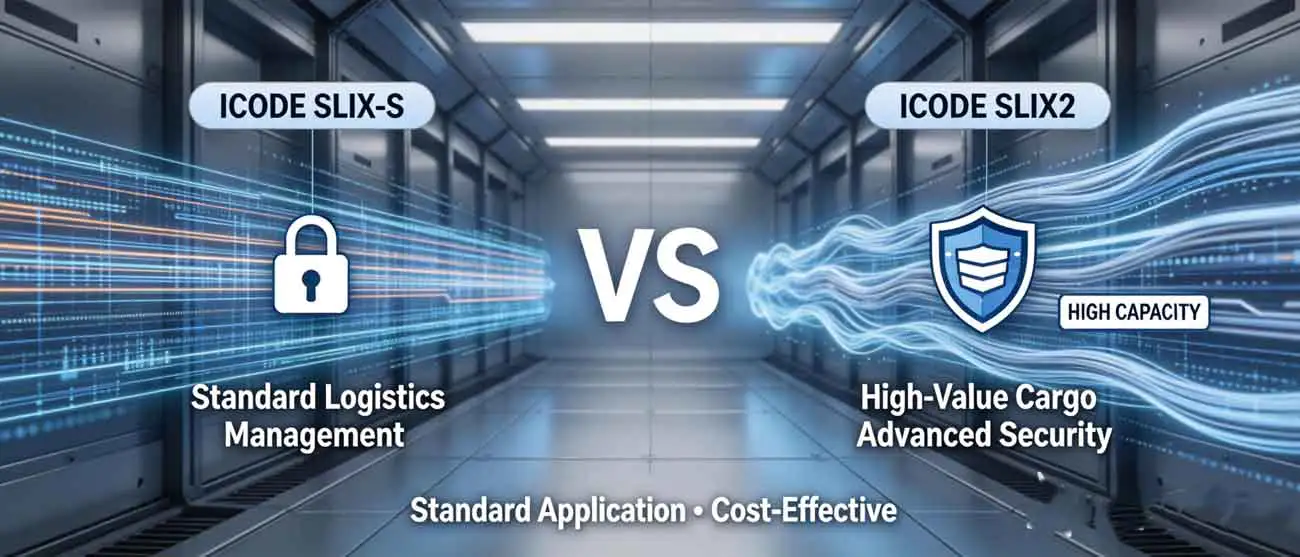
Core Parameter Comparison Between ICODE SLIX2 and ICODE SLIX-S Chips
Storage Capacity Differences Adapt to Different Industrial Logistics Data Bearing Needs
Industrial Logistics relies heavily on efficient data collection and transmission, and the storage capacity of RFID chips is a key factor affecting the efficiency of data management in industrial logistics scenarios. ICODE SLIX2 and ICODE SLIX-S, as two mainstream RFID chips widely used in Industrial Logistics, have obvious differences in storage capacity, which can adapt to different data bearing needs of industrial logistics. ICODE SLIX2 has a storage capacity of 256 bytes, of which 128 bytes are user-readable and writable, which is sufficient to store basic logistics data such as product serial numbers, batch numbers, production dates, storage locations, and transportation routes. This storage capacity is suitable for most general industrial logistics scenarios, such as the transportation and storage of ordinary mechanical parts, daily industrial supplies, and other products that do not require a large amount of data storage. In contrast, ICODE SLIX-S has a larger storage capacity of 512 bytes, with 384 bytes of user-readable and writable space. This larger storage capacity makes it more suitable for industrial logistics scenarios that need to carry a large amount of data, such as the transportation of high-value and complex components, which require storing detailed information including product specifications, quality inspection reports, maintenance records, and real-time transportation status. For example, in the transportation of precision electronic components, ICODE SLIX-S can store not only the basic information of the components but also the parameters of each component, the test results of the production process, and the requirements of the transportation environment, providing comprehensive data support for the whole process management of Industrial Logistics. The difference in storage capacity between the two chips provides enterprises with targeted choices according to their own data bearing needs, ensuring that the data management of Industrial Logistics is more efficient and accurate.
Different Reading Distances Meet the Reading and Writing Efficiency Requirements of Diverse Logistics Scenarios
In Industrial Logistics, different logistics scenarios have different requirements for the reading distance of RFID chips, which directly affects the reading and writing efficiency of data and the overall operation efficiency of the logistics link. ICODE SLIX2 and ICODE SLIX-S have significant differences in reading distance, which can meet the reading and writing efficiency requirements of diverse Industrial Logistics scenarios. ICODE SLIX2 has a reading distance of 0.5 to 1 meter under normal circumstances, which is suitable for logistics scenarios that require close-range and high-precision reading, such as warehouse inventory counting, product sorting, and loading and unloading verification. In these scenarios, staff need to accurately read the data of each product, and the short reading distance of ICODE SLIX2 can avoid misreading caused by too many nearby products, ensuring the accuracy of data reading. For example, in the warehouse inventory of small electronic components, staff can use a handheld reader to scan the ICODE SLIX2 chip on each component at close range, quickly complete the inventory counting, and ensure that the inventory data is consistent with the actual situation. ICODE SLIX-S, on the other hand, has a longer reading distance, which can reach 1 to 2 meters, making it suitable for logistics scenarios that require long-distance and batch reading, such as large-scale warehouse storage, container transportation, and assembly line operation. In these scenarios, staff can complete the batch reading of a large number of products without close contact, greatly improving the reading and writing efficiency. For example, in the container loading and unloading link of Industrial Logistics, staff can use a fixed reader to read the ICODE SLIX-S chip on the goods in the container at a long distance, quickly confirm the type and quantity of goods, and improve the efficiency of loading and unloading. The different reading distances of the two chips enable enterprises to choose according to the characteristics of their own logistics scenarios, ensuring that the reading and writing efficiency of Industrial Logistics is maximized.
Differences in Anti-Interference Performance Adapt to Complex Industrial Logistics Environments
Industrial Logistics environments are usually complex, with a lot of metal materials, electromagnetic interference, and other factors that may affect the normal operation of RFID chips. Therefore, the anti-interference performance of chips is crucial for ensuring the stability of data reading and writing in Industrial Logistics. ICODE SLIX2 and ICODE SLIX-S have differences in anti-interference performance, which can adapt to different complex Industrial Logistics environments. ICODE SLIX2 has basic anti-interference performance, which can resist general electromagnetic interference and weak metal interference, and is suitable for relatively simple Industrial Logistics environments, such as ordinary warehouses without a lot of metal equipment, and transportation routes with less electromagnetic interference. In these environments, ICODE SLIX2 can maintain stable data reading and writing, ensuring the smooth progress of logistics operations. However, in environments with strong electromagnetic interference or a large number of metal materials, such as metal processing workshops, container yards with a lot of metal containers, and transportation links with high-voltage lines, the anti-interference performance of ICODE SLIX2 may be affected, leading to reduced reading distance or even failure to read. ICODE SLIX-S is designed with enhanced anti-interference performance, adopting a special anti-metal and anti-electromagnetic interference structure, which can stably work in complex environments with strong electromagnetic interference and a large number of metal materials. For example, in the transportation of metal mechanical parts, the ICODE SLIX-S chip attached to the metal surface can still be accurately read at a long distance, without being affected by the metal material. The difference in anti-interference performance between the two chips allows enterprises to choose according to the complexity of their own Industrial Logistics environment, ensuring the stability and reliability of data reading and writing.
Cost Differences Affect Enterprises’ Bulk Purchasing and Long-Term Investment
Cost control is an important part of enterprise operation and management, and the cost difference between ICODE SLIX2 and ICODE SLIX-S directly affects enterprises’ bulk purchasing decisions and long-term investment plans in Industrial Logistics. In terms of unit price, ICODE SLIX2 has a clear cost advantage, with a unit price of about 0.2 to 0.4 US dollars per chip. This relatively low cost makes it more suitable for enterprises with large purchase volumes and strict cost control, such as enterprises engaged in the transportation and storage of low-value and large-quantity industrial products. For example, an enterprise that transports millions of ordinary mechanical parts every year can reduce the overall cost of Industrial Logistics by choosing ICODE SLIX2, which helps to improve the enterprise’s profit margin. ICODE SLIX-S, due to its larger storage capacity and stronger anti-interference performance, has a higher unit price, about 0.5 to 0.8 US dollars per chip. Although the cost is higher, it is more suitable for enterprises that have high requirements for data storage and anti-interference performance and are not sensitive to cost, such as enterprises engaged in the transportation of high-value precision components, medical equipment, and other products. For these enterprises, the high performance of ICODE SLIX-S can avoid economic losses caused by data reading errors or chip failure, and the long-term investment return is higher. In addition, the cost difference between the two chips also affects the long-term investment plan of enterprises. Enterprises with long-term Industrial Logistics development plans need to comprehensively consider the cost and performance of the chips, choose the chip that is most suitable for their own development needs, and achieve the balance between cost and efficiency.
Chip Selection Basis for Segmented Industrial Logistics Scenarios
Chip Adaptation Logic for Auto Parts Transportation Scenarios
Auto parts transportation is a key segment of Industrial Logistics, with the characteristics of a wide variety of parts, high precision requirements, complex transportation environment, and high demand for data traceability. The selection of ICODE SLIX2 and ICODE SLIX-S chips in this scenario needs to follow a clear adaptation logic based on the characteristics of auto parts transportation. Auto parts can be divided into high-precision core components (such as engine parts, electronic control units) and ordinary auxiliary components (such as screws, gaskets). For high-precision core components, the transportation process requires strict control of the environment (temperature, humidity) and real-time tracking of the transportation status, which requires the chip to have a large storage capacity and strong anti-interference performance. Therefore, ICODE SLIX-S is more suitable for this type of auto parts. It can store detailed information such as the precision parameters, quality inspection reports, and transportation environment requirements of the core components, and its enhanced anti-interference performance can ensure stable data reading even in the transportation environment with a lot of metal materials and electromagnetic interference. For ordinary auxiliary components, the data that needs to be stored is relatively simple (such as product model, batch number), and the transportation environment is relatively simple, so ICODE SLIX2 is more suitable. Its basic storage capacity can meet the data bearing needs, and the low cost can help enterprises control the overall cost of Industrial Logistics. In addition, auto parts transportation usually involves long-distance transportation and multiple transfers, so the chip’s durability and stability are also important considerations. Both ICODE SLIX2 and ICODE SLIX-S have good durability, but ICODE SLIX-S has better performance in complex environments, which is more suitable for long-distance transportation of high-precision components. The adaptation logic of auto parts transportation scenarios fully considers the characteristics of the parts and the transportation environment, ensuring that the selected chip can meet the actual needs of Industrial Logistics.
Chip Selection Principles for Electronic Component Warehousing Environments
Electronic component warehousing is another important segment of Industrial Logistics, with the characteristics of small product size, large quantity, high precision, and strict requirements for storage environment. The selection of ICODE SLIX2 and ICODE SLIX-S chips in this scenario needs to follow specific principles based on the characteristics of electronic component warehousing. First, the principle of matching storage capacity. Electronic components usually need to store information such as product model, batch number, production date, precision parameters, and storage location. For ordinary electronic components (such as resistors, capacitors), the required storage capacity is small, and ICODE SLIX2’s 256-byte storage capacity can fully meet the needs. For high-precision electronic components (such as chips, sensors), which need to store more detailed information such as test data and use instructions, ICODE SLIX-S’s 512-byte storage capacity is more suitable. Second, the principle of adapting to the storage environment. Electronic component warehouses usually have strict requirements for temperature and humidity, and there are a lot of electronic equipment, which may produce electromagnetic interference. ICODE SLIX-S has stronger anti-interference performance and can maintain stable data reading in environments with electromagnetic interference, while ICODE SLIX2 is suitable for warehouses with relatively weak electromagnetic interference. Third, the principle of cost control. For enterprises with a large number of ordinary electronic components in storage, choosing ICODE SLIX2 can reduce the warehousing management cost of Industrial Logistics; for enterprises with high-precision electronic components as the main products, the high performance of ICODE SLIX-S can ensure the accuracy of warehousing data, avoiding economic losses caused by data errors. In addition, the small size of electronic components requires the chip to be small and easy to attach, and both ICODE SLIX2 and ICODE SLIX-S have small sizes that can be easily attached to the surface of electronic components without affecting the storage and transportation of the components. The selection principles of electronic component warehousing environments ensure that the selected chip can effectively improve the efficiency of warehousing management in Industrial Logistics.
Industrial Logistics Scenario Characteristics Determine the Final Chip Selection Direction
The final selection direction of ICODE SLIX2 and ICODE SLIX-S chips in Industrial Logistics is ultimately determined by the characteristics of the specific Industrial Logistics scenario. Different Industrial Logistics scenarios have different requirements for data storage, reading distance, anti-interference performance, and cost, which directly affect the choice of chips. For Industrial Logistics scenarios with simple environment, small data storage demand, short reading distance, and strict cost control, such as the transportation and storage of ordinary industrial raw materials, ordinary mechanical parts, and other products, ICODE SLIX2 is the optimal choice. Its basic performance can meet the needs of the scenario, and the low cost can help enterprises reduce the overall operation cost of Industrial Logistics. For Industrial Logistics scenarios with complex environment, large data storage demand, long reading distance, and high requirements for data accuracy and stability, such as the transportation of high-value precision components, medical equipment, and the warehousing of electronic components, ICODE SLIX-S is more suitable. Its larger storage capacity, longer reading distance, and stronger anti-interference performance can ensure the smooth progress of logistics operations and the accuracy of data management. In addition, the scale of the enterprise and the long-term development plan also affect the chip selection direction. Large-scale enterprises with long-term Industrial Logistics development plans may prefer to choose ICODE SLIX-S to ensure the stability and scalability of the logistics system, while small and medium-sized enterprises with limited funds may choose ICODE SLIX2 to control costs. In short, the characteristics of the Industrial Logistics scenario are the core factor determining the chip selection direction, and enterprises need to comprehensively consider various factors to choose the chip that is most suitable for their own scenario.
Chip Preference Analysis of Industrial Enterprises in Europe, America and Asia
Chip Selection Tendency of European and American Industrial Enterprises Based on Supply Chain Complexity
European and American industrial enterprises have complex global supply chains, with the characteristics of long transportation distance, many transfer links, high requirements for data traceability, and strict quality control, which determines their chip selection tendency in Industrial Logistics. Due to the high complexity of the supply chain, European and American industrial enterprises have high requirements for the performance of RFID chips, especially in terms of storage capacity, anti-interference performance, and data stability. Therefore, most European and American industrial enterprises prefer to choose ICODE SLIX-S in Industrial Logistics. The 512-byte storage capacity of ICODE SLIX-S can store a large amount of data throughout the supply chain, including product information, transportation status, quality inspection records, and other details, which meets the high requirements of European and American enterprises for data traceability. Its enhanced anti-interference performance can ensure stable data reading in complex logistics environments such as long-distance transportation, container yards, and metal processing workshops, avoiding data loss or reading errors. In addition, European and American industrial enterprises pay more attention to the long-term stability and scalability of the logistics system. The high performance of ICODE SLIX-S can adapt to the continuous expansion of the supply chain and the increasing demand for data management, which is in line with the long-term development needs of European and American enterprises. For example, many large European and American auto manufacturers and electronic component enterprises use ICODE SLIX-S in their global Industrial Logistics system to realize real-time tracking and data management of products throughout the supply chain, improving the efficiency and transparency of the supply chain. Although the cost of ICODE SLIX-S is higher, European and American enterprises are more willing to invest in high-performance chips to ensure the stability and efficiency of the supply chain.
Chip Preferences of Asian Industrial Enterprises Combining Their Own Logistics Characteristics
Asian industrial enterprises have their own unique logistics characteristics, such as dense regional supply chains, large production scale, high cost sensitivity, and emphasis on logistics efficiency, which determines their chip selection preferences in Industrial Logistics. Compared with European and American enterprises, Asian industrial enterprises have relatively simple regional supply chains, with shorter transportation distances and fewer transfer links, so the requirements for chip storage capacity and anti-interference performance are relatively moderate. At the same time, Asian industrial enterprises usually have large production and logistics scales, and the demand for chip batch purchase is large, so cost control is an important factor in chip selection. Therefore, most Asian industrial enterprises prefer to choose ICODE SLIX2 in Industrial Logistics. The low cost of ICODE SLIX2 can help enterprises reduce the overall cost of Industrial Logistics when purchasing in large quantities, which is in line with the cost-sensitive characteristics of Asian enterprises. Its 256-byte storage capacity can meet the basic data storage needs of most Asian industrial logistics scenarios, such as the transportation and storage of ordinary mechanical parts, electronic components, and industrial raw materials. In addition, the reading distance of ICODE SLIX2 is suitable for the short-distance reading needs of Asian regional logistics, such as warehouse inventory, product sorting, and loading and unloading verification, which can ensure the efficiency of logistics operations. For example, many large manufacturing enterprises in China, Japan, and South Korea use ICODE SLIX2 in their Industrial Logistics system to realize efficient data management of products in the regional supply chain, while controlling the logistics cost. However, for Asian enterprises engaged in the export of high-value precision products and with complex global supply chains, they also choose ICODE SLIX-S to meet the high requirements of the international market for data traceability and logistics stability.
Regional Supply Chain Differences Affect Enterprises’ Choice of Chips
Regional supply chain differences are an important factor affecting the choice of ICODE SLIX2 and ICODE SLIX-S chips by industrial enterprises in Industrial Logistics. The supply chains in Europe, America, and Asia have obvious differences in complexity, transportation distance, regulatory requirements, and cost sensitivity, which directly lead to differences in enterprise chip selection. In Europe and America, the supply chain is global, with long transportation distances, many transfer links, and strict regulatory requirements for data traceability and product quality. Therefore, enterprises in these regions pay more attention to the performance of chips and prefer to choose ICODE SLIX-S with better performance to ensure the stability and transparency of the supply chain. In Asia, the supply chain is mainly regional, with shorter transportation distances, fewer transfer links, and higher cost sensitivity of enterprises. Therefore, enterprises in these regions prefer to choose ICODE SLIX2 with lower cost and moderate performance to meet the basic needs of Industrial Logistics while controlling costs. In addition, regional regulatory differences also affect enterprise chip selection. For example, European and American countries have stricter requirements for data security and privacy protection in Industrial Logistics, and ICODE SLIX-S has better data encryption performance, which is more in line with regional regulatory requirements. Asian countries pay more attention to logistics efficiency and cost control, and ICODE SLIX2 can better meet these needs. Regional supply chain differences make the chip selection of industrial enterprises show obvious regional characteristics, and enterprises need to choose chips according to the characteristics of the regional supply chain where they are located to ensure the efficiency and stability of Industrial Logistics.
Chip Performance in Harsh Logistics Environments
Stability and Durability of the Two Chips in High-Temperature Environments
Harsh logistics environments are common in Industrial Logistics, and high-temperature environments (such as transportation in desert areas, near high-temperature production workshops, and container transportation in summer) have a great impact on the stability and durability of RFID chips. The performance of ICODE SLIX2 and ICODE SLIX-S in high-temperature environments directly determines their applicability in these harsh Industrial Logistics scenarios. ICODE SLIX2 has a working temperature range of -20°C to 70°C, which can maintain stable performance in general high-temperature environments (such as 50°C to 60°C). However, in extreme high-temperature environments (above 70°C), the performance of ICODE SLIX2 may be affected, such as reduced reading distance, data loss, or even chip damage, which affects the normal progress of Industrial Logistics. ICODE SLIX-S is designed with high-temperature resistance, with a working temperature range of -40°C to 85°C, which can stably work in extreme high-temperature environments. Even in environments with a temperature of 80°C, ICODE SLIX-S can still maintain accurate data reading and writing, and its durability is not affected. For example, in the transportation of industrial products in desert areas where the daytime temperature often exceeds 70°C, ICODE SLIX-S can stably track the transportation status of products, while ICODE SLIX2 may have performance failures. In addition, the high-temperature resistance of ICODE SLIX-S also makes it suitable for Industrial Logistics scenarios such as near high-temperature production workshops and high-temperature product transportation. The stability and durability of the two chips in high-temperature environments determine their applicability in harsh Industrial Logistics scenarios, and enterprises need to choose according to the actual temperature conditions of their own logistics links.
Moisture Resistance and Data Reading Accuracy of Chips in High-Humidity Environments
High-humidity environments (such as transportation in rainy areas, coastal areas, and warehousing in humid regions) are another common harsh environment in Industrial Logistics, which may cause damage to chips and affect data reading accuracy. The moisture resistance of ICODE SLIX2 and ICODE SLIX-S directly affects their performance and service life in high-humidity Industrial Logistics scenarios. ICODE SLIX2 has basic moisture resistance, which can work stably in environments with a relative humidity of 0% to 85%. However, in high-humidity environments with a relative humidity of more than 85% (such as coastal areas during the rainy season), the moisture may penetrate into the chip, leading to short circuits, data loss, or reduced reading accuracy, which affects the normal data management of Industrial Logistics. ICODE SLIX-S is designed with enhanced moisture resistance, adopting a sealed structure to prevent moisture penetration, and can work stably in environments with a relative humidity of 0% to 95%. Even in high-humidity environments such as rainy areas and coastal warehouses, ICODE SLIX-S can maintain accurate data reading and writing, and its service life is not affected. For example, in the transportation of industrial products in coastal areas, where the air humidity is high all year round, ICODE SLIX-S can stably track the product information, while ICODE SLIX2 may have data reading errors due to moisture. In addition, the moisture resistance of ICODE SLIX-S also makes it suitable for Industrial Logistics scenarios such as warehousing in humid regions and transportation in rainy seasons. The moisture resistance and data reading accuracy of the two chips in high-humidity environments are important factors for enterprises to choose chips in harsh Industrial Logistics scenarios.
Impact of Dust Environment on Chip Reading and Writing Functions and Tolerance
Dust environments (such as construction site logistics, mining area product transportation, and warehouse storage in dusty regions) are also common harsh environments in Industrial Logistics, and a large amount of dust may affect the reading and writing functions of RFID chips. The dust tolerance of ICODE SLIX2 and ICODE SLIX-S directly determines their applicability in these Industrial Logistics scenarios. ICODE SLIX2 has basic dust tolerance, which can work normally in environments with a small amount of dust. However, in environments with a large amount of dust (such as mining areas and construction sites), the dust may cover the surface of the chip, blocking the radio frequency signal, leading to reduced reading distance or failure to read, which affects the efficiency of Industrial Logistics. ICODE SLIX-S is designed with enhanced dust tolerance, adopting a dust-proof structure to prevent dust from entering the chip, and its surface is treated with anti-dust coating, which can effectively prevent dust coverage. Even in environments with a large amount of dust, ICODE SLIX-S can maintain stable reading and writing functions, and its tolerance to dust is significantly higher than that of ICODE SLIX2. For example, in the transportation of mining equipment and construction materials in mining areas and construction sites, where the dust concentration is high, ICODE SLIX-S can stably read and write product data, ensuring the smooth progress of logistics operations, while ICODE SLIX2 may fail to read due to dust coverage. In addition, the dust tolerance of ICODE SLIX-S also makes it suitable for Industrial Logistics scenarios such as warehouse storage in dusty regions. The impact of dust environment on the reading and writing functions of the two chips and their tolerance differences provide enterprises with a basis for selection in harsh Industrial Logistics scenarios.
Cost Negotiation Strategies for Bulk Purchasing
Chip Price Difference Analysis for Bulk Purchasing of More Than 100,000 Pieces
Bulk purchasing is a common way for enterprises to reduce the cost of Industrial Logistics chips, and the price difference between ICODE SLIX2 and ICODE SLIX-S is more obvious when purchasing more than 100,000 pieces, which directly affects the enterprise’s purchasing cost. When purchasing more than 100,000 pieces, the unit price of ICODE SLIX2 can be reduced to 0.15 to 0.3 US dollars per chip, which is 25% to 20% lower than the unit price of small-batch purchasing. This price advantage is very obvious for enterprises with large purchase volumes, such as enterprises engaged in large-scale Industrial Logistics operations. For example, an enterprise that needs to purchase 500,000 chips for Industrial Logistics can save 25,000 to 50,000 US dollars by choosing ICODE SLIX2 instead of ICODE SLIX-S. When purchasing more than 100,000 pieces, the unit price of ICODE SLIX-S can be reduced to 0.4 to 0.6 US dollars per chip, which is 20% to 25% lower than the unit price of small-batch purchasing. Although the price is still higher than that of ICODE SLIX2, the price reduction range is also significant for enterprises that need high-performance chips. In addition, the price difference between the two chips also increases with the increase of purchase volume. When purchasing more than 1 million pieces, the unit price of ICODE SLIX2 can be as low as 0.1 to 0.25 US dollars, and the unit price of ICODE SLIX-S can be as low as 0.3 to 0.5 US dollars. The price difference analysis for bulk purchasing of more than 100,000 pieces helps enterprises formulate reasonable purchasing plans, choose chips that meet their needs, and reduce the overall cost of Industrial Logistics.
Cost Negotiation Skills and Preferential Acquisition for Large-Scale Purchasing
For large-scale purchasing of ICODE SLIX2 and ICODE SLIX-S chips in Industrial Logistics, mastering certain cost negotiation skills can help enterprises obtain more preferential prices and reduce purchasing costs. First, enterprises should conduct in-depth market research to understand the market price of the two chips, the price policies of different suppliers, and the price differences between different purchase volumes. This can help enterprises have a clear understanding of the market and gain an advantage in negotiations. Second, enterprises should choose multiple suppliers for comparison and negotiation, and use the competition between suppliers to obtain better preferential prices. For example, enterprises can provide the quotation of one supplier to another supplier and ask for a more favorable price. Third, enterprises should sign long-term cooperation agreements with suppliers. Long-term cooperation can enhance the trust between enterprises and suppliers, and suppliers are more willing to provide preferential prices and better after-sales service for long-term cooperative customers. Fourth, enterprises can put forward flexible payment terms, such as prepayment of a certain proportion of the payment, to exchange for price concessions. Fifth, enterprises can require suppliers to provide value-added services, such as free chip testing, technical support, and on-site installation guidance, which can also reduce the indirect cost of enterprises. For example, a large industrial enterprise purchasing 1 million chips for Industrial Logistics can obtain a 10% to 15% price discount by signing a long-term cooperation agreement with a supplier and putting forward flexible payment terms, which greatly reduces the purchasing cost. Mastering these negotiation skills can help enterprises obtain more preferential prices in large-scale purchasing and optimize the cost structure of Industrial Logistics.
Optimize Purchasing Cost Plan Combining Enterprise Usage and Long-Term Cooperation
Optimizing the purchasing cost plan of ICODE SLIX2 and ICODE SLIX-S chips in Industrial Logistics requires enterprises to combine their own usage and long-term cooperation with suppliers to achieve the balance between cost and performance. First, enterprises should accurately calculate their own chip usage, including monthly usage, annual usage, and future growth trends. This can help enterprises determine the appropriate purchase volume, avoid over-purchasing leading to capital occupation or under-purchasing leading to insufficient supply. For example, if an enterprise’s monthly chip usage is 10,000 pieces, it can choose to purchase 120,000 pieces annually to obtain the bulk purchase price discount, while avoiding excessive capital occupation. Second, enterprises should establish long-term cooperative relationships with suppliers. Long-term cooperation can not only obtain more favorable prices but also ensure the stability of chip supply and the quality of after-sales service. For example, enterprises can sign a one-year or three-year long-term cooperation agreement with suppliers, specifying the purchase volume, price, and after-sales service terms, which can reduce the uncertainty of purchasing and the cost of frequent supplier replacement. Third, enterprises should flexibly choose chips according to their own usage scenarios. For scenarios with low performance requirements, choose ICODE SLIX2 to control costs; for scenarios with high performance requirements, choose ICODE SLIX-S to ensure performance. At the same time, enterprises can negotiate with suppliers to mix purchase the two chips to obtain a more favorable overall price. For example, an enterprise can purchase 800,000 ICODE SLIX2 and 200,000 ICODE SLIX-S chips in bulk, and negotiate with suppliers to obtain a unified preferential price, which can reduce the overall purchasing cost while meeting the needs of different scenarios. Optimizing the purchasing cost plan by combining enterprise usage and long-term cooperation can help enterprises reduce the cost of Industrial Logistics and improve economic benefits.
Future Intelligent Development Trends of Industrial Logistics Chips
Development Direction of Chips Integrating Sensors to Realize Real-Time Temperature and Humidity Monitoring
With the continuous development of Industrial Logistics towards intelligence and refinement, the integration of sensors into RFID chips has become an important development direction, and ICODE SLIX2 and ICODE SLIX-S chips will also develop towards integrating sensors to realize real-time temperature and humidity monitoring. In many Industrial Logistics scenarios, such as the transportation of perishable industrial materials, high-precision electronic components, and medical equipment, the temperature and humidity of the transportation and storage environment have a great impact on the quality of products. The current chips can only store and transmit basic product information, but cannot monitor the environmental temperature and humidity in real time. In the future, ICODE SLIX2 and ICODE SLIX-S chips will integrate temperature and humidity sensors, which can real-time collect the temperature and humidity data of the environment during transportation and storage, and transmit the data to the Industrial Logistics management system in real time. This allows enterprises to monitor the environmental status of products in real time, find abnormal temperature and humidity in time, and take corresponding measures to avoid product quality damage. For example, in the transportation of high-precision electronic components, the integrated sensor chip can real-time monitor the temperature and humidity of the transportation environment, and when the temperature or humidity exceeds the standard, the system will send an alarm to the staff, who can adjust the transportation environment in time to ensure the quality of the components. The development of chips integrating sensors will greatly improve the refinement level of Industrial Logistics management and provide more comprehensive data support for product quality control.
Integration of Chips and Internet of Things Technology Promotes the Intelligent Upgrade of Industrial Logistics
The integration of RFID chips and Internet of Things (IoT) technology is another important trend in the future development of Industrial Logistics chips, which will promote the intelligent upgrade of Industrial Logistics. At present, the application of ICODE SLIX2 and ICODE SLIX-S chips in Industrial Logistics is mainly limited to data collection and transmission, and the connection with other IoT devices is not close enough. In the future, with the development of IoT technology, ICODE SLIX2 and ICODE SLIX-S chips will be closely integrated with IoT devices such as GPS locators, intelligent sensors, and cloud platforms, forming a comprehensive Industrial Logistics intelligent management system. The chips will collect product data, and the IoT devices will collect environmental data and location data, which will be transmitted to the cloud platform for integrated analysis and processing. This allows enterprises to realize real-time tracking, location positioning, environmental monitoring, and data analysis of products throughout the logistics process, improving the efficiency and intelligence level of Industrial Logistics. For example, the integrated system of chips and IoT technology can realize real-time positioning of goods in transportation, predict the arrival time, and adjust the transportation route in time according to traffic conditions; it can also realize intelligent inventory management, automatically remind staff to replenish goods when the inventory is insufficient, and reduce manual intervention. The integration of chips and IoT technology will break the information island in Industrial Logistics, realize the seamless connection of data throughout the supply chain, and promote the intelligent upgrade of Industrial Logistics.
Expansion of Intelligent Functions Brings New Possibilities for Industrial Logistics Management
The expansion of intelligent functions of ICODE SLIX2 and ICODE SLIX-S chips will bring new possibilities for Industrial Logistics management, making Industrial Logistics more efficient, accurate, and intelligent. In addition to integrating sensors and IoT technology, the future chips will also expand more intelligent functions, such as data encryption, anti-counterfeiting identification, and automatic fault diagnosis. Data encryption function can ensure the security and privacy of product data in Industrial Logistics, prevent data leakage and tampering, which is especially important for the transportation of high-value and confidential products. Anti-counterfeiting identification function can help enterprises identify counterfeit products in the logistics process, protect the enterprise’s brand reputation and economic interests. Automatic fault diagnosis function can monitor the working status of the chip in real time, find chip faults in time, and remind staff to replace the chip, ensuring the smooth progress of data collection and transmission. For example, in the transportation of high-value industrial products, the chip with data encryption and anti-counterfeiting identification functions can prevent the product from being counterfeited and the data from being tampered with, ensuring the safety of the product and the accuracy of the data. The expansion of intelligent functions will make ICODE SLIX2 and ICODE SLIX-S chips play a more important role in Industrial Logistics, help enterprises solve more logistics management problems, and promote the high-quality development of Industrial Logistics. The future intelligent development of Industrial Logistics chips will bring a new revolution to Industrial Logistics management, making the whole logistics process more intelligent, efficient, and reliable.
Why Choose Mytopband?
- Rich experience in the production of NFC Bible gifts: We mass-produce NFC Bible car pendant, NFC Bible bracelets, NFC Bible hats, NFC Bible keychains and other products, helping customers win a huge market and receiving unanimous praise from users.
- Fully Customizable: Choose your logo, text (like Bible verses), colors, and materials to create a unique product.
- Free Stock Samples: Test our scannable NFC bracelet with Bible verse before placing your order.
- Low MOQ as 500pcs: Perfect for startups and small businesses.

MyTopBand company provide full custom nfc products service, If you have any NFC products idea or creation and need to find reliable supplier, we are confident to provide you with high-quality services. Please find us: www.mytopband.com, or send message to info@mytopband.com, we will reply you within 24 hours.