
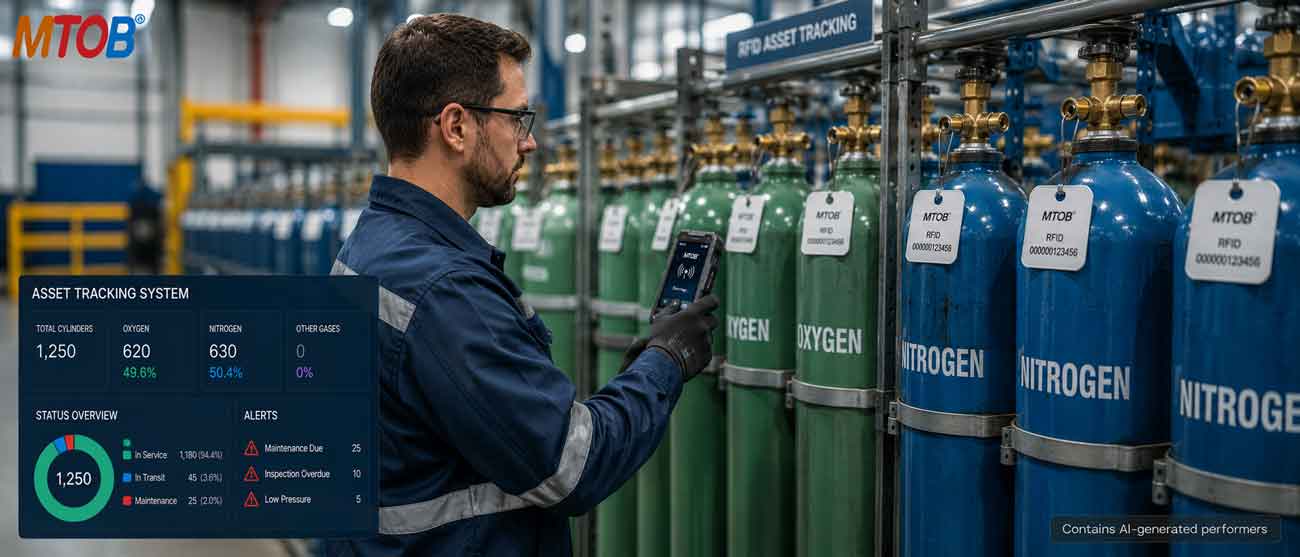
-
Production facilities
-
Distribution centers
-
Transportation fleets
-
Customer locations
-
Service workshops
A single gas company may manage tens of thousands of cylinders simultaneously.
-
Lost cylinders
-
Inventory inaccuracies
-
Delayed deliveries
-
Regulatory compliance risks
-
High replacement costs
Why Traditional Cylinder Tracking Methods Fail
-
Painted serial numbers
-
Metal nameplates
-
Barcode labels
-
Manual logs
-
Spreadsheet records
While these methods are inexpensive, they often become unreliable in demanding industrial environments.
Cylinder Movement Is Difficult to Monitor
Tracking these movements manually becomes increasingly difficult as operations grow.
Labels Become Damaged
-
Weather
-
Chemicals
-
Abrasion
-
High-pressure cleaning
can make traditional labels difficult to read.
Inventory Audits Require Significant Labor
How an RFID Gas Cylinder Tracking System Works
An RFID Gas Cylinder Tracking System combines physical RFID tags with software and reader infrastructure.
Step 1: RFID Tags Are Attached to Cylinders
-
Cylinder ID
-
Gas type
-
Manufacturing date
-
Inspection history
-
Ownership information
- Current status
Step 2: RFID Readers Capture Movement Data
-
Filling stations
-
Warehouse entrances
-
Loading docks
-
Distribution centers
-
Customer return points
Whenever a cylinder passes a reader, the system automatically records its location.
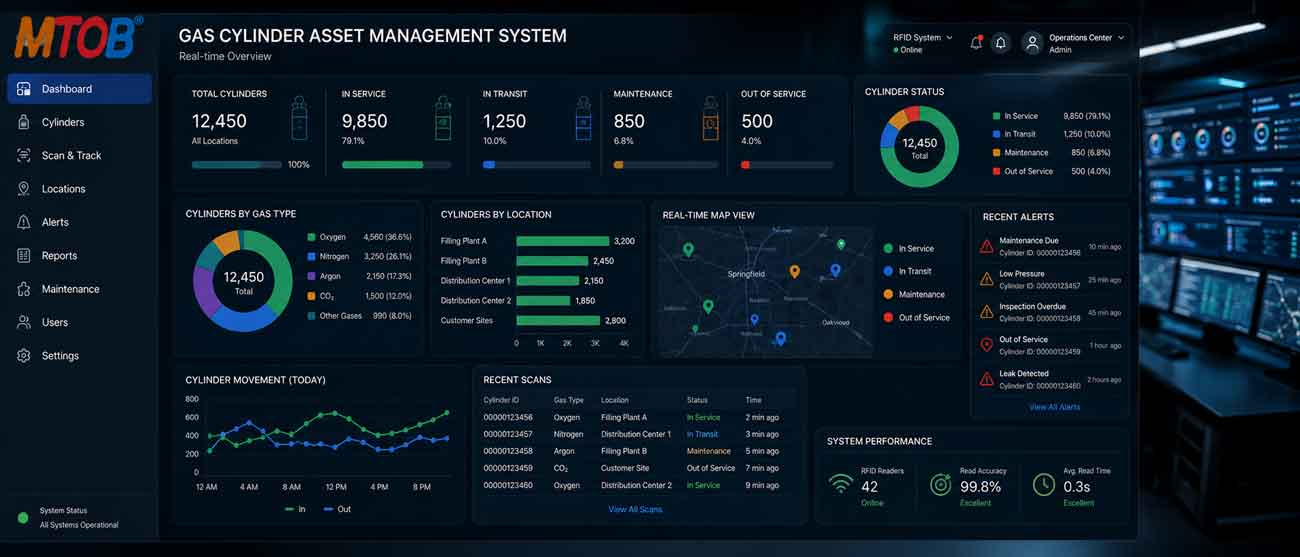
Step 3: Software Creates Real-Time Visibility
-
Cylinder location
-
Inventory levels
-
Maintenance status
-
Utilization rates
The Cylinder Lifecycle: Where RFID Creates Value
RFID provides visibility throughout every stage.
Manufacturing and Commissioning
This establishes a complete lifecycle record from day one.
Filling Operations
-
Reduced processing errors
-
Improved operational accuracy
-
Better production visibility
Distribution
-
Shipment contents
-
Delivery status
-
Asset movements
This improves accountability throughout the supply chain.
Customer Usage
-
Which customers retain cylinders the longest?
-
Where are assets accumulating?
-
Which locations experience the highest loss rates?
Inspection and Maintenance
Five Operational Problems RFID Solves
Problem #1: Cylinder Loss
RFID improves accountability and asset recovery.
Problem #2: Inventory Inaccuracy
Real-time visibility reduces discrepancies between physical inventory and system records.
Problem #3: Compliance Challenges
Digital records simplify regulatory reporting and inspection management.
Problem #4: Excess Inventory Purchases
RFID improves utilization and reduces unnecessary capital expenditures.
Problem #5: Slow Customer Returns
Business Impact: Where ROI Comes From
However, most ROI originates from operational improvements.
Reduced Asset Losses
Fewer missing cylinders.
Better Inventory Accuracy
More reliable planning and forecasting.
Increased Asset Utilization
Existing cylinders generate greater value.
Lower Labor Costs
Inventory audits become faster and more accurate.
Improved Customer Service
Which Gas Suppliers Benefit Most?
RFID cylinder tracking is particularly valuable for organizations managing large mobile asset fleets.
Industrial Gas Suppliers
Tracking oxygen, nitrogen, argon, and specialty gases.
LPG Distributors
Managing propane and LPG cylinder fleets.
Healthcare Gas Providers
Tracking medical oxygen cylinders and related assets.
Beverage Gas Companies
Managing CO₂ cylinders for food and beverage applications.
Welding Gas Suppliers
RFID Tags Suitable for Gas Cylinder Tracking
Different environments require different RFID solutions.
Metal-Mount RFID Tags
Designed specifically for metal surfaces.
High-Durability RFID Tags
Suitable for harsh industrial environments.
UHF RFID Tags
Ideal for longer read-range applications.
NFC-Enabled Tags
Future Trends in Cylinder Asset Management
Emerging developments include:
IoT-Connected Cylinders
Real-time monitoring of location and status.
Predictive Maintenance
Using operational data to anticipate maintenance requirements.
Digital Product Passports
Tracking complete asset histories throughout the lifecycle.
AI-Powered Utilization Analytics
Why RFID Is Becoming the Standard for Cylinder Tracking
-
Real-time asset visibility
-
Improved inventory accuracy
-
Better compliance management
-
Reduced cylinder losses
-
Higher operational efficiency
For gas suppliers managing large cylinder fleets, RFID is rapidly becoming a strategic asset management technology rather than simply a tracking tool.
FAQ
What is an RFID Gas Cylinder Tracking System?
Can RFID tags work on metal gas cylinders?
How does RFID reduce cylinder losses?
Is RFID suitable for LPG cylinder tracking?
What is the typical ROI for RFID cylinder tracking?
ROI varies by operation size, but many organizations achieve savings through reduced losses, improved utilization, and lower labor costs.

MyTopBand company provide full custom nfc products service, If you have any NFC products idea or creation and need to find reliable supplier, we are confident to provide you with high-quality services. Please find us: www.mytopband.com, or send message to info@mytopband.com, we will reply you within 24 hours.