
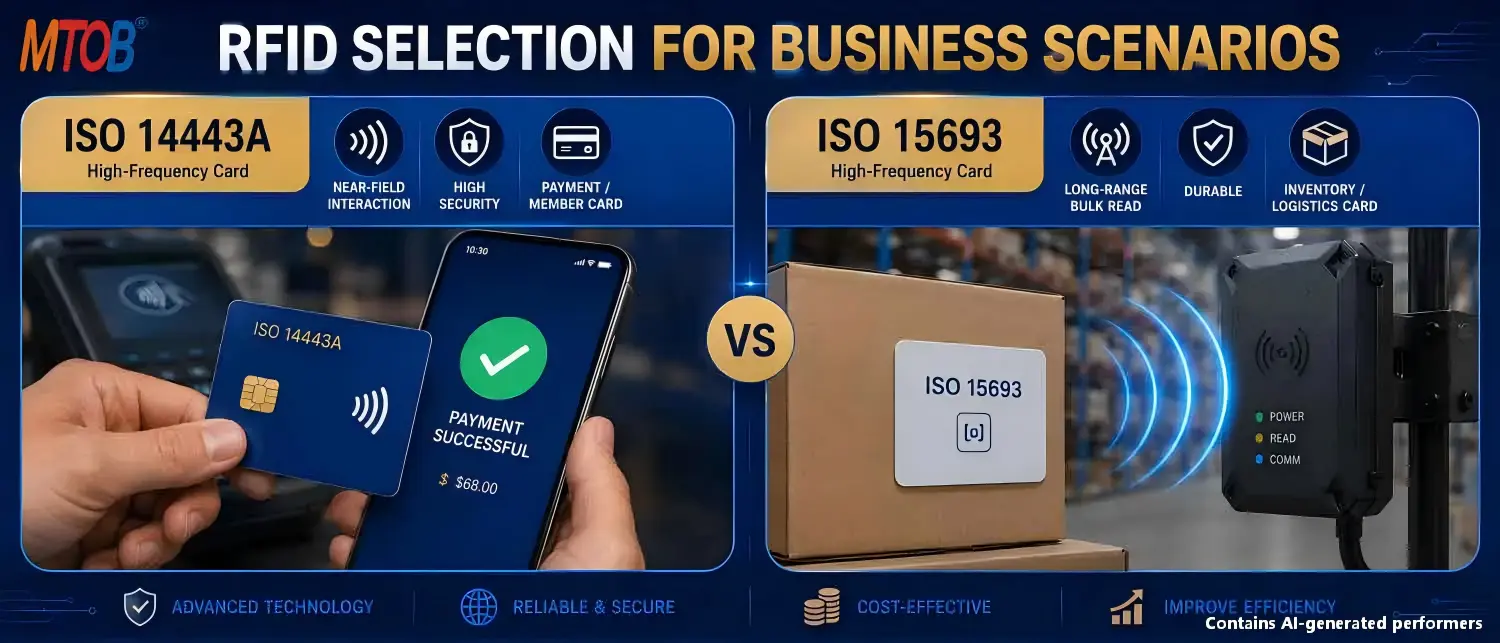
Core Technical Principles and Communication Differences of Two RFID Protocols
Core Technical Principles Distinction of Two RFID Protocols
In the global commercial application of RFID Cards, the selection of appropriate RFID protocols is the foundation of efficient operation, and the core technical principles of different protocols determine their applicability in various scenarios. The two most widely used RFID protocols in commercial fields are High-Frequency (HF) RFID protocol (represented by ISO/IEC 14443 and ISO/IEC 15693) and Ultra-High-Frequency (UHF) RFID protocol (represented by ISO/IEC 18000-6C). The core technical principles of these two protocols are significantly different, which directly affects their performance and application scope. The HF RFID protocol operates at a frequency of 13.56 MHz and adopts the near-field coupling principle to realize data transmission. It relies on the electromagnetic induction between the reader and the RFID Cards to transfer energy and data—when the RFID Cards enter the electromagnetic field emitted by the reader, the coil on the card induces an electric current to power the chip, and then completes data interaction through frequency modulation. This principle determines that the HF protocol has high data transmission stability and strong anti-interference ability in short distances. In contrast, the UHF RFID protocol operates at a frequency range of 860-960 MHz and adopts the far-field propagation principle, using electromagnetic wave reflection to transmit data. The RFID Cards under the UHF protocol can receive the radio frequency signal from the reader at a long distance, and reflect the stored data back to the reader through the backscattering technology, which enables long-distance and batch reading. The difference in these two core technical principles is the fundamental reason for the differences in their communication methods, performance parameters, and commercial adaptation directions, and also provides a basis for enterprises to select suitable RFID Cards according to their own needs.
Communication Method Differences and Applicable Scenarios of Different Protocols
The differences in the core technical principles of the two RFID protocols lead to obvious differences in their communication methods, which further determine their applicable commercial scenarios. The HF RFID protocol adopts a near-field communication method, with a communication distance generally within 10 cm, and the communication process requires close contact or short-distance proximity between the RFID Cards and the reader. This communication method has the advantages of stable data transmission, low error rate, and strong anti-interference ability against external radio frequency signals, making it suitable for scenarios that require high data accuracy and short-distance identification. For example, in retail store cash registers, medical equipment management, and access control systems, HF RFID Cards are widely used because they can ensure accurate data reading and avoid misreading caused by long-distance communication. In addition, the HF protocol supports full-duplex communication, which can realize two-way data transmission between the reader and the RFID Cards, making it suitable for scenarios that require real-time data interaction, such as financial payment and personal identity verification. On the other hand, the UHF RFID protocol adopts a far-field communication method, with a communication distance ranging from 1 to 15 meters, and supports batch reading of multiple RFID Cards at the same time—one reader can read dozens or even hundreds of RFID Cards within the effective range at one time. This communication method is efficient and fast, suitable for scenarios that require large-scale, long-distance, and rapid data collection. Typical application scenarios include logistics warehousing inventory, large-scale retail store shelf management, and industrial production line material tracking. The UHF protocol’s communication method also has the advantage of non-line-of-sight reading, which means that RFID Cards can be read even if they are blocked by non-metallic objects such as cartons and plastic, making it more flexible in complex commercial environments.
Technical Principle Differences Determine the Commercial Adaptation Direction of Protocols
The differences in the core technical principles of the two RFID protocols directly determine their commercial adaptation directions, and enterprises need to select the corresponding protocol RFID Cards according to their business characteristics and operational needs. The HF RFID protocol, based on the near-field coupling principle, has the characteristics of high data accuracy, stable communication, and strong security, so its commercial adaptation direction is mainly focused on scenarios that require high data reliability and short-distance interaction. In the financial field, HF RFID Cards are widely used in credit cards, electronic wallets, and other payment tools because they can ensure the security of transaction data and avoid data leakage or tampering. In the medical field, HF RFID Cards are used to manage medical devices, drugs, and patient information, as they can accurately record and transmit sensitive data, ensuring the traceability and safety of medical processes. In addition, the HF protocol’s small size and low power consumption make it suitable for scenarios where RFID Cards need to be embedded in small objects, such as jewelry tags and electronic access cards. The UHF RFID protocol, based on the far-field propagation principle, has the advantages of long reading distance, batch reading, and high efficiency, so its commercial adaptation direction is mainly focused on scenarios that require large-scale, rapid, and long-distance data collection. In the logistics and supply chain field, UHF RFID Cards are used to track goods throughout the process, from warehousing, transportation to delivery, which can greatly improve the efficiency of inventory management and logistics operation. In the retail field, UHF RFID Cards are used for shelf inventory, anti-theft management, and rapid checkout, helping retail enterprises reduce labor costs and improve operational efficiency. In the industrial field, UHF RFID Cards are used to track production materials and finished products, realizing the transparency and traceability of the production process. It can be seen that the technical principle differences between the two protocols determine their unique commercial adaptation advantages, and enterprises must fully consider these differences when selecting RFID Cards.
Core Performance Parameter Comparison of Two RFID Protocols
Reading Distance Differences Adapt to the Needs of Different Commercial Scenarios
Reading distance is one of the core performance parameters of RFID Cards, and the significant difference in reading distance between the two RFID protocols makes them suitable for different commercial scenarios. The HF RFID protocol, due to the limitation of the near-field coupling principle, has a relatively short reading distance, generally between 1 cm and 10 cm. This short reading distance has both advantages and disadvantages: the advantage is that it can avoid misreading caused by mutual interference between multiple RFID Cards in a dense environment, ensuring the accuracy of data reading; the disadvantage is that it requires close contact between the reader and the RFID Cards, which is not suitable for scenarios that require long-distance and rapid reading. Therefore, HF RFID Cards are more suitable for scenarios where the operation space is small, the number of RFID Cards is small, and high reading accuracy is required. For example, in small retail stores, medical clinics, and office access control systems, the use of HF RFID Cards can meet the daily operational needs, and the short reading distance can also avoid the problem of misreading other irrelevant RFID Cards. In contrast, the UHF RFID protocol has a much longer reading distance, which can reach 1-15 meters, and even up to 20 meters in an open environment. This long reading distance enables the reader to read RFID Cards without close contact, and can realize batch reading of multiple RFID Cards at the same time, which is very suitable for scenarios that require large-scale and rapid data collection. For example, in large logistics warehouses, staff can use handheld readers to read all RFID Cards on the goods on the entire shelf from a distance, completing the inventory work in a short time; in large shopping malls, UHF RFID Cards can be used for anti-theft management, and the reader installed at the exit can read the RFID Cards on the goods in the customer’s shopping cart in real time, avoiding theft. The difference in reading distance between the two protocols provides a clear basis for enterprises to select RFID Cards according to the scale of their business and the needs of data collection.
Data Transmission Rate Differences Adapt to the Requirements of Efficient Operation in Different Businesses
Data transmission rate is another key performance parameter that affects the application effect of RFID Cards, and the differences in data transmission rate between the two RFID protocols adapt to the efficient operation requirements of different commercial businesses. The HF RFID protocol has a relatively low data transmission rate, generally between 106 kbps and 424 kbps. This transmission rate is sufficient for scenarios that require small amounts of data transmission, such as personal identity verification, access control, and simple product information recording. For example, when using HF RFID Cards for access control, the card only needs to transmit simple identity information to the reader, and the low transmission rate can ensure the stability and accuracy of data transmission, avoiding delays caused by high-speed transmission. In addition, the low data transmission rate of the HF protocol also makes the power consumption of RFID Cards lower, which can extend the service life of the card, especially for passive RFID Cards that do not have a built-in battery. On the other hand, the UHF RFID protocol has a much higher data transmission rate, generally between 40 kbps and 640 kbps, and some high-performance UHF RFID Cards can even reach a higher transmission rate. This high transmission rate enables the rapid transmission of large amounts of data between the RFID Cards and the reader, which is very suitable for scenarios that require efficient data collection and processing. For example, in logistics warehousing, each RFID Card needs to store a large amount of information such as the product’s name, model, production date, and transportation route, and the high transmission rate of the UHF protocol can ensure that the reader quickly reads and processes this information, improving the efficiency of inventory management and logistics operation. In large-scale retail stores, the high transmission rate of UHF RFID Cards can realize rapid checkout, where customers only need to push the shopping cart through the reader channel, and the system can quickly read all the RFID Cards on the goods and complete the payment, greatly reducing the customer’s waiting time. The difference in data transmission rate between the two protocols enables enterprises to select RFID Cards according to the amount of data to be transmitted and the efficiency requirements of their business operations.
Anti-Interference Performance Comparison Adapts to Complex Commercial Environments
In complex commercial environments, there are often a variety of interference factors, such as other radio frequency signals, metal objects, and environmental noise, which will affect the normal operation of RFID Cards. Therefore, the anti-interference performance of RFID Cards is an important parameter to ensure the stability of data transmission, and there are obvious differences in anti-interference performance between the two RFID protocols. The HF RFID protocol, operating at a frequency of 13.56 MHz, has strong anti-interference performance against external radio frequency signals. This is because the 13.56 MHz frequency band is a globally unified industrial, scientific, and medical (ISM) frequency band, with less interference from other radio frequency signals, and the near-field coupling communication method of the HF protocol also reduces the impact of external interference. In addition, the HF RFID Cards have strong adaptability to metal objects—when attached to metal surfaces, the reading performance will not be significantly affected, which is suitable for scenarios with a large number of metal objects, such as industrial production workshops and medical equipment management. For example, in an industrial workshop with a large number of metal machines, HF RFID Cards can still stably transmit data, ensuring the normal operation of the production tracking system. In contrast, the UHF RFID protocol, operating at a frequency range of 860-960 MHz, is more susceptible to interference from external factors. The UHF frequency band is often used by other wireless communication devices, such as mobile phones, WIFI, and Bluetooth, which will cause mutual interference and affect the reading accuracy of RFID Cards. In addition, metal objects and liquid substances will significantly attenuate the UHF radio frequency signal, leading to a reduction in reading distance or even failure to read. Therefore, UHF RFID Cards are more suitable for open and less interference environments, such as large logistics warehouses and open-air retail venues. However, with the continuous improvement of technology, the anti-interference performance of UHF RFID Cards has been greatly improved—some high-performance UHF RFID Cards adopt anti-metal and anti-liquid designs, which can be used in scenarios with metal and liquid interference, expanding their application scope. The comparison of anti-interference performance between the two protocols helps enterprises select suitable RFID Cards according to the complexity of their business environment.
Cost Differences Affect Enterprise Bulk Procurement Decisions
Cost is an important factor that enterprises must consider when purchasing RFID Cards in bulk, and there are obvious differences in the cost of RFID Cards under the two RFID protocols, which directly affects the bulk procurement decisions of enterprises. The HF RFID Cards have a relatively mature production process, simple chip structure, and low production cost—each HF RFID Card costs about 0.1 to 0.5 US dollars, which is suitable for enterprises that need to purchase a large number of RFID Cards and have limited cost budgets. For example, small and medium-sized retail stores, office buildings, and medical clinics often choose HF RFID Cards because of their low cost, which can meet their basic operational needs without increasing too much cost pressure. In addition, the reader of the HF protocol is also relatively cheap, and the cost of building an HF RFID system is relatively low, which is suitable for small and medium-sized enterprises with limited investment capacity. On the other hand, the UHF RFID Cards have a more complex chip structure and production process, and the cost is relatively high—each UHF RFID Card costs about 0.3 to 1.5 US dollars, which is 2-3 times that of HF RFID Cards. The high cost of UHF RFID Cards is mainly due to the high-performance chips and antennas they use, which can support long-distance and batch reading. In addition, the reader of the UHF protocol is also more expensive, and the cost of building a UHF RFID system is relatively high, which is more suitable for large enterprises with sufficient funds and high operational efficiency requirements. For example, large logistics companies, large-scale retail chains, and industrial enterprises often choose UHF RFID Cards, because although the initial investment cost is high, the high efficiency and high efficiency brought by UHF RFID Cards can help enterprises reduce long-term labor costs and improve operational efficiency, achieving cost savings in the long run. The cost difference between the two protocols enables enterprises to select RFID Cards according to their own fund strength and long-term operational planning, balancing cost and efficiency.
RFID Protocol Selection Basis for Different Commercial Scenarios
RFID Protocol Adaptation Logic and Selection Points for Retail Scenarios
Retail scenarios have diverse operational needs, including shelf inventory, rapid checkout, anti-theft management, and product traceability, so the selection of RFID Cards and their protocols must follow the adaptation logic of “scenario demand first” and focus on key selection points. The core demand of retail scenarios is to improve operational efficiency, reduce labor costs, and enhance customer experience, so the selection of RFID protocols should be based on the scale of the retail store, the type of goods, and the operational process. For small and medium-sized retail stores (such as convenience stores and specialty stores) with a small number of goods and a small store area, HF RFID Cards are more suitable. This is because small and medium-sized retail stores have limited space, and the goods are densely placed. The short reading distance of the HF protocol can avoid misreading between multiple RFID Cards, ensuring the accuracy of inventory and checkout. In addition, the low cost of HF RFID Cards can reduce the cost pressure of small and medium-sized retail stores. For example, convenience stores can use HF RFID Cards to manage daily inventory and checkout, which can not only improve the efficiency of inventory counting but also shorten the customer’s waiting time. For large-scale retail stores (such as supermarkets and shopping malls) with a large number of goods and a large store area, UHF RFID Cards are more suitable. The long reading distance and batch reading function of the UHF protocol can greatly improve the efficiency of shelf inventory—staff can complete the inventory of the entire shelf in a short time without checking each product one by one. In addition, UHF RFID Cards can be used for anti-theft management and rapid checkout, which can reduce the labor cost of the store and enhance the customer experience. The key selection points for retail scenarios include: first, the matching degree between the reading distance of the protocol and the store area; second, the matching degree between the data transmission rate and the checkout efficiency requirements; third, the cost of RFID Cards and the store’s budget; fourth, the anti-interference performance of the protocol and the store’s environmental complexity. By comprehensively considering these points, retail enterprises can select suitable RFID Cards and protocols to optimize their operational management.
Performance Requirements and Selection Principles of RFID Protocols for Medical Scenarios
Medical scenarios have extremely high requirements for the performance of RFID Cards and their protocols, as they are related to the safety of patients and the normality of medical operations. The core performance requirements of medical scenarios for RFID protocols include high data accuracy, strong security, good anti-interference performance, and compliance with medical industry standards. Medical scenarios involve the management of medical devices, drugs, patient information, and other sensitive data, so the RFID protocol must ensure the accuracy and security of data transmission, avoiding data leakage or tampering. HF RFID Cards are more suitable for medical scenarios, mainly because the HF protocol has high data accuracy and strong security—its near-field communication method can avoid data interference and ensure the accuracy of sensitive data transmission. In addition, the HF protocol complies with the relevant standards of the medical industry, such as ISO 14443, which can meet the regulatory requirements of the medical field. For example, in the management of medical devices, HF RFID Cards can be attached to medical instruments to record the instrument’s use history, maintenance records, and sterilization status, ensuring the traceability and safety of medical instruments. In the management of drugs, HF RFID Cards can record the drug’s production date, expiration date, batch number, and other information, helping medical institutions track the entire process of drugs and avoid the use of expired or counterfeit drugs. The selection principles of RFID protocols for medical scenarios include: first, compliance with medical industry standards to ensure that RFID Cards and protocols meet the regulatory requirements of the medical field; second, high data accuracy and security to protect sensitive medical data; third, good anti-interference performance to adapt to the complex environment of hospitals (such as a large number of medical equipment and radio frequency signals); fourth, non-toxic and harmless materials to avoid affecting the health of patients. In addition, medical institutions also need to consider the compatibility between RFID Cards and existing medical management systems to ensure the smooth integration of the RFID system into the daily medical management process.
Protocol Selection in Transportation Scenarios Fits the Demand for Efficient Passage
Transportation scenarios, including highway toll collection, public transportation card swiping, and airport luggage tracking, have core demands for efficient passage and rapid data collection, so the selection of RFID Cards and their protocols must focus on the adaptability to efficient passage. The key requirements of transportation scenarios for RFID protocols are fast data transmission rate, long reading distance, and strong anti-interference performance, which can ensure the smooth progress of efficient passage. For highway toll collection and airport luggage tracking scenarios, UHF RFID Cards are more suitable. The long reading distance of the UHF protocol (up to 15 meters) enables the reader to read the RFID Cards on the vehicle or luggage without stopping, realizing rapid toll collection and luggage tracking. For example, in highway toll collection, vehicles equipped with UHF RFID Cards can pass through the toll station without stopping, and the system can automatically read the card information and deduct the toll, greatly improving the efficiency of toll collection and reducing traffic jams. In airport luggage tracking, UHF RFID Cards can be attached to luggage, and the reader installed at the luggage sorting station can quickly read the luggage information, realizing the real-time tracking of luggage and reducing the loss rate of luggage. For public transportation scenarios (such as buses and subways), HF RFID Cards are more suitable. The short reading distance of the HF protocol can ensure the accuracy of card swiping, avoiding misreading caused by multiple cards in the same area. In addition, the low cost of HF RFID Cards is suitable for large-scale promotion and use in public transportation, and the stable data transmission can ensure the smooth progress of card swiping. The selection of protocols in transportation scenarios should also consider the environmental characteristics of the scenario—for example, highway toll collection scenarios have more external interference (such as vehicle engines and radio signals), so RFID Cards with strong anti-interference performance should be selected; public transportation scenarios have a large number of card swiping users, so RFID Cards with fast data transmission rate should be selected. By selecting the appropriate protocol RFID Cards, transportation departments can greatly improve the efficiency of passage and enhance the user experience.
Protocol Adaptation in Industrial Commercial Scenarios Combined with Production and Operation Characteristics
Industrial commercial scenarios, including production line material tracking, warehouse inventory, and product quality traceability, have the characteristics of large-scale operations, complex environments, and high requirements for data real-time performance, so the selection of RFID Cards and their protocols must be combined with the production and operation characteristics of the enterprise. The core demand of industrial commercial scenarios is to realize the transparency and traceability of the production and operation process, improve production efficiency, and reduce operational costs. For production line material tracking and product quality traceability scenarios, HF RFID Cards are more suitable in some cases—for example, in the production of precision electronic components, the HF protocol’s high data accuracy and stable communication can ensure the accurate recording of each component’s production process and quality information, helping enterprises trace product quality problems. However, for large-scale warehouse inventory and logistics transportation in industrial scenarios, UHF RFID Cards are more advantageous. The long reading distance and batch reading function of the UHF protocol can greatly improve the efficiency of warehouse inventory—staff can use handheld readers to read all RFID Cards on the goods in the warehouse from a distance, completing the inventory work in a short time. In addition, the UHF protocol’s non-line-of-sight reading function enables RFID Cards to be read even if they are blocked by packaging materials, which is suitable for the complex packaging of industrial products. The protocol adaptation in industrial commercial scenarios also needs to consider the environmental characteristics of the production workshop—for example, production workshops often have a large number of metal objects and high-temperature environments, so RFID Cards with anti-metal and high-temperature resistance should be selected. In addition, industrial enterprises also need to consider the compatibility between RFID Cards and the existing production management system, ensuring that the RFID system can be seamlessly integrated into the production and operation process, realizing real-time data interaction and sharing. By combining the production and operation characteristics and environmental factors, industrial enterprises can select suitable RFID Cards and protocols to optimize the production and operation process.
Analysis of RFID Protocol Preferences of Enterprises in Different Regions of the World
Protocol Selection Tendency of European and American Enterprises Based on Industry Application Data
European and American enterprises have a long history of applying RFID Cards, and their protocol selection tendency is mainly based on rich industry application data, focusing on the matching degree between the protocol and the industry’s operational needs and regulatory requirements. European and American countries have mature industrial systems and strict regulatory standards, so European and American enterprises pay more attention to the performance, security, and compliance of RFID protocols when selecting RFID Cards. In the retail industry, European and American large-scale retail enterprises (such as Walmart and Amazon) mainly choose UHF RFID Cards. According to industry application data, the use of UHF RFID Cards can reduce the inventory error rate of retail enterprises by 80% and improve the inventory efficiency by 3-5 times, which is very in line with the large-scale and efficient operational needs of European and American retail enterprises. In the medical industry, European and American medical institutions mainly choose HF RFID Cards, because the HF protocol complies with the strict regulatory standards of the European and American medical industry (such as the FDA in the United States and the EMA in the European Union), and its high data accuracy and security can ensure the safety of medical data and patient information. In the logistics and supply chain industry, European and American logistics enterprises (such as DHL and FedEx) also mainly choose UHF RFID Cards, as the long reading distance and batch reading function of the UHF protocol can greatly improve the efficiency of logistics operation and reduce the loss rate of goods. In addition, European and American enterprises also pay attention to the sustainability and environmental protection of RFID Cards, and tend to choose RFID Cards made of environmentally friendly materials, which is in line with the global environmental protection trend. The protocol selection tendency of European and American enterprises is based on a large number of industry application data, focusing on long-term operational efficiency and compliance, which provides a reference for enterprises in other regions.
Protocol Preferences of Asian Enterprises Combined with Their Own Business Models
Asian enterprises have unique business models and market characteristics, so their protocol preferences for RFID Cards are mainly combined with their own business models, focusing on cost-effectiveness and flexibility. Asian countries (such as China, Japan, and South Korea) have a large number of small and medium-sized enterprises, and the cost sensitivity of these enterprises is relatively high, so they tend to choose cost-effective RFID Cards. In the retail industry, Asian small and medium-sized retail enterprises mainly choose HF RFID Cards because of their low cost and simple operation, which can meet their basic inventory and checkout needs without increasing too much cost pressure. For large-scale retail enterprises and logistics enterprises in Asia, they also choose UHF RFID Cards, but they pay more attention to the cost control of UHF RFID Cards, and often cooperate with manufacturers to customize cost-effective UHF RFID Cards. In the public transportation industry, Asian countries (such as China and Japan) mainly use HF RFID Cards for public transportation card swiping, because the low cost of HF RFID Cards is suitable for large-scale promotion and use, and the stable communication can ensure the smooth progress of card swiping. In addition, Asian enterprises pay more attention to the flexibility of RFID protocols, and tend to choose RFID Cards that support multiple protocol compatibility, which can adapt to the diverse operational needs of enterprises. For example, some Asian manufacturing enterprises choose RFID Cards that support both HF and UHF protocols, which can be used in both production line tracking and warehouse inventory, improving the flexibility and applicability of the RFID system. The protocol preferences of Asian enterprises are closely combined with their own business models, focusing on cost-effectiveness and flexibility, which is in line with the market characteristics and development needs of Asian countries.
Regional Industry Differences Affect Enterprises’ RFID Protocol Selection
Regional industry differences are an important factor affecting enterprises’ RFID protocol selection. Different regions have different dominant industries and industrial characteristics, which lead to differences in the demand for RFID Cards and their protocols. In Europe and America, the dominant industries are high-end manufacturing, modern logistics, and the medical industry, which have high requirements for the performance and compliance of RFID Cards. Therefore, European and American enterprises tend to choose high-performance RFID Cards with mature protocols (such as UHF RFID Cards for logistics and HF RFID Cards for medical care). For example, Germany, which is dominated by high-end manufacturing, widely uses UHF RFID Cards in the production process to track production materials and finished products, improving production efficiency and product quality. In Asia, the dominant industries are small and medium-sized manufacturing, retail, and public transportation, which have high requirements for cost-effectiveness and flexibility. Therefore, Asian enterprises tend to choose cost-effective RFID Cards with simple operation (such as HF RFID Cards for small and medium-sized retail and public transportation). In addition, regional regulatory differences also affect enterprises’ RFID protocol selection. For example, the European Union has strict regulatory requirements for the data security and environmental protection of RFID Cards, so European enterprises must choose RFID Cards that comply with EU standards; China has clear requirements for the frequency band of UHF RFID Cards (920-925 MHz), so Chinese enterprises must choose UHF RFID Cards that meet this frequency band requirement. Regional industry differences also affect the promotion and application of RFID technology—for example, in regions with developed logistics industries, UHF RFID Cards are more widely used; in regions with developed public transportation, HF RFID Cards are more popular. Therefore, enterprises must fully consider regional industry differences and regulatory requirements when selecting RFID Cards and their protocols, to ensure that the selected RFID Cards can adapt to the local market environment and operational needs.
Selection and Cost Calculation of Protocol-Compatible Equipment
Key Points for Selecting Card Readers Adaptable to Two Protocols
With the diversification of commercial operational needs, more and more enterprises choose to use RFID Cards of two protocols (HF and UHF) at the same time, which requires the selection of card readers adaptable to two protocols to ensure the smooth operation of the RFID system. The key points for selecting card readers adaptable to two protocols include performance compatibility, stability, scalability, and cost. First, performance compatibility is the core— the card reader must be able to stably read both HF and UHF RFID Cards, ensuring that the reading distance, data transmission rate, and anti-interference performance of the two protocols meet the enterprise’s operational needs. For example, the card reader should be able to read HF RFID Cards within 10 cm and UHF RFID Cards within 10 meters, and support batch reading of UHF RFID Cards. Second, stability is very important— the card reader must be able to work stably for a long time in complex commercial environments, avoiding failures such as reading errors and data loss. Enterprises should choose card readers with mature technology and reliable quality, and conduct strict testing before purchase to ensure their stability. Third, scalability is also a key point— the card reader should support software and hardware upgrades, which can adapt to the enterprise’s future operational development needs. For example, if the enterprise expands its business scale and increases the number of RFID Cards, the card reader should be able to support more concurrent reading and data processing capabilities. Fourth, cost is an important factor— enterprises should choose card readers with reasonable prices and high cost-effectiveness, avoiding excessive investment. In addition, enterprises should also consider the after-sales service of the card reader manufacturer, ensuring that there is timely technical support and maintenance services when the card reader fails. By comprehensively considering these key points, enterprises can select suitable card readers adaptable to two protocols, ensuring the smooth integration and operation of the RFID system.
Performance Requirements and Selection Suggestions for Protocol-Compatible Terminals
Protocol-compatible terminals (such as handheld readers, fixed readers, and mobile reading devices) are important components of the RFID system, and their performance directly affects the efficiency and stability of the RFID system. The performance requirements for protocol-compatible terminals include strong compatibility, high data processing capacity, good anti-interference performance, and long service life. First, strong compatibility— the terminal must be able to be compatible with both HF and UHF RFID protocols, and can stably read RFID Cards of different protocols, ensuring the versatility of the terminal. Second, high data processing capacity— the terminal must be able to quickly process the data read from RFID Cards, and support real-time data transmission to the background management system, ensuring the timeliness of data. For example, handheld readers should be able to process dozens of RFID Card data per second, and fixed readers should be able to process hundreds of RFID Card data per second. Third, good anti-interference performance— the terminal must be able to work stably in complex commercial environments, resisting interference from external radio frequency signals, metal objects, and environmental noise. Fourth, long service life— the terminal should be made of high-quality materials, with strong wear resistance and durability, adapting to the long-term use needs of enterprises. The selection suggestions for protocol-compatible terminals include: first, select terminals from well-known manufacturers with mature technology and reliable quality, which can ensure the performance and stability of the terminals; second, select terminals according to the enterprise’s operational scenarios— for example, handheld readers are suitable for mobile inventory and on-site data collection, while fixed readers are suitable for fixed positions such as warehouse entrances and exits; third, consider the compatibility between the terminal and the enterprise’s existing management system, ensuring that the terminal can be seamlessly integrated into the system; fourth, conduct on-site testing before purchase, verifying the performance of the terminal in the actual operational environment. By following these selection suggestions, enterprises can select suitable protocol-compatible terminals, improving the efficiency and stability of the RFID system.
Cost Calculation Method for Bulk Purchase of Compatible Equipment
Bulk purchase of protocol-compatible equipment (card readers, terminals, RFID Cards) is an important investment for enterprises, and scientific cost calculation is crucial to control investment costs and improve investment returns. The cost calculation method for bulk purchase of compatible equipment mainly includes four parts: equipment purchase cost, installation and debugging cost, operation and maintenance cost, and replacement cost. First, equipment purchase cost— this is the main part of the total cost, including the unit price of the equipment and the purchase quantity. Enterprises should obtain quotes from multiple manufacturers, compare the price and quality of the equipment, and select cost-effective equipment. For example, when purchasing protocol-compatible card readers, enterprises can negotiate with manufacturers for preferential prices according to the purchase quantity, reducing the unit purchase cost. Second, installation and debugging cost— this includes the cost of on-site installation, system debugging, and staff training. Enterprises should calculate this cost according to the complexity of the installation and debugging and the number of staff to be trained. For example, if the enterprise has a large number of terminals that need to be installed and debugged, the installation and debugging cost will be relatively high. Third, operation and maintenance cost— this includes the cost of equipment maintenance, software upgrades, and technical support during the use of the equipment. Enterprises should calculate this cost according to the service life of the equipment and the maintenance cycle. For example, the annual operation and maintenance cost of the equipment is generally 5%-10% of the purchase cost. Fourth, replacement cost— this includes the cost of replacing old equipment and damaged equipment during the use of the equipment. Enterprises should calculate this cost according to the service life of the equipment and the expected damage rate. For example, if the service life of the card reader is 5 years, the replacement cost should be calculated according to the number of card readers that need to be replaced each year. By comprehensively calculating these four parts of the cost, enterprises can obtain the total cost of bulk purchase of compatible equipment, and formulate a reasonable purchase plan according to their own fund strength and operational needs, achieving the balance between cost and efficiency.
Integrated Development Trend of RFID Protocols and Commercial Application Prospects
Core Direction of the Future Integrated Development of RFID Protocols
With the continuous development of global commercial digitization and intelligence, the integrated development of RFID protocols has become an inevitable trend, and its core direction is to realize the compatibility and integration of different protocols, improve the versatility and applicability of RFID Cards, and meet the diverse operational needs of enterprises. The first core direction is the integration of HF and UHF protocols— developing RFID Cards that support both HF and UHF protocols, which can realize the advantages of both protocols: the high data accuracy and security of the HF protocol, and the long reading distance and batch reading function of the UHF protocol. Such RFID Cards can be used in multiple scenarios, such as retail stores that need both short-distance checkout and long-distance inventory, improving the flexibility and applicability of the RFID system. The second core direction is the integration of RFID protocols with other technologies, such as the Internet of Things (IoT), big data, and artificial intelligence (AI). By integrating with IoT technology, RFID Cards can realize real-time data transmission and remote monitoring, enabling enterprises to manage RFID Cards and related objects remotely; by integrating with big data technology, enterprises can analyze the data collected by RFID Cards, obtain valuable operational insights, and optimize operational decisions; by integrating with AI technology, RFID systems can realize intelligent identification, intelligent early warning, and intelligent management, improving the automation level of operations. The third core direction is the miniaturization and integration of RFID Cards— developing smaller, thinner, and more integrated RFID Cards, which can be embedded in various small objects, expanding the application scope of RFID Cards. For example, miniaturized RFID Cards can be embedded in jewelry, electronic products, and medical devices, realizing the traceability and management of small objects. The integrated development of RFID protocols will break the limitations of a single protocol, providing more comprehensive and efficient solutions for global commercial scenarios.
The Role of Protocol Integration in Improving Operational Efficiency of Commercial Scenarios
The integration of RFID protocols plays an important role in improving the operational efficiency of commercial scenarios, helping enterprises reduce costs, improve efficiency, and enhance their core competitiveness. First, protocol integration can improve the versatility of RFID Cards, reducing the cost of equipment replacement and system upgrade. Enterprises no longer need to purchase different types of RFID Cards and equipment for different scenarios, but can use integrated protocol RFID Cards to meet multiple operational needs, reducing the initial investment and long-term operation costs. For example, a retail enterprise can use integrated protocol RFID Cards to complete both checkout and inventory, avoiding the need to purchase separate HF and UHF RFID Cards and equipment. Second, protocol integration can improve the efficiency of data collection and processing. Integrated protocol RFID Cards can realize the advantages of both HF and UHF protocols, enabling rapid and accurate data collection in different scenarios, and real-time data transmission to the background management system, improving the timeliness and accuracy of data processing. For example, in a logistics warehouse, integrated protocol RFID Cards can be read in batches at a long distance during inventory, and read at a short distance during goods delivery, ensuring the efficiency and accuracy of data collection. Third, protocol integration can enhance the flexibility and adaptability of the RFID system, enabling enterprises to quickly adapt to changes in operational needs and market environments. For example, if an enterprise expands its business scope from retail to logistics, it can use the existing integrated protocol RFID system without major upgrades, reducing the cost and time of system adjustment. Fourth, protocol integration can promote the integration of different business links, realizing the seamless connection of data between different links, such as production, inventory, transportation, and sales, improving the overall operational efficiency of the enterprise. The role of protocol integration in improving operational efficiency is increasingly prominent, and it will become an important driving force for the digital transformation of commercial enterprises.
Application Prospects of RFID Cards in the Commercial Field Under the Integration Trend
Under the trend of RFID protocol integration, RFID Cards will have broader application prospects in the commercial field, and will be widely used in more industries and scenarios, bringing new development opportunities for global commercial enterprises. In the retail industry, integrated protocol RFID Cards will become the mainstream, realizing the integration of checkout, inventory, anti-theft, and product traceability, helping retail enterprises improve operational efficiency and enhance customer experience. For example, customers can use integrated protocol RFID Cards to complete self-checkout, and retail enterprises can use the same RFID Cards to complete inventory and anti-theft management, realizing the intelligence of the entire retail process. In the medical industry, integrated protocol RFID Cards will be more widely used in the management of medical devices, drugs, and patient information, ensuring the safety and traceability of medical processes, and improving the efficiency of medical services. In the logistics and supply chain industry, integrated protocol RFID Cards will realize the full-process tracking of goods, from production, warehousing, transportation to delivery, improving the efficiency of logistics operation and reducing the loss rate of goods. In the industrial field, integrated protocol RFID Cards will be integrated into the production and operation process, realizing the transparency and traceability of the production process, improving production efficiency and product quality. In addition, with the integration of RFID protocols and other technologies (such as IoT, big data, and AI), RFID Cards will be applied in more emerging commercial scenarios, such as smart cities, smart homes, and smart transportation, bringing more convenience and value to people’s lives and enterprise operations. The application prospects of RFID Cards in the commercial field under the integration trend are very broad, and they will become an important infrastructure for the digital and intelligent development of the global commercial industry.
Why Choose Mytopband?
- Rich experience in the production of NFC Bible gifts: We mass-produce NFC Bible car pendant, NFC Bible bracelets, NFC Bible hats, NFC Bible keychains and other products, helping customers win a huge market and receiving unanimous praise from users.
- Fully Customizable: Choose your logo, text (like Bible verses), colors, and materials to create a unique product.
- Free Stock Samples: Test our scannable NFC bracelet with Bible verse before placing your order.
- Low MOQ as 500pcs: Perfect for startups and small businesses.

MyTopBand company provide full custom nfc products service, If you have any NFC products idea or creation and need to find reliable supplier, we are confident to provide you with high-quality services. Please find us: www.mytopband.com, or send message to info@mytopband.com, we will reply you within 24 hours.