
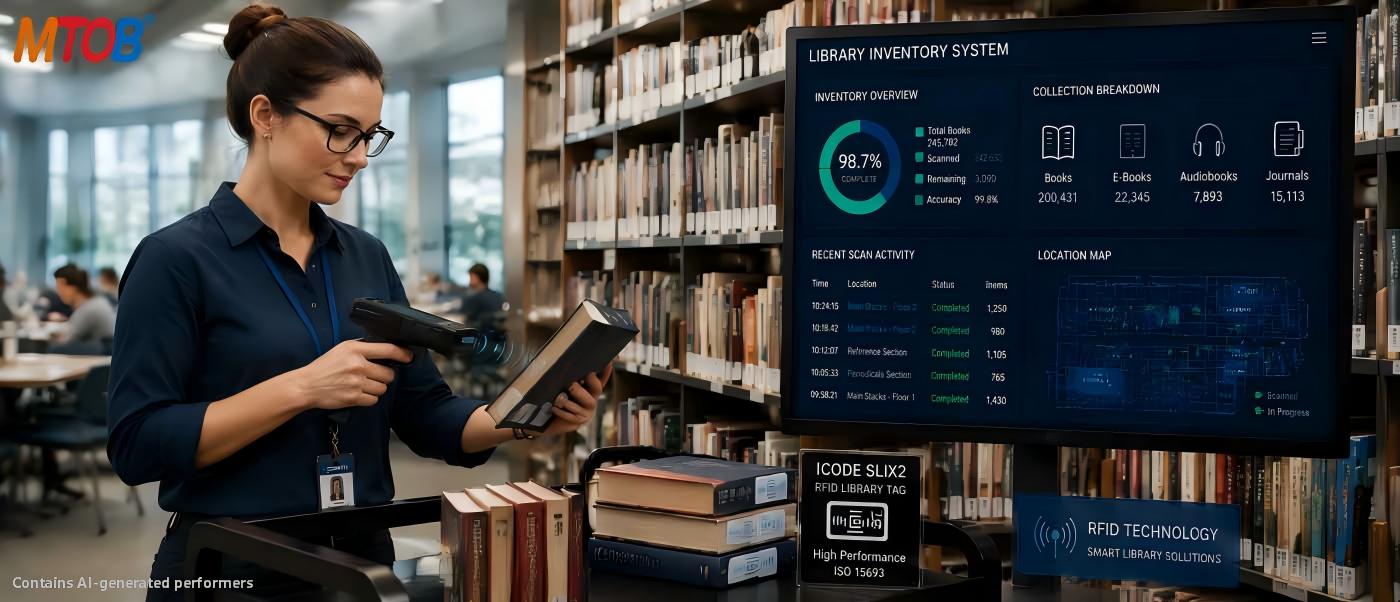
Libraries worldwide are rapidly modernizing their operations through RFID technology. As collections expand and staffing resources remain limited, libraries need more efficient methods for inventory management, self-checkout, anti-theft protection, and asset tracking.
Among the most widely used technologies are ICODE SLIX2 and various ISO 15693 Tags. While both belong to the HF RFID ecosystem, they offer different levels of performance, scalability, and operational benefits.
For librarians, system integrators, and educational institutions evaluating RFID solutions, understanding the differences between ICODE SLIX2 and standard ISO 15693 Tags is critical for maximizing return on investment and improving library efficiency.
Why Libraries Are Adopting RFID Technology
Traditional barcode systems have served libraries for decades, but they present several limitations.
Common challenges include:
-
Slow inventory counting
-
Manual book handling
-
Long checkout queues
-
Limited automation
-
Higher labor requirements
-
Inaccurate asset visibility
RFID technology addresses these issues by enabling contactless identification and bulk reading capabilities.
Modern RFID library systems support:
-
Self-service checkout
-
Automated returns
-
Shelf inventory scanning
-
Collection tracking
-
Security management
-
Resource optimization
As libraries transition toward smart library models, RFID infrastructure becomes a strategic investment rather than simply an operational upgrade.
Understanding ISO 15693 RFID Technology
ISO 15693 is an international standard for high-frequency RFID operating at 13.56 MHz.
The standard defines communication protocols for vicinity cards and RFID tags designed for longer reading distances than traditional NFC systems.
Key characteristics include:
-
Operating frequency: 13.56 MHz
-
Typical read range: up to 1 meter depending on system design
-
Anti-collision support
-
Multi-tag reading capability
-
International interoperability
Many RFID Library Tags are based on ISO 15693 because it offers a balance between performance, cost, and deployment flexibility.
However, ISO 15693 is a protocol standard rather than a specific chip technology.
This means performance varies significantly depending on the RFID chip selected.
What Is ICODE SLIX2?
ICODE SLIX2 is an advanced RFID chip developed by NXP Semiconductors based on the ISO 15693 standard.
It was specifically designed for applications requiring:
-
Longer read distances
-
Faster inventory scanning
-
Improved data integrity
-
Enhanced privacy protection
-
Large-scale asset management
Compared to many generic ISO 15693 Tags, ICODE SLIX2 provides additional features that improve operational efficiency in library environments.
For this reason, it has become one of the most widely adopted technologies in modern RFID library systems.
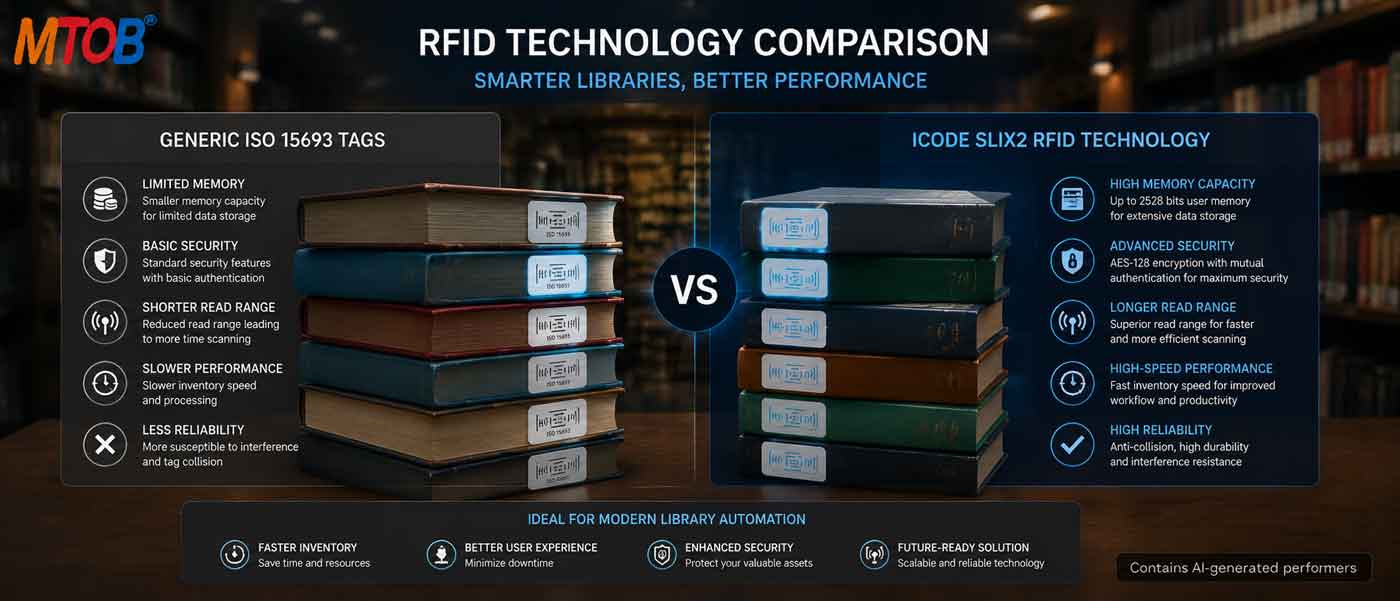
ICODE SLIX2 vs Standard ISO 15693 Tags
Although ICODE SLIX2 complies with ISO 15693, not all ISO 15693 Tags offer the same capabilities.
The comparison is therefore best understood as:
ICODE SLIX2 vs Basic ISO 15693 Implementations
Reading Distance
Basic ISO 15693 Tags
-
Moderate read range
-
Performance varies by chip manufacturer
ICODE SLIX2
-
Optimized sensitivity
-
Extended reading distance
-
Improved reader communication
Winner: ICODE SLIX2
For mobile inventory applications, longer reading distance translates directly into faster workflows.
Inventory Management Performance
Inventory audits consume substantial library resources.
Staff may need to scan:
-
Thousands of books
-
Periodicals
-
Archives
-
Educational materials
Standard ISO 15693 Tags
Inventory processes are effective but may require slower scanning speeds.
ICODE SLIX2
Enhanced anti-collision performance allows faster identification of multiple items simultaneously.
Benefits include:
-
Faster shelf scanning
-
Reduced labor costs
-
Improved collection visibility
-
More frequent audits
Winner: ICODE SLIX2
Anti-Collision Capabilities
Libraries rarely scan a single item at a time.
RFID systems often encounter dozens of tags simultaneously.
Why Anti-Collision Matters
Without effective anti-collision mechanisms:
-
Tags interfere with each other
-
Reading accuracy decreases
-
Processing speed slows
ICODE SLIX2 incorporates advanced anti-collision technologies that help readers identify multiple books efficiently.
This capability is especially valuable in:
-
High-density shelving
-
Returns processing stations
-
Automated sorting systems
Winner: ICODE SLIX2
Privacy and Security Features
Libraries increasingly prioritize patron privacy.
Modern RFID deployments must balance accessibility with data protection.
Standard ISO 15693 Tags
Basic implementations generally focus on identification functionality.
ICODE SLIX2
Additional security functions may include:
-
Privacy protection mechanisms
-
Data integrity support
-
Access controls
-
Enhanced system management features
These capabilities help institutions align with privacy and governance requirements.
Winner: ICODE SLIX2
Shelf Management Efficiency
Shelf management represents one of the most labor-intensive library activities.
Tasks include:
-
Locating misplaced books
-
Verifying inventory
-
Identifying missing items
-
Monitoring collection organization
ICODE SLIX2 improves these processes through:
-
Faster scanning
-
Better read reliability
-
Higher inventory accuracy
Staff can walk through aisles with handheld RFID readers and identify hundreds of books within minutes.
This dramatically reduces operational workload.
Self-Checkout and User Experience
Patrons increasingly expect self-service options.
RFID technology enables:
-
Faster borrowing
-
Automated returns
-
Reduced waiting times
Standard ISO 15693 Tags
Support self-service functionality effectively.
ICODE SLIX2
Improved reading reliability creates smoother user interactions.
Benefits include:
-
Fewer scanning errors
-
Faster transactions
-
Better patron satisfaction
Winner: ICODE SLIX2
Long-Term Cost Considerations
Cost is often a major factor in RFID projects.
At first glance, basic ISO 15693 Tags may appear less expensive.
However, long-term ROI depends on:
-
Labor savings
-
Inventory efficiency
-
System reliability
-
Asset visibility
-
User satisfaction
Many libraries find that the operational advantages of ICODE SLIX2 outweigh the slightly higher initial investment.
When evaluating total cost of ownership, performance often matters more than tag price alone.
Applications Beyond Traditional Libraries
ICODE SLIX2 is also widely used in:
Academic Libraries
Managing large university collections.
Public Libraries
Supporting self-service and inventory automation.
Corporate Knowledge Centers
Tracking technical documentation and research materials.
Archives
Managing valuable historical collections.
Media Libraries
Tracking multimedia assets and specialized collections.
These diverse applications demonstrate the flexibility of the technology.
Future Trends in RFID Library Systems
Library technology continues to evolve.
Emerging trends include:
AI-Assisted Collection Management
RFID data integrated with predictive analytics.
Smart Shelves
Real-time monitoring of book placement and availability.
Automated Robotics
RFID-enabled sorting and retrieval systems.
Digital Twin Libraries
Physical collections connected to digital management platforms.
Smart Campus Integration
Libraries connected with broader educational infrastructure.
ICODE SLIX2 provides a strong foundation for these future developments because of its scalability and performance characteristics.
How to Choose the Right RFID Library Tags
When selecting RFID Library Tags, decision makers should evaluate:
Collection Size
Larger collections benefit from advanced scanning capabilities.
Inventory Frequency
Frequent audits require efficient tag performance.
System Compatibility
Ensure compatibility with existing RFID infrastructure.
Budget Objectives
Evaluate both initial costs and long-term operational savings.
Future Expansion Plans
Choose technologies capable of supporting future growth.
For most modern libraries seeking long-term scalability, ICODE SLIX2 represents one of the strongest options available within the ISO 15693 ecosystem.
Why ICODE SLIX2 Is Becoming the Preferred Choice for Smart Libraries
As libraries pursue greater automation and operational efficiency, RFID technology continues to play a central role.
While standard ISO 15693 Tags provide reliable RFID functionality, ICODE SLIX2 offers significant advantages in:
-
Reading performance
-
Inventory speed
-
Anti-collision capability
-
User experience
-
Long-term scalability
For institutions investing in smart library infrastructure, ICODE SLIX2 delivers a future-ready platform that supports both current operational needs and emerging digital transformation initiatives.
FAQ
Is ICODE SLIX2 compatible with ISO 15693 readers?
Yes. ICODE SLIX2 is fully based on the ISO 15693 standard and is compatible with RFID systems designed for ISO 15693 communication protocols.
Why is ICODE SLIX2 popular in libraries?
ICODE SLIX2 offers excellent reading performance, strong anti-collision capabilities, and efficient inventory management features, making it ideal for large collections.
Can RFID Library Tags improve inventory accuracy?
Yes. RFID Library Tags allow rapid identification of books and assets, helping libraries maintain more accurate inventory records while reducing manual labor.
Does ICODE SLIX2 support self-checkout systems?
Yes. ICODE SLIX2 works effectively in self-checkout environments and can improve transaction speed and user convenience.
What is the main difference between ICODE SLIX2 and generic ISO 15693 Tags?
ICODE SLIX2 is a specific high-performance RFID chip implementation based on ISO 15693, while generic ISO 15693 Tags may offer varying performance depending on the chip and design used.

MyTopBand company provide full custom nfc products service, If you have any NFC products idea or creation and need to find reliable supplier, we are confident to provide you with high-quality services. Please find us: www.mytopband.com, or send message to info@mytopband.com, we will reply you within 24 hours.