
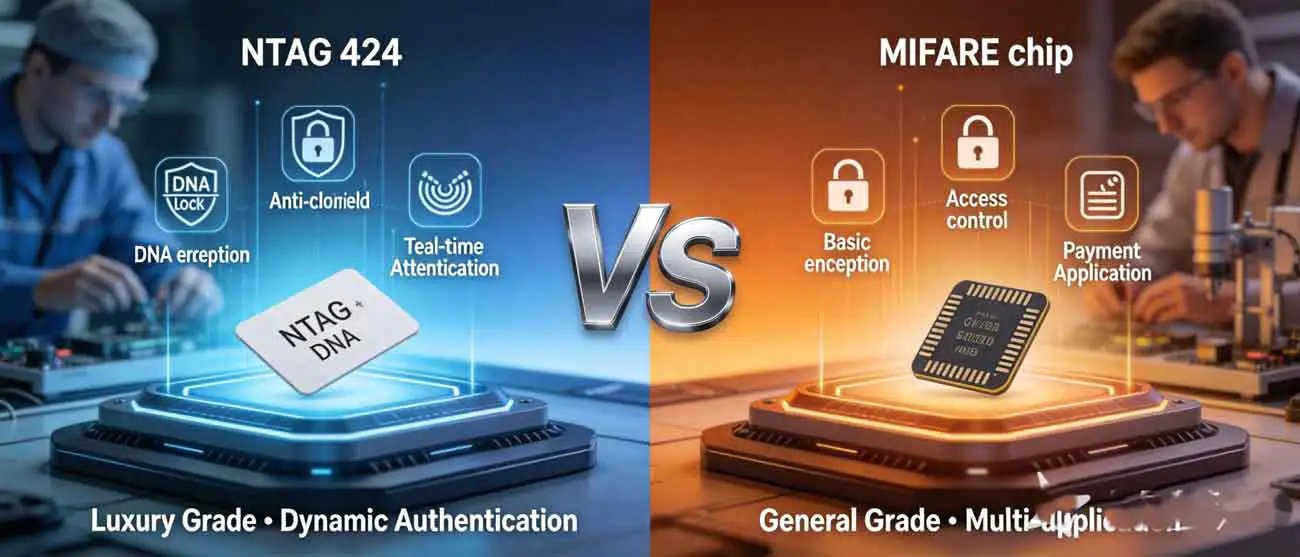
Core Anti-Counterfeiting Differences Between NTAG 424 DNA and MIFARE Chips
Encryption Level Differences Determine the Height of Luxury Anti-Counterfeiting Safety Barriers
In the field of global luxury anti-counterfeiting, encryption level is the core factor determining the safety barrier of anti-counterfeiting chips, and there are obvious differences in encryption capabilities between NTAG 424 DNA and MIFARE chips, which directly affect their anti-counterfeiting effectiveness in luxury applications. NTAG 424 DNA adopts advanced AES-256 encryption technology, which is currently one of the most secure encryption standards in the industry. This encryption technology can encrypt all data stored in the chip, including product information, traceability data, and anti-counterfeiting codes, making it extremely difficult for counterfeiters to crack or tamper with the data. The AES-256 encryption algorithm has a huge key space, and it would take an astronomical amount of time and computing resources to crack it through brute force, which effectively blocks the possibility of counterfeiting through data forgery. In contrast, most MIFARE chips adopt AES-128 encryption technology or even lower-level encryption methods. Although this encryption level can meet the basic anti-counterfeiting needs of general commodities, it is far from enough for luxury goods with high value and high counterfeiting risks. Counterfeiters can use professional equipment to crack the encryption of MIFARE chips in a short time, copy the data, and produce counterfeit luxury goods with fake chips, which seriously endangers the interests of luxury brands and consumers. For luxury brands that focus on brand reputation and anti-counterfeiting safety, the higher encryption level of NTAG 424 DNA provides a more reliable safety barrier, which can effectively resist various counterfeiting behaviors and protect the brand’s image and market share.
Differences in Anti-Cloning Capabilities Affect the Anti-Counterfeiting and Anti-Counterfeiting Effects of Chips
Anti-cloning capability is another key indicator to measure the anti-counterfeiting performance of luxury anti-counterfeiting chips, and the obvious gap between NTAG 424 DNA and MIFARE chips in this regard directly affects their practical application effects in luxury anti-counterfeiting. NTAG 424 DNA is equipped with a unique anti-cloning mechanism, which integrates a dedicated anti-cloning chip and a one-time programmable (OTP) memory. Each NTAG 424 DNA chip has a unique serial number that cannot be duplicated, and the data stored in the OTP memory can only be written once and cannot be modified or erased. This means that even if counterfeiters crack the encryption of the chip, they cannot copy the unique serial number and OTP data, making it impossible to produce identical counterfeit chips. In addition, NTAG 424 DNA also supports dynamic signature technology. Each time the chip is read, it will generate a unique dynamic signature, which changes randomly and cannot be predicted or copied, further enhancing the anti-cloning effect. On the other hand, MIFARE chips lack a perfect anti-cloning mechanism. Most MIFARE chips do not have a unique non-duplicable serial number, and their data can be easily copied by professional equipment. Counterfeiters only need to read the data of the original MIFARE chip and write it into a blank chip to produce a counterfeit chip with the same information, which greatly reduces the anti-counterfeiting effect. In the luxury market where counterfeiting is rampant, the strong anti-cloning capability of NTAG 424 DNA makes it more suitable for high-end luxury anti-counterfeiting needs, while MIFARE chips are more suitable for low-end luxury or auxiliary anti-counterfeiting scenarios.
Differences in Data Storage Capacity Adapt to Different Luxury Traceability Needs
Different luxury categories have different requirements for traceability data storage, and the differences in data storage capacity between NTAG 424 DNA and MIFARE chips make them suitable for different luxury traceability scenarios. NTAG 424 DNA has a large storage capacity of up to 8KB, which can store a large amount of detailed traceability data and anti-counterfeiting information. For luxury goods that require full-life-cycle traceability, such as high-end leather goods, watches, and jewelry, NTAG 424 DNA can store information such as production date, production process parameters, quality inspection results, logistics records, after-sales service records, and even the story and design concept of the product. This detailed data not only helps brands realize full-process traceability and quality control but also allows consumers to query the complete information of the product, enhancing consumer trust. In contrast, the storage capacity of MIFARE chips is relatively limited, usually between 1KB and 4KB, which can only store simple information such as product model, serial number, and basic anti-counterfeiting code. This storage capacity is difficult to meet the needs of high-end luxury goods for detailed traceability data. For example, high-end watches need to store detailed information such as movement parameters, assembly process, and maintenance records, which MIFARE chips cannot fully carry. Therefore, for luxury brands that pay attention to full-process traceability and information transparency, NTAG 424 DNA is a more suitable choice, while MIFARE chips can only be used in luxury categories with simple traceability needs, such as some low-end accessories.
Comparison of Core Anti-Counterfeiting Parameters Highlights the Differences in Application Adaptability Between the Two
The comparison of core anti-counterfeiting parameters between NTAG 424 DNA and MIFARE chips clearly reflects their differences in application adaptability, providing a clear basis for luxury brands to select anti-counterfeiting chips. In terms of encryption level, NTAG 424 DNA uses AES-256 encryption, while MIFARE chips mainly use AES-128 encryption, which makes NTAG 424 DNA have a higher safety factor. In terms of anti-cloning capability, NTAG 424 DNA has a unique anti-cloning mechanism and dynamic signature technology, which can effectively prevent chip cloning, while MIFARE chips lack effective anti-cloning measures and are easy to be copied. In terms of data storage capacity, NTAG 424 DNA has an 8KB large capacity, which can store detailed traceability data, while MIFARE chips have a limited storage capacity of 1KB-4KB, which can only store simple information. In addition, NTAG 424 DNA also has advantages in data transmission speed and compatibility. It supports fast data reading and writing, and is compatible with most mainstream mobile phones and reading devices, which is more convenient for brand management and consumer verification. MIFARE chips have relatively slow data transmission speed and poor compatibility with some new devices, which affects the user experience. These core parameter differences determine that NTAG 424 DNA is more suitable for high-end luxury brands with high anti-counterfeiting requirements and detailed traceability needs, while MIFARE chips are more suitable for low-end luxury brands or scenarios with basic anti-counterfeiting needs. Luxury brands can select the most suitable chip according to their own brand positioning and product characteristics.
Basis for Chip Adaptation in Different Luxury Categories
Chip Adaptation Logic and Application Points for Leather Goods
Leather goods are one of the core categories in the luxury market, with the characteristics of high value, long service life, and easy counterfeiting. The chip adaptation for leather goods needs to follow the logic of balancing anti-counterfeiting safety, durability, and aesthetics, and NTAG 424 DNA and MIFARE chips have different application points in this category. Leather goods are often used in daily life, and the chip needs to have good durability, be able to resist friction, moisture, and temperature changes, and not be easily damaged. NTAG 424 DNA has excellent physical durability, with a waterproof, dustproof, and wear-resistant design, which can adapt to the daily use environment of leather goods. At the same time, its large storage capacity can store detailed information such as the leather material, production process, and maintenance methods of the leather goods, which helps brands realize full-process traceability and provides consumers with professional maintenance guidance. In terms of installation, NTAG 424 DNA can be embedded in the inner layer of the leather goods, which does not affect the appearance and touch of the leather goods, ensuring the aesthetics of the product. For mid-to-low-end leather goods, MIFARE chips can also be used for auxiliary anti-counterfeiting. However, due to their poor anti-cloning capability and limited storage capacity, they can only provide basic anti-counterfeiting functions and cannot meet the high-end anti-counterfeiting needs of high-end leather goods. The application points of leather goods chip adaptation also include ensuring that the chip does not affect the breathability and softness of the leather, and the installation position is hidden to avoid being easily damaged or tampered with by counterfeiters. NTAG 424 DNA perfectly meets these requirements, making it the preferred chip for high-end leather goods brands.
Requirements for Miniaturization and Durability of Chips for Watch Categories
High-end watches are precision instruments with small internal space, complex structure, and high requirements for durability and stability. Therefore, the chip adaptation for watch categories focuses on miniaturization and durability, and NTAG 424 DNA has obvious advantages over MIFARE chips in this regard. Watches have limited internal space, especially the movement and case parts, which require the chip to be extremely small to avoid affecting the normal operation of the watch. NTAG 424 DNA adopts advanced miniaturization technology, with a size of only a few millimeters, which can be easily embedded in the watch case, movement, or strap without affecting the precision and appearance of the watch. In contrast, MIFARE chips are relatively large in size, and it is difficult to install them in small parts of the watch, which may affect the normal operation of the watch. In terms of durability, high-end watches need to work stably in various environments, including high temperature, low temperature, and vibration, which requires the chip to have strong environmental adaptability. NTAG 424 DNA has excellent high-temperature and low-temperature resistance, can work stably in the range of -40℃ to 85℃, and has strong anti-vibration performance, which can adapt to the wearing environment of watches. MIFARE chips have relatively poor environmental adaptability, and their performance may be affected in extreme environments, which is not suitable for high-end watches with high durability requirements. In addition, high-end watches need to store detailed traceability information such as movement parameters, assembly process, and maintenance records, which requires the chip to have a large storage capacity. NTAG 424 DNA’s 8KB storage capacity can fully meet these needs, while MIFARE chips’ limited storage capacity cannot carry detailed traceability data. Therefore, NTAG 424 DNA is more suitable for high-end watch categories, while MIFARE chips are rarely used in high-end watch anti-counterfeiting.
Adaptation Principles and Installation Methods for Chip Concealment in Jewelry Categories
Jewelry categories have high requirements for aesthetics and concealment, and the chip adaptation needs to follow the principle of not affecting the appearance and value of the jewelry, while ensuring the stability and anti-counterfeiting performance of the chip. NTAG 424 DNA, with its miniaturization and high concealment characteristics, is more in line with the adaptation requirements of jewelry categories. Jewelry is usually small in size and exquisite in design, and the chip needs to be installed in a hidden position to avoid affecting the overall aesthetics. NTAG 424 DNA’s ultra-small size allows it to be embedded in the setting of jewelry, such as the inner side of the ring, the back of the pendant, or the clasp of the necklace, which is not easy to be found and does not affect the appearance of the jewelry. In contrast, MIFARE chips are relatively large, and it is difficult to install them in a hidden position without affecting the appearance of the jewelry. In terms of installation methods, jewelry chips need to adopt non-destructive installation to avoid damaging the jewelry. NTAG 424 DNA can be fixed by laser welding or special adhesive, which does not damage the structure and material of the jewelry, ensuring the value of the jewelry. MIFARE chips are relatively heavy, and the installation may require drilling or other destructive methods, which will damage the jewelry and reduce its value. In addition, jewelry has high requirements for anti-counterfeiting safety, as counterfeit jewelry has a huge impact on brand reputation. NTAG 424 DNA’s high encryption level and strong anti-cloning capability can effectively prevent counterfeiting, while MIFARE chips’ poor anti-counterfeiting performance is difficult to meet the needs of jewelry anti-counterfeiting. The concealment adaptation principle of jewelry chips also requires that the chip does not affect the wearing comfort of the jewelry, and NTAG 424 DNA’s small size and light weight can perfectly meet this requirement.
Category Characteristics Determine the Selection Direction of the Two Chips
The characteristics of different luxury categories directly determine the selection direction of NTAG 424 DNA and MIFARE chips, and luxury brands need to select chips according to the unique characteristics of their own product categories to achieve the best anti-counterfeiting effect. High-end luxury categories with high value, complex production processes, and high anti-counterfeiting requirements, such as high-end leather goods, high-end watches, and high-end jewelry, are more suitable for selecting NTAG 424 DNA. These categories require chips to have high encryption level, strong anti-cloning capability, large storage capacity, and good durability and concealment, which are all advantages of NTAG 424 DNA. For example, high-end leather goods need detailed traceability data and durable chips, high-end watches need miniaturized and stable chips, and high-end jewelry needs hidden and non-destructive installed chips, all of which NTAG 424 DNA can fully meet. In contrast, mid-to-low-end luxury categories with low value, simple production processes, and basic anti-counterfeiting requirements, such as low-end accessories, simple leather goods, and ordinary jewelry, can choose MIFARE chips. These categories do not require too high anti-counterfeiting performance and detailed traceability data, and MIFARE chips’ basic anti-counterfeiting functions and low cost can meet their needs. In addition, some luxury brands may use a combination of the two chips, using NTAG 424 DNA for high-end product lines and MIFARE chips for mid-to-low-end product lines, to balance anti-counterfeiting effect and cost. In short, the selection direction of the two chips is closely related to the category characteristics, and only by selecting chips according to the category characteristics can luxury brands achieve the best anti-counterfeiting effect and cost control.
Analysis of Chip Preferences of European and American Luxury Brands
Chip Selection Tendency and Application Scenarios of Luxury Leather Goods Brands Such as LV
European and American luxury leather goods brands represented by LV have extremely high requirements for anti-counterfeiting, and their chip selection tendency is mainly to choose NTAG 424 DNA, which is closely related to their brand positioning and product characteristics. LV, as a world-renowned luxury leather goods brand, has a large number of counterfeit products in the market, which seriously affects the brand’s reputation and market share. Therefore, LV has high requirements for the anti-counterfeiting performance of chips, and NTAG 424 DNA’s high encryption level, strong anti-cloning capability, and large storage capacity perfectly meet LV’s anti-counterfeiting needs. LV embeds NTAG 424 DNA chips in the inner layer of its leather goods, such as handbags, wallets, and luggage, which are hidden and not easy to be found by counterfeiters. The chips store detailed information such as the production date, production workshop, leather material, and quality inspection results of the leather goods, which helps LV realize full-process traceability and quality control. In addition, LV also uses the dynamic signature technology of NTAG 424 DNA to generate a unique dynamic code for each product, which consumers can query through mobile phones to verify the authenticity of the product. This not only improves the anti-counterfeiting effect but also enhances the consumer experience. In terms of application scenarios, LV uses NTAG 424 DNA chips in all its high-end leather goods product lines, including classic monogram series, limited edition series, and custom series. For some mid-to-low-end accessory product lines, LV may use MIFARE chips as auxiliary anti-counterfeiting, but the core product lines still rely on NTAG 424 DNA to ensure anti-counterfeiting safety. The chip selection tendency of LV reflects the preference of high-end luxury leather goods brands for high-performance anti-counterfeiting chips.
Chip Preferences and Adaptation Reasons of High-End Watch Brands Such as Rolex
High-end watch brands such as Rolex, which focus on precision and quality, have a clear preference for NTAG 424 DNA chips, and their adaptation reasons are closely related to the characteristics of high-end watches and the performance advantages of NTAG 424 DNA. Rolex, as a leader in the high-end watch market, has extremely strict requirements for product precision, durability, and anti-counterfeiting. High-end watches have small internal space, complex structure, and require chips to be miniaturized, stable, and durable. NTAG 424 DNA’s ultra-small size allows it to be embedded in the movement or case of the watch without affecting the precision and operation of the watch. Its excellent high-temperature, low-temperature, and anti-vibration performance can adapt to the harsh wearing environment of watches, ensuring stable operation for a long time. In addition, Rolex needs to store detailed traceability information such as movement parameters, assembly process, maintenance records, and after-sales service information, and NTAG 424 DNA’s 8KB large storage capacity can fully carry this information, helping Rolex realize full-process traceability and quality control. The high encryption level and strong anti-cloning capability of NTAG 424 DNA can effectively prevent counterfeiters from copying the chip and producing counterfeit Rolex watches, which is crucial for protecting Rolex’s brand reputation and market share. In contrast, MIFARE chips are relatively large in size, poor in durability, and limited in storage capacity, which cannot meet the requirements of high-end watches such as Rolex. Therefore, Rolex has fully adopted NTAG 424 DNA chips in its product lines, and the chips have become an important part of Rolex’s anti-counterfeiting system. This preference also reflects the demand of high-end watch brands for high-performance, miniaturized, and durable anti-counterfeiting chips.
Chip Selection of European and American Luxury Brands Meets Their Own Brand Anti-Counterfeiting Needs
The chip selection of European and American luxury brands is not blind, but closely combined with their own brand positioning and anti-counterfeiting needs, and the choice between NTAG 424 DNA and MIFARE chips fully reflects this principle. European and American luxury brands have clear brand positioning, and high-end brands with high value and high reputation, such as LV, Rolex, Chanel, and Cartier, have extremely high requirements for anti-counterfeiting. They need chips to have high encryption level, strong anti-cloning capability, large storage capacity, and good adaptability to product characteristics, so NTAG 424 DNA has become their first choice. These brands regard anti-counterfeiting as an important part of brand protection, and the high performance of NTAG 424 DNA can effectively prevent counterfeiting, protect the brand’s reputation and market share, and enhance consumer trust. For mid-to-low-end European and American luxury brands or brand accessory product lines, which have relatively low anti-counterfeiting requirements and pay more attention to cost control, MIFARE chips are a more suitable choice. These brands do not need too detailed traceability data and high-level anti-counterfeiting performance, and MIFARE chips’ basic anti-counterfeiting functions and low cost can meet their needs. In addition, some European and American luxury brands will also formulate personalized chip application strategies according to their own product characteristics. For example, leather goods brands pay more attention to the durability and storage capacity of chips, watch brands pay more attention to the miniaturization and stability of chips, and jewelry brands pay more attention to the concealment and non-destructive installation of chips. NTAG 424 DNA can meet the personalized needs of different brands, while MIFARE chips are more suitable for simple anti-counterfeiting scenarios. It can be seen that the chip selection of European and American luxury brands is completely based on their own brand anti-counterfeiting needs, aiming to achieve the best balance between anti-counterfeiting effect and cost.
Comparison of Verification Convenience Between the Two Chips on the Consumer Side
Verification Method and Step Complexity of NTAG 424 DNA Chips
The verification convenience on the consumer side is an important factor affecting the consumer experience of luxury goods, and NTAG 424 DNA chips have obvious advantages in this regard, with simple verification methods and low step complexity. Consumers can verify the authenticity of luxury goods with NTAG 424 DNA chips through ordinary smart phones, without the need for professional equipment or complex operations. The specific verification steps are very simple: first, consumers only need to turn on the NFC function of their mobile phones, then attach the mobile phone to the position where the chip is installed on the luxury goods, and the mobile phone will automatically recognize the NTAG 424 DNA chip and pop up the verification page. On the verification page, consumers can view detailed product information, including production date, origin, quality inspection results, and other traceability data, and the page will also display the authenticity verification result in real time. The entire verification process takes only 2-3 seconds, which is fast and convenient. In addition, NTAG 424 DNA chips support multiple verification methods, including NFC verification, QR code verification (the chip can be linked with a QR code), and official app verification, which provides consumers with more choices. Consumers can choose the most convenient verification method according to their own habits. The simple verification steps and multiple verification methods of NTAG 424 DNA chips not only improve the consumer experience but also help consumers quickly distinguish the authenticity of luxury goods, avoiding the purchase of counterfeit products. Compared with traditional anti-counterfeiting methods, the verification convenience of NTAG 424 DNA chips has been greatly improved.
Whether MIFARE Chips Require a Dedicated APP and Operation Threshold
Compared with NTAG 424 DNA chips, MIFARE chips have higher operation thresholds on the consumer side, and most MIFARE chips require consumers to download and install a dedicated app to complete the verification, which affects the consumer experience. Unlike NTAG 424 DNA chips that can be directly verified through the mobile phone’s built-in NFC function, MIFARE chips have poor compatibility with mobile phone systems, and most mobile phones cannot directly recognize MIFARE chips. Therefore, consumers need to download the dedicated verification app provided by the luxury brand first, and then complete the verification through the app. The specific steps are: download and install the dedicated app, register and log in to the app, turn on the mobile phone’s NFC function, attach the mobile phone to the chip position, and the app will read the chip data and display the verification result. This process is more cumbersome than the verification of NTAG 424 DNA chips, and the operation threshold is higher. For consumers who are not familiar with smart phone operations, it may take a long time to complete the verification, which affects the consumer experience. In addition, some MIFARE chips have slow data transmission speed, and the verification process may be stuck or fail, further reducing the verification experience. Moreover, the dedicated app may occupy the mobile phone’s storage space, and some consumers may be reluctant to download the app for verification, which makes it difficult for MIFARE chips to play an effective anti-counterfeiting role on the consumer side. The high operation threshold of MIFARE chips is one of the important reasons why high-end luxury brands are reluctant to choose them.
Verification Convenience on the Consumer Side Affects Luxury Purchase Experience
The verification convenience on the consumer side has a direct impact on the luxury purchase experience, and even affects the consumer’s purchase decision. Luxury consumers pursue a high-quality and convenient shopping experience, and the complexity of the anti-counterfeiting verification process will directly affect their satisfaction with the brand. For consumers, the simple and fast verification method of NTAG 424 DNA chips can bring a good purchase experience. Consumers can quickly verify the authenticity of the product before and after purchase, which enhances their confidence in the purchase and avoids the worry of buying counterfeit products. This not only improves the consumer’s satisfaction with the brand but also enhances the brand’s reputation and loyalty. On the contrary, the cumbersome verification process of MIFARE chips will reduce the consumer’s purchase experience. Consumers may feel annoyed because they need to download a dedicated app and go through complex steps to complete the verification, and even give up purchasing the product because of the high operation threshold. In addition, the inconvenience of verification will also make it difficult for consumers to quickly distinguish the authenticity of the product, which may lead to consumers buying counterfeit products by mistake, causing economic losses and affecting the consumer’s trust in the brand. In the fierce luxury market competition, the consumer experience is an important factor for brands to gain competitive advantages. The verification convenience of NTAG 424 DNA chips helps luxury brands improve the consumer experience, attract more consumers, and enhance their market competitiveness.
Comparative Analysis of the Simplicity of the Verification Processes of the Two Chips
A comparative analysis of the verification processes of NTAG 424 DNA and MIFARE chips clearly shows that NTAG 424 DNA has a simpler verification process and lower operation threshold, which is more in line with the consumer’s demand for convenient verification. The verification process of NTAG 424 DNA chips is very simple: turn on the mobile phone’s NFC function, attach the mobile phone to the chip position, and the mobile phone will automatically pop up the verification page, and the verification result and product information can be viewed in real time. The entire process does not require downloading any apps, does not require registration and login, and takes only a few seconds to complete, which is very convenient for consumers. In contrast, the verification process of MIFARE chips is relatively cumbersome: first, consumers need to find and download the dedicated verification app of the brand, install the app, register and log in to the app, then turn on the mobile phone’s NFC function, attach the mobile phone to the chip position, and wait for the app to read the chip data and display the verification result. The entire process takes 1-2 minutes, and there may be problems such as app download failure, login difficulty, and slow data reading, which affect the verification efficiency. In addition, NTAG 424 DNA chips support multiple verification methods, consumers can choose the most convenient way according to their own habits, while MIFARE chips can only be verified through a dedicated app, which is relatively single. The simplicity of the verification process directly determines the consumer’s verification experience. NTAG 424 DNA chips with a simple verification process can better meet the consumer’s needs, while MIFARE chips with a cumbersome verification process are difficult to be favored by consumers and high-end luxury brands.
Chip Procurement Costs and Bulk Application Strategies of Brands
Differences in Procurement Costs Between NTAG 424 DNA and MIFARE Chips
There are obvious differences in procurement costs between NTAG 424 DNA and MIFARE chips, which is one of the important factors affecting the chip selection of luxury brands. Due to the advanced technology, high performance, and complex production process of NTAG 424 DNA chips, their procurement cost is relatively high. The unit price of NTAG 424 DNA chips is usually 30% to 50% higher than that of MIFARE chips. For example, the unit price of a common NTAG 424 DNA chip is about 1.5 to 2.0 US dollars, while the unit price of a MIFARE chip with similar basic functions is about 0.8 to 1.2 US dollars. The higher procurement cost of NTAG 424 DNA chips is mainly due to their advanced AES-256 encryption technology, anti-cloning mechanism, large storage capacity, and miniaturization design, which require higher research and development and production costs. In contrast, MIFARE chips have relatively simple technology, low performance requirements, and simple production processes, so their procurement cost is lower. However, it should be noted that although the procurement cost of NTAG 424 DNA chips is higher, it can provide higher anti-counterfeiting performance and better consumer experience, which can help luxury brands reduce the losses caused by counterfeiting and enhance brand value. For high-end luxury brands with high brand value and large sales volume, the higher procurement cost of NTAG 424 DNA chips is acceptable, as the return brought by anti-counterfeiting is far greater than the cost investment. For mid-to-low-end luxury brands with limited budgets, the lower procurement cost of MIFARE chips is more attractive, but they need to bear the risk of poor anti-counterfeiting effect.
Preferential Policies and Cost Control for Bulk Procurement of Chips by Luxury Brands
Bulk procurement is the main way for luxury brands to purchase anti-counterfeiting chips, and mastering the preferential policies for bulk procurement and cost control methods can help brands reduce procurement costs while ensuring anti-counterfeiting performance. Most chip manufacturers will provide preferential policies for bulk procurement of chips, and the preferential intensity is positively related to the procurement quantity. For example, when the procurement quantity of NTAG 424 DNA chips exceeds 100,000 pieces, manufacturers will usually give a 10% to 15% discount; when the procurement quantity exceeds 500,000 pieces, the discount can reach 20% to 25%. For MIFARE chips, the preferential intensity of bulk procurement is slightly lower, usually 5% to 10% discount when the procurement quantity exceeds 100,000 pieces. In addition, some manufacturers also provide additional preferential policies, such as free delivery, free after-sales service, and free sample testing, which can further reduce the procurement cost of luxury brands. In terms of cost control, luxury brands can take the following measures: first, conduct market research and compare the prices and quality of chips from different manufacturers, select manufacturers with high cost-effectiveness, and avoid purchasing high-priced and low-quality chips. Second, sign long-term cooperation agreements with chip manufacturers, which can not only obtain more favorable prices but also ensure the stability of chip quality and supply. Third, reasonably plan the procurement quantity according to the actual sales volume and production needs, avoid over-purchase leading to inventory backlog and capital occupation, and also avoid under-purchase affecting production and sales. Fourth, integrate the procurement needs of multiple product lines, concentrate on bulk procurement, and improve the procurement quantity to obtain higher preferential discounts. These measures can help luxury brands effectively control the procurement cost of chips.
Optimize Bulk Chip Application Schemes Combining Brand Positioning and Usage
Optimizing bulk chip application schemes by combining brand positioning and usage is the key for luxury brands to balance anti-counterfeiting effect and cost, and realize the rational use of chips. First, luxury brands need to clarify their own brand positioning and product structure. High-end luxury brands with high brand value and high anti-counterfeiting requirements should focus on using NTAG 424 DNA chips in their core product lines to ensure anti-counterfeiting safety, and can use MIFARE chips as auxiliary anti-counterfeiting in mid-to-low-end accessory product lines to control costs. For example, LV uses NTAG 424 DNA chips in its high-end handbag and luggage product lines, and uses MIFARE chips in its small accessory product lines such as key chains and card holders. Second, brands need to count the usage of chips in different product lines, including the quantity and frequency of chips required for each product, and formulate targeted bulk procurement plans. For product lines with large sales volume and high anti-counterfeiting requirements, they should purchase NTAG 424 DNA chips in large quantities to obtain higher preferential discounts; for product lines with small sales volume and low anti-counterfeiting requirements, they can purchase MIFARE chips in appropriate quantities to avoid cost waste. Third, brands need to consider the replacement cycle of chips and purchase an appropriate amount of spare chips according to the replacement cycle to avoid the shortage of chips affecting production and sales. Fourth, brands can cooperate with chip manufacturers to customize chips according to their own product characteristics, such as customizing the size, storage capacity, and encryption level of chips, avoiding unnecessary performance waste and further reducing costs. By combining brand positioning and usage to optimize the bulk chip application scheme, luxury brands can not only ensure the anti-counterfeiting effect of their products but also effectively control procurement costs, improving economic benefits and brand competitiveness.
Future Development Trends of Luxury Anti-Counterfeiting Chips
Low-Power Technology Becomes the Core Development Direction of Luxury Anti-Counterfeiting Chips
With the continuous development of luxury anti-counterfeiting technology and the increasing demand for consumer convenience, low-power technology has become the core development direction of luxury anti-counterfeiting chips, including NTAG 424 DNA and MIFARE chips. Luxury anti-counterfeiting chips need to work stably for a long time, and low-power technology can effectively extend the service life of the chips, reduce energy consumption, and improve the stability of the chips. At present, NTAG 424 DNA has adopted advanced low-power technology, which can work for several years without additional power supply, and its energy consumption is much lower than that of traditional chips. In the future, chip manufacturers will further optimize the low-power technology of NTAG 424 DNA, reducing energy consumption while improving performance, making it more suitable for long-term use in luxury goods. For MIFARE chips, which have relatively high energy consumption, manufacturers will also step up the research and development of low-power technology to improve their service life and stability. Low-power technology not only benefits the long-term use of chips but also reduces the impact of chips on the environment, which is in line with the global green development trend. In addition, low-power technology can also improve the data transmission efficiency of chips, making the verification process faster and more convenient for consumers. For luxury brands, the application of low-power chips can reduce the cost of chip replacement and improve the reliability of the anti-counterfeiting system. Therefore, low-power technology will become an important direction for the development of luxury anti-counterfeiting chips in the future.
Miniaturized Design Adapts to More Refined Luxury Scenarios
With the continuous refinement of luxury product design and the expansion of application scenarios, miniaturized design has become an important development trend of luxury anti-counterfeiting chips, and NTAG 424 DNA, which has the advantage of miniaturization, will be further optimized. In recent years, luxury products have become more and more refined, and some small-sized luxury goods, such as small jewelry, watch movements, and mini leather goods, have very limited space for chip installation, which requires chips to be more miniaturized. At present, NTAG 424 DNA has achieved a very small size, but in the future, chip manufacturers will further reduce the size of NTAG 424 DNA through advanced manufacturing technology, making it possible to install chips in more refined luxury scenarios. For example, chips can be embedded in the tiny setting of small jewelry, the core part of the watch movement, and even the fabric of luxury clothing, which does not affect the appearance and use of the product. MIFARE chips, which are relatively large in size, will also accelerate the pace of miniaturization research and development to adapt to more refined luxury scenarios. In addition, the miniaturized design of chips will also improve the concealment of chips, making it more difficult for counterfeiters to find and tamper with the chips, further enhancing the anti-counterfeiting effect. The miniaturized design of luxury anti-counterfeiting chips will not only adapt to more refined luxury scenarios but also promote the innovation of luxury product design, bringing more possibilities for the development of the luxury industry.
The Balance Between Anti-Counterfeiting and Convenience Drives the Continuous Upgrade of Chip Technology
In the future, the balance between anti-counterfeiting performance and verification convenience will become the core demand of luxury brands for anti-counterfeiting chips, which will drive the continuous upgrade of chip technology, including NTAG 424 DNA and MIFARE chips. Luxury brands not only require chips to have high encryption level, strong anti-cloning capability, and good durability to resist counterfeiting but also require chips to have simple verification methods and low operation thresholds to improve the consumer experience. At present, NTAG 424 DNA has achieved a good balance between anti-counterfeiting and convenience, but in the future, it will be further upgraded in terms of both. On the one hand, the encryption technology and anti-cloning mechanism of NTAG 424 DNA will be continuously optimized to resist more advanced counterfeiting technologies and further improve the anti-counterfeiting safety. On the other hand, the verification method of NTAG 424 DNA will be more convenient, such as supporting faster NFC reading, more verification methods, and better compatibility with various devices. For MIFARE chips, which have poor anti-counterfeiting performance and cumbersome verification methods, manufacturers will focus on improving their anti-counterfeiting performance while simplifying the verification process, such as upgrading encryption technology, adding anti-cloning mechanisms, and optimizing compatibility with mobile phones to reduce the operation threshold. In addition, the integration of chip technology with other technologies, such as Internet of Things, big data, and artificial intelligence, will also become a development trend. For example, chips can be connected to the brand’s cloud platform to realize real-time monitoring of products and intelligent anti-counterfeiting. The continuous upgrade of chip technology driven by the balance between anti-counterfeiting and convenience will provide more powerful support for the development of the luxury anti-counterfeiting industry, helping luxury brands better protect their brand value and meet consumer needs.
Why Choose Mytopband?
- Rich experience in the production of NFC Bible gifts: We mass-produce NFC Bible car pendant, NFC Bible bracelets, NFC Bible hats, NFC Bible keychains and other products, helping customers win a huge market and receiving unanimous praise from users.
- Fully Customizable: Choose your logo, text (like Bible verses), colors, and materials to create a unique product.
- Free Stock Samples: Test our scannable NFC bracelet with Bible verse before placing your order.
- Low MOQ as 500pcs: Perfect for startups and small businesses.

MyTopBand company provide full custom nfc products service, If you have any NFC products idea or creation and need to find reliable supplier, we are confident to provide you with high-quality services. Please find us: www.mytopband.com, or send message to info@mytopband.com, we will reply you within 24 hours.