
Core Technical Differences Between RFID Cards with ISO 14443A and ISO 15693 Protocols
Communication Distance Differences Adapt to Different Industrial Scenario Needs
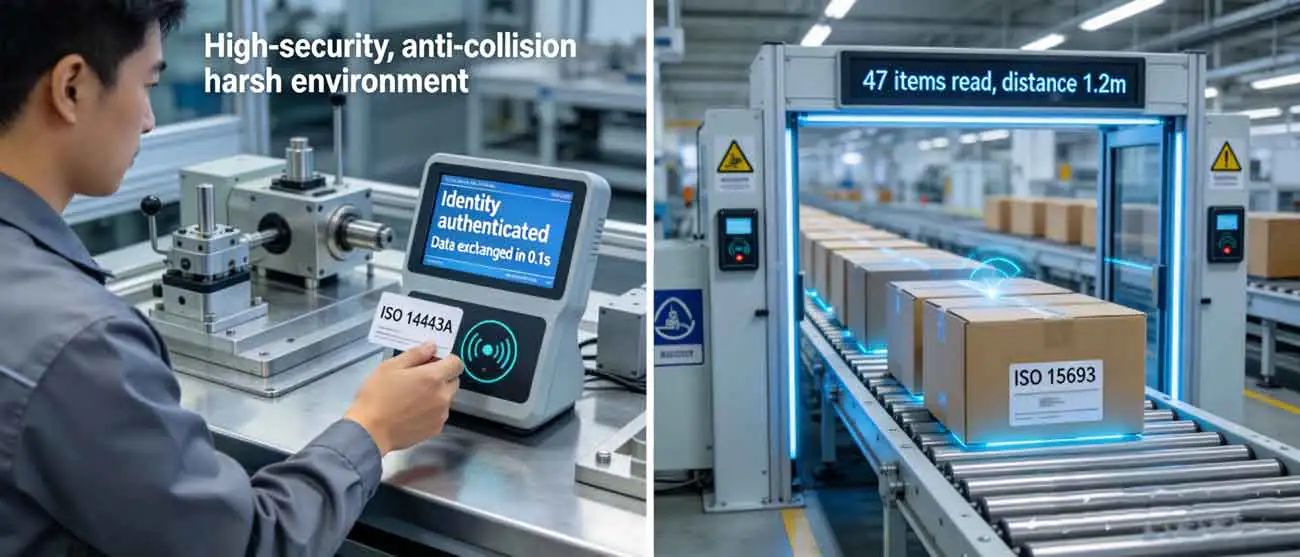
Communication distance is one of the core technical differences between RFID Cards with ISO 14443A and ISO 15693 protocols, and this difference directly determines their adaptation to different industrial scenarios. RFID Cards complying with the ISO 14443A protocol are typical near-field communication tags, with a communication distance usually limited to 0-10 centimeters. This short-distance communication feature is designed to meet the needs of industrial scenarios that require high-precision identification and anti-collision, such as product assembly line verification, small parts traceability, and access control management in industrial workshops. For example, in the electronic component assembly process, workers need to accurately identify each small electronic part attached with an ISO 14443A RFID Card to ensure that the correct parts are assembled into the product. The short communication distance of ISO 14443A RFID Cards can effectively avoid misreading adjacent parts, ensuring the accuracy of identification. In contrast, RFID Cards adopting the ISO 15693 protocol have a longer communication distance, usually ranging from 0.5 to 3 meters, and can even reach 5 meters under the support of high-performance readers. This long-distance communication advantage makes ISO 15693 RFID Cards more suitable for large-scale industrial scenarios, such as warehouse inventory management, large-scale equipment tracking, and cross-border logistics of bulk industrial products. For instance, in a large industrial warehouse storing hundreds of batches of raw materials, staff can use a handheld reader to scan multiple ISO 15693 RFID Cards from a distance, quickly completing inventory counting without approaching each batch of materials individually. The different communication distances of the two protocols make RFID Cards applicable to different industrial scenarios, providing targeted solutions for enterprises with different needs.
Different Data Rates Meet Different Industrial Transmission Efficiency Requirements
The data transmission rate is another key technical difference between ISO 14443A and ISO 15693 RFID Cards, which directly affects their adaptation to industrial transmission efficiency requirements. ISO 14443A RFID Cards adopt a high data transmission rate, usually up to 106 kbps, which can quickly transmit a large amount of data in a short time. This high-speed transmission feature is particularly suitable for industrial scenarios that require real-time transmission of detailed product information, such as high-precision manufacturing, electronic product testing, and industrial process monitoring. For example, in the automotive component testing process, each automotive component attached with an ISO 14443A RFID Card needs to transmit detailed testing data (such as performance parameters, testing time, and tester information) to the industrial control system in real time. The high data rate of ISO 14443A ensures that the testing data is transmitted quickly and accurately, avoiding delays in the testing process and improving production efficiency. On the other hand, ISO 15693 RFID Cards have a relatively lower data transmission rate, usually around 26.48 kbps, but they have better anti-interference performance during data transmission. This lower data rate is more suitable for industrial scenarios that do not require real-time transmission of large amounts of data but focus on stable and reliable data transmission, such as warehouse inventory management, raw material tracking, and cross-border transportation of industrial products. For example, in the cross-border transportation of bulk industrial raw materials, ISO 15693 RFID Cards only need to transmit basic information (such as material type, quantity, and origin) stably, and the lower data rate can reduce the impact of external interference, ensuring that the data is not lost or tampered with during transmission. The different data rates of the two protocols make RFID Cards able to meet the transmission efficiency requirements of different industrial scenarios, helping enterprises balance transmission speed and data stability.
Anti-Interference Performance Differences Adapt to Complex Industrial Environments
Industrial environments are often complex, with various interference factors such as electromagnetic radiation, metal materials, high temperature, and dust, and the anti-interference performance of RFID Cards directly affects their application effect in industrial scenarios. There are significant differences in anti-interference performance between ISO 14443A and ISO 15693 RFID Cards. ISO 14443A RFID Cards have relatively weak anti-interference performance, especially in environments with strong electromagnetic interference or a large number of metal materials. The near-field communication method of ISO 14443A makes it easily affected by surrounding metal objects and electromagnetic signals, leading to reduced reading accuracy or even failure to read. Therefore, ISO 14443A RFID Cards are more suitable for relatively clean and stable industrial environments, such as electronic component assembly workshops, clean rooms, and precision manufacturing workshops, where the interference factors are relatively few. In contrast, ISO 15693 RFID Cards are designed with stronger anti-interference performance, adopting advanced signal shielding technology and anti-metal design, which can effectively resist the interference of electromagnetic radiation and metal materials. Even in harsh industrial environments such as heavy industrial workshops, high-temperature production lines, and metal processing plants, ISO 15693 RFID Cards can still maintain stable reading performance. For example, in a steel processing factory with strong electromagnetic radiation and a large number of metal equipment, ISO 15693 RFID Cards attached to steel products can still be accurately read by readers, ensuring the smooth progress of product traceability. The different anti-interference performances of the two protocols make RFID Cards able to adapt to different complex industrial environments, providing reliable identification and traceability support for enterprises in different industries.
Differences in Core Technical Parameters Affect the Actual Industrial Application Effect
In addition to communication distance, data rate, and anti-interference performance, there are also differences in core technical parameters such as anti-collision performance, storage capacity, and working frequency between ISO 14443A and ISO 15693 RFID Cards, which further affect their actual application effects in industrial scenarios. In terms of anti-collision performance, ISO 14443A RFID Cards adopt a time-division multiple access (TDMA) anti-collision algorithm, which can effectively identify multiple tags at the same time, but the number of identifiable tags is relatively limited, usually up to dozens. This anti-collision performance is suitable for industrial scenarios with a small number of tags to be identified at the same time, such as product assembly line verification and small-batch parts traceability. ISO 15693 RFID Cards adopt a frequency-division multiple access (FDMA) anti-collision algorithm, which has a stronger anti-collision capability and can identify hundreds of tags at the same time, making it more suitable for large-scale industrial scenarios such as warehouse inventory management and bulk product tracking. In terms of storage capacity, ISO 14443A RFID Cards usually have a smaller storage capacity, ranging from 1K to 4K bits, which is suitable for storing simple product information such as product codes and production dates. ISO 15693 RFID Cards have a larger storage capacity, ranging from 4K to 64K bits, which can store more detailed product information such as traceability data, production process records, and quality inspection results. In terms of working frequency, both ISO 14443A and ISO 15693 RFID Cards work in the 13.56 MHz frequency band, but their frequency modulation methods and signal encoding formats are different, leading to differences in their compatibility with different readers and application stability. These differences in core technical parameters make ISO 14443A and ISO 15693 RFID Cards have different advantages in actual industrial applications, and enterprises need to select appropriate RFID Cards according to their specific application scenarios and needs.
Selection Basis of RFID Cards with Two Protocols in Industrial Scenarios
Protocol Selection Logic and Adaptation Points in Automotive Manufacturing Scenarios
Automotive manufacturing scenarios have complex production processes, diverse product types, and high requirements for traceability and identification accuracy, so the selection of RFID Cards with ISO 14443A and ISO 15693 protocols needs to follow a clear logic and focus on key adaptation points. The core selection logic is to match the protocol characteristics with the specific needs of each link in the automotive manufacturing process. In the automotive component assembly link, which requires high-precision identification and real-time data transmission, ISO 14443A RFID Cards are more suitable. This is because the short communication distance of ISO 14443A can avoid misreading adjacent components, ensuring that the correct components are assembled into the vehicle, and its high data rate can quickly transmit detailed component information (such as component model, production batch, and quality inspection results) to the assembly control system. For example, in the engine assembly process, each engine component attached with an ISO 14443A RFID Card can be accurately identified by the assembly line reader, and the component information is transmitted in real time to ensure that the assembly process is correct. In contrast, in the automotive component warehousing and transportation links, which require large-scale identification and long-distance reading, ISO 15693 RFID Cards are more suitable. The long communication distance and strong anti-collision performance of ISO 15693 allow staff to quickly scan a large number of components in the warehouse, improving inventory efficiency, and its strong anti-metal interference performance can adapt to the metal characteristics of automotive components. The key adaptation points include: matching the communication distance with the operation space of the scenario, matching the data rate with the real-time transmission requirements, matching the anti-interference performance with the environmental interference factors, and matching the storage capacity with the amount of information to be stored. By following this selection logic and focusing on these adaptation points, automotive manufacturing enterprises can select the most suitable RFID Cards for each link, improving production efficiency and traceability level.
Adaptation Principles and Application Scenarios of Protocols in Electronic Assembly Scenarios
Electronic assembly scenarios are characterized by small product size, high assembly precision, large batch production, and strict requirements for anti-static and anti-interference, so the selection of RFID Cards with ISO 14443A and ISO 15693 protocols needs to follow specific adaptation principles and target different application scenarios. The core adaptation principle is to prioritize precision, stability, and compatibility, ensuring that the RFID Cards can adapt to the small-size assembly environment and high-precision identification requirements. In the electronic component packaging and small-size component assembly links, ISO 14443A RFID Cards are the preferred choice. The small size of ISO 14443A RFID Cards can be easily attached to small electronic components (such as chips, resistors, and capacitors) without affecting the assembly process, and their short communication distance and high anti-collision performance can ensure the accurate identification of each small component. For example, in the mobile phone component assembly process, each small component attached with an ISO 14443A RFID Card can be accurately identified by the assembly line reader, ensuring that the correct components are assembled into the mobile phone. In the electronic component warehouse management and batch transportation links, ISO 15693 RFID Cards are more suitable. The long communication distance and large storage capacity of ISO 15693 allow staff to quickly scan a large number of electronic components in the warehouse, and store detailed information such as component specifications, production dates, and storage locations. In addition, ISO 15693 RFID Cards have better anti-static performance, which can adapt to the anti-static requirements of electronic assembly scenarios. The main application scenarios of ISO 14443A in electronic assembly include small component identification, assembly line verification, and product quality testing; the main application scenarios of ISO 15693 include warehouse inventory management, batch component transportation, and large-scale component traceability. By following the adaptation principles and combining with specific application scenarios, electronic assembly enterprises can select the most suitable RFID Cards, improving assembly efficiency and product quality.
Industrial Scenario Complexity Determines the Direction of Protocol Selection
The complexity of industrial scenarios is the core factor determining the selection direction of ISO 14443A and ISO 15693 RFID Cards, as the complexity directly affects the requirements for communication distance, data rate, anti-interference performance, and anti-collision performance of RFID Cards. Industrial scenarios can be divided into simple scenarios, general complex scenarios, and highly complex scenarios according to the level of complexity, and different complexity levels correspond to different protocol selection directions. Simple industrial scenarios are characterized by clean environment, few interference factors, small-scale identification, and low real-time transmission requirements, such as small-scale parts processing workshops and simple warehouse management. In such scenarios, ISO 14443A RFID Cards are more suitable, as their short communication distance and high precision can meet the basic identification needs, and their lower cost can help enterprises control expenses. General complex industrial scenarios are characterized by certain interference factors (such as a small number of metal objects and weak electromagnetic radiation), medium-scale identification, and moderate real-time transmission requirements, such as automotive component assembly workshops and electronic component manufacturing workshops. In such scenarios, enterprises need to choose according to specific link needs: ISO 14443A for high-precision assembly links and ISO 15693 for warehousing and transportation links. Highly complex industrial scenarios are characterized by harsh environment (such as strong electromagnetic radiation, high temperature, and a large number of metal objects), large-scale identification, and high stability requirements, such as heavy industrial workshops, steel processing plants, and large-scale logistics warehouses. In such scenarios, ISO 15693 RFID Cards are the preferred choice, as their strong anti-interference performance, long communication distance, and strong anti-collision performance can adapt to the harsh environment and large-scale identification needs. In addition, the complexity of the industrial scenario also affects the selection of RFID Card storage capacity and working stability: the more complex the scenario, the higher the requirements for storage capacity and working stability, and ISO 15693 RFID Cards have more advantages in this regard. Therefore, enterprises should first evaluate the complexity of their industrial scenarios, and then select the appropriate RFID Card protocol according to the evaluation results, ensuring that the RFID Cards can play a good role in the actual application process.
Analysis of Protocol Preferences of Industrial Enterprises in Different Regions
European Industrial Enterprises Prefer to Choose Protocols Adapted to Local Standards
European industrial enterprises have a long history of industrial development, mature industrial standards, and strict requirements for product quality and safety, so they prefer to choose RFID Cards with protocols adapted to local standards when selecting ISO 14443A and ISO 15693. Europe has formulated a series of strict industrial standards and norms for RFID technology, and these standards are closely integrated with the local industrial development characteristics and application needs. ISO 14443A and ISO 15693 are both international standards, but European industrial enterprises will make targeted selections based on local industry standards and application scenarios. For example, in the European automotive manufacturing industry, which has strict quality control and traceability requirements, many enterprises prefer to use ISO 14443A RFID Cards in the assembly link, as the high precision and high data rate of ISO 14443A can meet the local strict quality inspection standards. In the European logistics and warehousing industry, which focuses on efficiency and stability, enterprises prefer to use ISO 15693 RFID Cards, as their long communication distance and strong anti-interference performance can adapt to the large-scale logistics and warehousing needs in Europe. In addition, European industrial enterprises pay great attention to the compatibility between RFID Cards and local industrial equipment and systems, and the protocols they choose must be compatible with the existing equipment and systems to avoid the cost of system transformation. For example, most European electronic assembly enterprises use equipment compatible with ISO 14443A, so they tend to choose ISO 14443A RFID Cards to ensure the smooth operation of the production line. The preference of European industrial enterprises for protocols adapted to local standards is not only to meet the regulatory requirements but also to improve the efficiency and stability of industrial production.
North American Industrial Enterprises’ Protocol Selection is Consistent with Their Own Production Processes
North American industrial enterprises are known for their efficient production processes, advanced technological level, and emphasis on practical application effects, so their selection of ISO 14443A and ISO 15693 RFID Cards is closely consistent with their own production processes, focusing on improving production efficiency and reducing costs. North American industrial enterprises usually have standardized and efficient production processes, and the selection of RFID Card protocols is based on the specific needs of each link in the production process, rather than blindly pursuing international standards or local norms. For example, in the North American automotive manufacturing industry, which focuses on lean production and rapid assembly, enterprises will choose ISO 14443A RFID Cards in the high-precision assembly link to ensure the accuracy of assembly and improve production efficiency; in the warehousing and transportation link, which focuses on rapid turnover, enterprises will choose ISO 15693 RFID Cards to speed up inventory counting and logistics transportation. In the North American electronic manufacturing industry, which has large-scale production and high automation level, enterprises often choose ISO 15693 RFID Cards in the warehouse management link to adapt to the large-scale identification needs, and choose ISO 14443A RFID Cards in the product testing link to meet the high-precision testing requirements. In addition, North American industrial enterprises pay great attention to the cost-effectiveness of RFID Cards, and will select protocols according to the balance between production needs and cost. For example, if a production link does not require high-precision identification or long-distance reading, enterprises will choose ISO 14443A RFID Cards with lower cost; if a link requires large-scale identification and long-distance reading, enterprises will choose ISO 15693 RFID Cards even if the cost is slightly higher. The protocol selection of North American industrial enterprises fully reflects the characteristics of practicality and efficiency, which is closely integrated with their own production processes.
Regional Industrial Development Characteristics Affect Protocol Preference Selection
The industrial development characteristics of different regions are important factors affecting the protocol preference selection of industrial enterprises, as the industrial development level, industrial structure, and application needs of different regions are different, leading to differences in the demand for RFID Card protocols. In regions with a high level of industrial automation and advanced manufacturing technology (such as Western Europe and North America), industrial enterprises have higher requirements for the performance of RFID Cards, and their protocol selection is more diversified, choosing ISO 14443A or ISO 15693 according to specific application scenarios. For example, Western European countries have a high level of automotive and electronic manufacturing, and enterprises in these regions will choose ISO 14443A for high-precision links and ISO 15693 for large-scale management links. In regions with rapid industrial development and focus on large-scale production (such as Southeast Asia and China), industrial enterprises pay more attention to the efficiency and cost-effectiveness of RFID Cards, and tend to choose ISO 15693 RFID Cards in most scenarios. This is because ISO 15693 has a long communication distance and strong anti-collision performance, which can adapt to the large-scale production and management needs of these regions, and its cost is relatively reasonable, which can help enterprises control production costs. In regions with relatively backward industrial development and simple production processes (such as some African and South American countries), industrial enterprises have relatively low requirements for RFID Cards, and tend to choose ISO 14443A RFID Cards with lower cost and simpler operation, which can meet their basic identification and traceability needs. In addition, the industrial structure of the region also affects protocol selection: regions dominated by heavy industry tend to choose ISO 15693 with strong anti-interference performance, while regions dominated by light industry tend to choose ISO 14443A with higher precision. It can be seen that regional industrial development characteristics directly determine the protocol preference of industrial enterprises, and enterprises will select the most suitable RFID Card protocol according to the industrial development characteristics of their region.
Cost Comparison and Bulk Purchase Strategy of RFID Cards with Two Protocols
Cost Differences Between ISO 14443A and ISO 15693 Protocol RFID Cards
There are obvious cost differences between RFID Cards with ISO 14443A and ISO 15693 protocols, and these differences are mainly caused by differences in core chip technology, production process, and performance parameters, which directly affect the purchase decisions of industrial enterprises. In general, the cost of ISO 14443A RFID Cards is relatively lower, and the unit price is usually 10% to 20% lower than that of ISO 15693 RFID Cards. The main reason for the lower cost of ISO 14443A is that its core chip technology is relatively mature, the production process is simpler, and the performance parameters (such as storage capacity and anti-interference performance) are relatively basic, which reduces the production cost. For example, a common ISO 14443A RFID Card with 2K storage capacity has a unit price of about 0.5 to 0.8 US dollars, while an ISO 15693 RFID Card with the same storage capacity has a unit price of about 0.6 to 1.0 US dollars. The higher cost of ISO 15693 RFID Cards is due to their more advanced core chip technology, more complex production process, and stronger performance (such as long communication distance, strong anti-interference performance, and large storage capacity). In addition, the cost of ISO 15693 RFID Cards also includes the research and development cost of anti-metal design and signal shielding technology, which further increases the unit price. However, with the continuous development and popularization of RFID technology, the cost gap between the two protocols is gradually narrowing. For large-scale bulk purchases, the cost difference can be further reduced. Industrial enterprises need to comprehensively consider the cost and application needs when selecting, and not only pursue low cost but also ensure that the performance of RFID Cards can meet the actual application requirements.
Preferential Policies for Bulk Purchase and Cost Control Skills
Bulk purchase is the main way for industrial enterprises to purchase RFID Cards, and mastering preferential policies for bulk purchase and cost control skills can help enterprises reduce purchase costs and improve economic benefits. Most RFID Card manufacturers will provide preferential policies for bulk purchase, and the preferential intensity is usually positively related to the purchase quantity. For example, when the purchase quantity of RFID Cards exceeds 10,000 pieces, manufacturers will usually give a 5% to 10% discount; when the purchase quantity exceeds 100,000 pieces, the discount can reach 15% to 20%. In addition, some manufacturers also provide additional preferential policies, such as free delivery, free after-sales service, and free sample testing, which can further reduce the purchase cost of enterprises. In terms of cost control skills, industrial enterprises can take the following measures: first, conduct market research and compare the prices and quality of RFID Cards from different manufacturers, select manufacturers with high cost-effectiveness, and avoid purchasing high-priced and low-quality products. Second, sign long-term cooperation agreements with manufacturers, which can not only obtain more favorable prices but also ensure the stability of product quality and supply. Third, reasonably plan the purchase quantity according to the actual production needs, avoid over-purchase leading to inventory backlog and capital occupation, and also avoid under-purchase affecting production progress. Fourth, integrate the purchase needs of multiple departments or multiple production lines, concentrate on bulk purchase, and improve the purchase quantity to obtain higher preferential discounts. In addition, enterprises can also negotiate with manufacturers to customize RFID Cards according to their own application needs, avoiding unnecessary performance waste and further reducing costs. By mastering these preferential policies and cost control skills, industrial enterprises can effectively reduce the purchase cost of RFID Cards while ensuring the quality and supply stability.
Optimize Bulk Purchase Plans Combining Usage and Scenarios
Optimizing bulk purchase plans by combining usage and scenarios is the key to ensuring that industrial enterprises purchase suitable RFID Cards at the lowest cost, which requires enterprises to fully understand their own usage and application scenarios and formulate targeted purchase plans. First, enterprises need to count the usage of RFID Cards in different application scenarios, including the quantity, frequency, and performance requirements of RFID Cards required for each scenario. For example, if an enterprise needs 50,000 ISO 14443A RFID Cards for the assembly line and 30,000 ISO 15693 RFID Cards for the warehouse, it should purchase them separately according to the quantity and protocol to avoid mixing purchases and affecting the application effect. Second, enterprises need to analyze the application scenarios of RFID Cards, determine the performance requirements of RFID Cards in each scenario (such as communication distance, data rate, and storage capacity), and select the appropriate type of RFID Card to avoid purchasing high-performance and high-cost RFID Cards for scenarios with low requirements. For example, the warehouse management scenario only needs ISO 15693 RFID Cards with basic storage capacity and long communication distance, and there is no need to purchase high-capacity and high-anti-interference models, which can reduce costs. Third, enterprises need to consider the replacement cycle of RFID Cards, purchase an appropriate amount of spare RFID Cards according to the replacement cycle, to avoid the shortage of RFID Cards affecting production, and also avoid excessive spare inventory leading to capital occupation. Fourth, enterprises can cooperate with manufacturers to formulate a phased bulk purchase plan, purchase RFID Cards in batches according to the production progress, which can reduce the pressure of one-time capital investment and also adapt to the changes in production needs. By combining usage and scenarios to optimize the bulk purchase plan, industrial enterprises can not only ensure that the purchased RFID Cards are suitable for actual applications but also minimize the purchase cost, improving the economic benefits of the enterprise.
Selection Suggestions for Protocol-Compatiable Device Readers
Key Points for Selecting Readers Adapted to ISO 14443A Protocol
Selecting readers adapted to the ISO 14443A protocol is crucial to ensuring the normal operation of ISO 14443A RFID Cards in industrial scenarios, and the selection needs to focus on key points such as reading performance, compatibility, stability, and industrial adaptability. First, in terms of reading performance, the reader should have high reading accuracy and fast reading speed, which can adapt to the high-precision and real-time identification needs of ISO 14443A RFID Cards. The reading distance of the reader should be matched with the communication distance of ISO 14443A (0-10 centimeters), ensuring that the RFID Card can be accurately read within the effective distance. In addition, the reader should have strong anti-collision performance, which can accurately identify multiple ISO 14443A RFID Cards at the same time, avoiding misreading or missing reading. Second, in terms of compatibility, the reader should be fully compatible with the ISO 14443A protocol, and can communicate smoothly with various ISO 14443A RFID Cards from different manufacturers, avoiding compatibility problems. At the same time, the reader should be compatible with the enterprise’s existing industrial control system and data management system, ensuring that the read data can be transmitted to the system in real time. Third, in terms of stability, the reader should have industrial-grade stability, which can work stably for a long time in industrial environments with certain interference factors, avoiding frequent failures affecting production. The reader should be equipped with a reliable heat dissipation system and anti-interference design, which can resist the impact of electromagnetic radiation and temperature changes. Fourth, in terms of industrial adaptability, the reader should have a compact design, which can be easily installed in narrow industrial spaces (such as assembly lines and small workshops). At the same time, the reader should have good dust-proof, waterproof, and anti-vibration performance, adapting to the complex industrial environment. By focusing on these key points, industrial enterprises can select readers suitable for ISO 14443A RFID Cards, ensuring the smooth progress of identification and traceability work.
Performance Requirements for Readers Adapted to ISO 15693 Protocol
Readers adapted to the ISO 15693 protocol need to meet higher performance requirements to match the long communication distance, strong anti-interference performance, and large-scale identification characteristics of ISO 15693 RFID Cards, and the selection should focus on performance indicators such as reading distance, anti-interference ability, anti-collision performance, and data transmission stability. First, in terms of reading distance, the reader should have a long reading distance, which can reach 3-5 meters, matching the communication distance of ISO 15693 RFID Cards, ensuring that staff can read the RFID Card from a distance, improving work efficiency. The reader should also have adjustable reading distance, which can be adjusted according to the actual application scenario, avoiding the impact of excessive reading distance on identification accuracy. Second, in terms of anti-interference ability, the reader should have strong anti-electromagnetic interference and anti-metal interference ability, which can work stably in harsh industrial environments such as heavy industrial workshops and metal processing plants, ensuring that the reading performance is not affected by surrounding interference factors. The reader should adopt advanced signal filtering technology and shielding design, reducing the impact of external interference on data transmission. Third, in terms of anti-collision performance, the reader should have strong anti-collision capability, which can identify hundreds of ISO 15693 RFID Cards at the same time, adapting to large-scale identification scenarios such as warehouse inventory management. The reader should adopt an efficient anti-collision algorithm, reducing the time required for identification and improving work efficiency. Fourth, in terms of data transmission stability, the reader should have a stable data transmission interface (such as RS232, Ethernet, etc.), which can transmit the read data to the enterprise’s data management system in real time, ensuring the accuracy and timeliness of data. In addition, the reader should have industrial-grade durability, with dust-proof, waterproof, high-temperature resistant, and vibration-resistant performance, adapting to the complex industrial environment. Meeting these performance requirements can ensure that the reader can fully play the role of ISO 15693 RFID Cards, improving the efficiency of industrial management.
Installation and Usage Notes for Readers in Industrial Scenarios
The correct installation and usage of readers in industrial scenarios are crucial to ensuring the stable operation of RFID Cards and improving the efficiency of identification and traceability, and there are important notes that need to be followed in both installation and usage. In terms of installation, first, the installation location of the reader should be selected according to the application scenario, ensuring that the reading distance of the reader matches the position of the RFID Card. For example, in the assembly line scenario, the reader should be installed near the assembly position, ensuring that the ISO 14443A RFID Card on the component can be accurately read; in the warehouse scenario, the reader should be installed at a height and position that can cover the entire warehouse area, ensuring that the ISO 15693 RFID Card on the goods can be read from a distance. Second, the reader should be installed away from strong interference sources (such as high-voltage lines, large metal equipment, and electromagnetic generators), avoiding the interference of these sources on the reader’s reading performance. Third, the installation should be firm and stable, especially in scenarios with vibration (such as production lines and workshops), to avoid the reader falling or shifting due to vibration, affecting the reading effect. Fourth, the wiring of the reader should be standardized, ensuring that the power supply and data transmission lines are connected correctly, avoiding short circuits or poor contact. In terms of usage, first, the reader should be calibrated regularly to ensure that its reading accuracy and reading distance meet the requirements, and timely adjust the parameters if there is any deviation. Second, the reader should be maintained regularly, including cleaning the surface dust, checking the wiring, and testing the performance, to avoid failures caused by dust accumulation or wiring problems. Third, the staff should be trained to master the correct operation method of the reader, avoiding misoperation leading to damage to the reader or inaccurate reading. Fourth, in case of reader failure, it should be shut down in time for maintenance, and spare readers should be prepared to avoid affecting the normal production progress. Following these installation and usage notes can ensure the stable operation of the reader, extend its service life, and improve the efficiency of RFID Card identification and traceability.
Future Integration and Development Trends of the Two Protocols in Industrial Internet of Things
New Requirements for RFID Protocol Compatibility in Industrial Internet of Things
With the rapid development of the Industrial Internet of Things (IIoT), the application of RFID technology in industrial scenarios is becoming more and more extensive, and new requirements for the compatibility of RFID protocols (ISO 14443A and ISO 15693) have been put forward. The Industrial Internet of Things emphasizes the interconnection and intercommunication of all devices and systems, realizing the integration and sharing of data throughout the industrial chain. Therefore, the compatibility of RFID protocols is no longer limited to the compatibility between RFID Cards and readers, but also requires the compatibility between RFID protocols and various industrial Internet of Things devices, systems, and platforms. First, the RFID protocol needs to be compatible with various industrial sensors and control devices, ensuring that the data collected by the RFID Card can be integrated with the data of other sensors, providing comprehensive data support for industrial intelligent management. For example, the data of ISO 14443A RFID Cards in the assembly line can be integrated with the data of temperature sensors and pressure sensors, realizing the real-time monitoring of the assembly process. Second, the RFID protocol needs to be compatible with cloud computing and big data platforms, ensuring that the large amount of data collected by RFID Cards can be uploaded to the cloud platform for storage, analysis, and mining, providing data support for enterprise decision-making. Third, the RFID protocol needs to have good scalability, which can adapt to the continuous upgrading and iteration of the Industrial Internet of Things technology, and support the integration of new application scenarios and new functions. Fourth, the RFID protocol needs to ensure the security of data transmission and storage, preventing data leakage and tampering in the Industrial Internet of Things environment, which is crucial for industrial production safety and enterprise trade secrets. These new requirements for protocol compatibility are promoting the continuous development and improvement of ISO 14443A and ISO 15693 protocols, making them more suitable for the development needs of the Industrial Internet of Things.
Integration Application Directions of ISO 14443A and ISO 15693 Protocols
In the future, the integration and application of ISO 14443A and ISO 15693 protocols will become an important development trend in the Industrial Internet of Things, and the two protocols will complement each other’s advantages to meet the diverse needs of industrial scenarios. The main integration application directions include the following aspects: first, the integration of the two protocols in the full industrial chain. In the industrial production process, different links have different requirements for RFID Cards: the high-precision assembly link uses ISO 14443A RFID Cards, and the large-scale warehousing and transportation link uses ISO 15693 RFID Cards. The integration of the two protocols can realize the seamless connection of data between different links, forming a complete traceability chain from production to sales. For example, the data of ISO 14443A RFID Cards in the assembly link can be integrated with the data of ISO 15693 RFID Cards in the warehousing link, realizing the full-process traceability of products. Second, the development of dual-protocol RFID Cards. Manufacturers will develop RFID Cards that support both ISO 14443A and ISO 15693 protocols, which can switch protocols according to different application scenarios, improving the flexibility and applicability of RFID Cards. For example, a dual-protocol RFID Card can use the ISO 14443A protocol in the assembly line for high-precision identification, and use the ISO 15693 protocol in the warehouse for long-distance reading, avoiding the need to replace RFID Cards for different scenarios. Third, the integration of the two protocols in the intelligent management system. The industrial intelligent management system will integrate the reading data of ISO 14443A and ISO 15693 RFID Cards, realizing unified management and analysis of data, improving the efficiency of intelligent management. For example, the system can automatically identify the protocol type of the RFID Card, read and process the data, and provide targeted management suggestions for enterprises. The integration application of the two protocols will make RFID technology play a more important role in the Industrial Internet of Things, promoting the transformation and upgrading of industrial production.
The Promoting Role of Protocol Integration in Industrial Intelligent Management
The integration of ISO 14443A and ISO 15693 protocols will play an important promoting role in industrial intelligent management, helping enterprises improve management efficiency, reduce costs, and enhance market competitiveness. First, protocol integration can realize the full-process data connection of the industrial chain, providing comprehensive and accurate data support for industrial intelligent management. The data collected by ISO 14443A and ISO 15693 RFID Cards in different links can be integrated into the intelligent management system, allowing enterprises to grasp the production, warehousing, transportation, and other links in real time, and make scientific decisions based on the data. For example, enterprises can adjust the production plan according to the inventory data of ISO 15693 RFID Cards and the assembly data of ISO 14443A RFID Cards, avoiding overproduction or underproduction. Second, protocol integration can improve the flexibility and adaptability of industrial management, allowing enterprises to quickly respond to changes in market demand. The dual-protocol RFID Cards and integrated management system can adapt to different application scenarios and production needs, reducing the cost of system transformation and equipment replacement. For example, when the production process changes, enterprises can switch the protocol of RFID Cards without replacing the entire RFID system, improving the flexibility of management. Third, protocol integration can promote the automation and intelligence of industrial production, reducing manual intervention and improving production efficiency. The integrated data of the two protocols can be used to realize the automatic control of the production line, the automatic inventory of the warehouse, and the automatic tracking of logistics, reducing the labor cost and error rate. Fourth, protocol integration can enhance the traceability and quality control level of industrial products, helping enterprises improve product quality and meet the regulatory requirements of various countries. The full-process traceability data formed by the integration of the two protocols can quickly locate quality problems and recall defective products, reducing economic losses and brand damage. In conclusion, the integration of ISO 14443A and ISO 15693 protocols will strongly promote the development of industrial intelligent management, helping enterprises achieve high-quality development in the Industrial Internet of Things era.
Why Choose Mytopband?
- Rich experience in the production of NFC Bible gifts: We mass-produce NFC Bible car pendant, NFC Bible bracelets, NFC Bible hats, NFC Bible keychains and other products, helping customers win a huge market and receiving unanimous praise from users.
- Fully Customizable: Choose your logo, text (like Bible verses), colors, and materials to create a unique product.
- Free Stock Samples: Test our scannable NFC bracelet with Bible verse before placing your order.
- Low MOQ as 500pcs: Perfect for startups and small businesses.

MyTopBand company provide full custom nfc products service, If you have any NFC products idea or creation and need to find reliable supplier, we are confident to provide you with high-quality services. Please find us: www.mytopband.com, or send message to info@mytopband.com, we will reply you within 24 hours.