
Reputation Management Pain Points of European and American Chain Gas Stations
Difficulties in Collecting Car Owners’ Reviews, Making It Hard to Grasp Real Service Feedback
In the highly competitive European and American retail gas station industry, understanding real customer needs and service feedback is the key to optimizing operations and improving reputation, but most chain gas stations are facing the pain point of difficult collection of car owners’ reviews. At present, most gas stations rely on traditional customer feedback methods, such as paper comment forms, customer service hotlines, and online review platforms that require manual search. These methods have obvious limitations: paper comment forms are easily ignored by car owners who are in a hurry to leave after refueling, and the recovery rate is usually less than 15%; customer service hotlines require car owners to spend extra time making calls, which is inefficient and has a low initiative to feedback; online review platforms are scattered, and gas station managers need to spend a lot of time sorting out reviews from multiple platforms, and many car owners are unwilling to take the initiative to leave reviews unless they have extreme positive or negative experiences. As a result, gas station managers can only obtain a small amount of one-sided feedback, which cannot fully reflect the real service level and customer experience. Google Review Tags can effectively solve this pain point by providing a convenient and fast review channel. Car owners only need to scan the tag with their mobile phones after refueling to quickly leave their evaluations, which not only improves the review collection rate but also ensures the authenticity and comprehensiveness of the feedback, helping gas stations grasp the real service situation and lay a foundation for reputation improvement. In addition, Google Review Tags can automatically sort and classify reviews, making customer feedback management more efficient and reducing the workload of managers.
Delayed Response to Negative Feedback Affects Customer Experience and Brand Reputation
Negative feedback is an inevitable part of gas station operation, but the delayed response to negative feedback has become a major pain point that seriously affects customer experience and brand reputation of European and American chain gas stations. Many gas stations lack a systematic customer feedback management mechanism, and the time for managers to discover negative reviews is often delayed by 24 to 48 hours. During this period, negative reviews may be seen by more potential customers, and the negative impact continues to expand; at the same time, the car owners who left negative feedback cannot get timely responses and solutions, which further aggravates their dissatisfaction, and even leads to customer churn and spread of negative word-of-mouth. For example, a car owner may leave a negative review about “long waiting time for refueling” on Google, but if the gas station does not respond in time, other potential car owners who see the review may choose other nearby gas stations, resulting in the loss of customers. In addition, delayed response to negative feedback also makes car owners feel that their opinions are not valued, which seriously affects their sense of identity and trust in the brand. Google Review Tags can effectively solve this problem by enabling real-time notification of reviews. Once a car owner leaves a negative review, the gas station management team can receive a timely reminder and quickly respond to the customer’s needs, explain the problem and put forward solutions, which not only can appease the dissatisfied customer and reduce customer churn but also can show other potential customers the gas station’s positive attitude towards feedback, thereby reducing the negative impact on brand reputation.
Inadequate Reputation Management Leads to Continuous Decline in Customer Repurchase Rate
Inadequate reputation management is another core pain point of European and American chain gas stations, which directly leads to a continuous decline in customer repurchase rate and affects the long-term development of the brand. Many gas stations pay more attention to short-term sales performance and ignore the importance of reputation management, failing to effectively collect, analyze and use customer feedback, and also failing to take targeted measures to improve service quality based on feedback. As a result, the service level of the gas station remains stagnant, and customer satisfaction continues to decline, leading to a gradual loss of regular customers. According to a survey by the American Petroleum Institute, gas stations with poor reputation management have an average customer repurchase rate of less than 40%, while those with perfect reputation management have a repurchase rate of more than 70%. For example, some gas stations have long-term problems such as dirty convenience stores, unfriendly staff, and inaccurate fuel metering, but they do not take improvement measures because they do not pay attention to customer feedback, resulting in more and more customers choosing other gas stations. In addition, inadequate reputation management also makes it difficult for gas stations to form a good brand image. In the era of information transparency, customers are more willing to choose gas stations with good online reviews and high reputation. Google Review Tags can help gas stations strengthen reputation management by providing a convenient feedback channel and real-time review data, enabling gas stations to timely find their own problems, optimize service quality, enhance customer satisfaction and loyalty, and thus improve the customer repurchase rate.
Lack of Effective Data Support for Service Optimization, Making It Difficult to Focus on Key Points
Service optimization is the core of improving gas station retail reputation, but many European and American chain gas stations lack effective data support for service optimization, making it difficult to focus on key points and achieve precise improvement. At present, most gas stations rely on subjective experience to carry out service optimization, rather than based on scientific data analysis. For example, some gas station managers may feel that the waiting time for refueling is a problem and blindly add refueling guns, but in fact, the real pain point of customers is the slow speed of cashiers; some gas stations invest a lot of money in upgrading convenience store facilities, but customers are more concerned about the variety and price of commodities. This kind of blind optimization not only wastes a lot of resources but also cannot effectively solve customer pain points, resulting in poor optimization results. The root cause of this problem is the lack of effective data support. Google Review Tags can provide gas stations with rich and accurate customer feedback data, including customer evaluations of refueling service, convenience store service, car washing service, and other aspects. These data can be sorted and analyzed to help gas station managers clearly understand the key pain points of customers, identify the weak links of service, and thus carry out targeted service optimization. For example, through the analysis of review data, if it is found that most customers complain about the insufficient variety of convenience store snacks, the gas station can adjust the commodity category in a targeted manner; if customers reflect that the car washing service is slow, the gas station can optimize the car washing process and increase staff, so as to achieve precise optimization and improve service quality efficiently. Customer feedback management based on data can help gas stations avoid blind investment and improve the efficiency of service optimization.
Gas Station-Specific Adaptive Design of Google Review Tags
Oil-Proof and Waterproof Design Adapts to the Complex Use Environment of Gas Stations
Gas stations have a complex use environment, with a lot of oil fumes, oil stains, and possible rain and water splashes, so the oil-proof and waterproof design of Google Review Tags is essential to ensure their normal use. Google Review Tags for gas stations adopt a professional oil-proof and waterproof structure design, using high-quality waterproof and oil-resistant materials, such as sealed PVC and waterproof adhesive, which can effectively prevent oil stains and water from entering the tag interior, avoiding damage to the chip and affecting the scanning function. The surface of the tag is treated with a special oil-resistant coating, which can easily wipe off oil stains and keep the tag clean and clear, ensuring that car owners can scan it smoothly even if the tag is stained with oil. In addition, the tag also has good high-temperature resistance and low-temperature resistance, which can adapt to the extreme temperature environment of gas stations in different regions, whether it is the high temperature of 35℃ or above in summer in Europe and America, or the low temperature of -10℃ or below in winter, it can maintain stable performance. For example, in rainy days, the tag will not be short-circuited due to water immersion, and car owners can still scan it to leave reviews; when the tag is stained with gasoline or diesel, it can be wiped clean with a cloth, and the scanning function will not be affected. The oil-proof and waterproof design of Google Review Tags fully adapts to the complex use environment of gas stations, ensuring the long-term stable use of the tags and providing a reliable guarantee for the smooth collection of customer reviews.
Placed at the Cashier Counter for Car Owners to Scan Quickly After Refueling
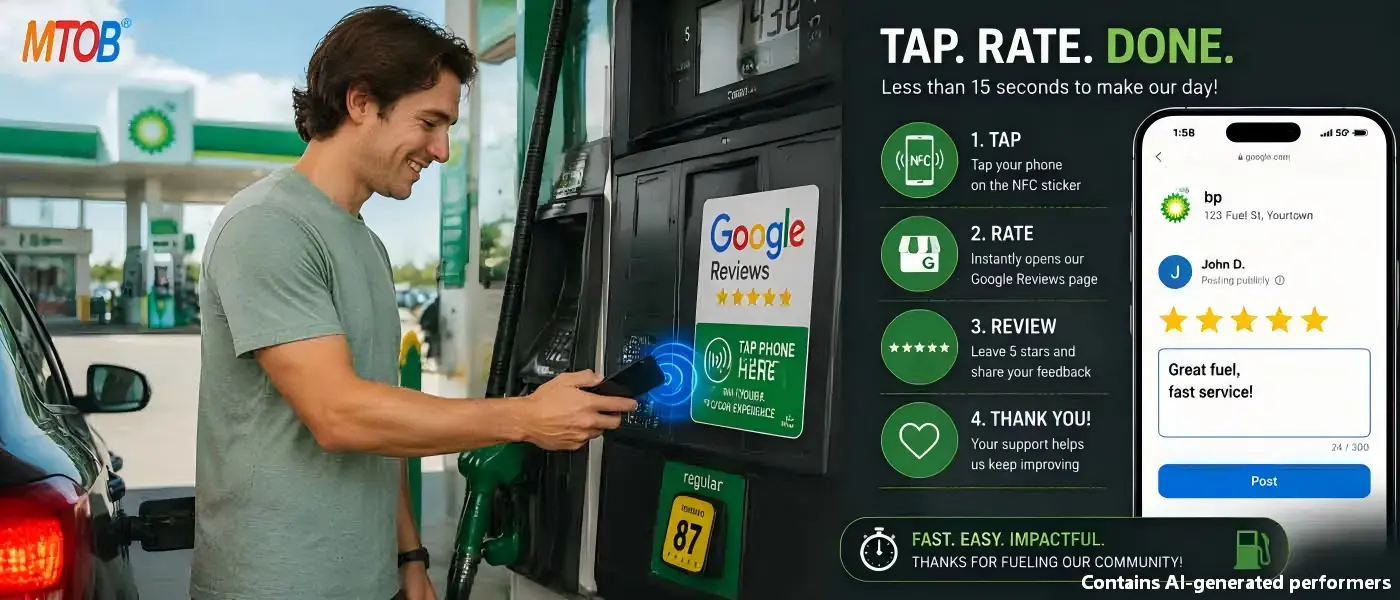
The placement position of Google Review Tags directly affects the scanning rate of car owners, so placing them at the cashier counter is a key design that fits the gas station’s business process and facilitates car owners to scan quickly after refueling. Car owners usually need to go to the cashier counter to pay after refueling, which is the last link of their stay at the gas station and the most convenient time to scan and leave reviews. Google Review Tags are placed in a prominent position at the cashier counter, such as next to the cash register or on the countertop near the payment terminal, with clear prompts such as “Scan to Leave a Review and Get a Small Gift”, which can effectively attract the attention of car owners. The size of the tag is designed to be moderate, neither too large to occupy the counter space nor too small to be ignored by car owners. In addition, the tag is equipped with a high-definition QR code and NFC chip, which supports both code scanning and close-range感应, car owners can choose the most convenient way to scan according to their own habits. For example, car owners who are used to using mobile phone cameras can directly scan the QR code to enter the review page; car owners with NFC-enabled mobile phones can simply put their mobile phones close to the tag to complete the scanning, which takes only 0.1 to 0.3 seconds. Placing Google Review Tags at the cashier counter fully considers the business process of gas stations and the habits of car owners, maximizes the convenience of car owners scanning and leaving reviews, and effectively improves the review collection rate.
Reasonable Layout Near the Fuel Nozzles to Improve Scanning Convenience
In addition to the cashier counter, reasonably arranging Google Review Tags near the fuel nozzles is another important design to improve scanning convenience, meeting the needs of car owners who want to leave reviews immediately after refueling without going to the cashier counter. Many car owners choose self-service refueling, and after refueling, they may directly leave the gas station without going to the cashier counter, so placing tags near the fuel nozzles can capture this part of the customer group and further improve the review collection rate. The tags are installed on the fuel nozzle bracket or the nearby wall, at a height of 1.5 to 1.8 meters, which is convenient for car owners to scan without bending down or standing on tiptoe. Each fuel nozzle is equipped with a separate Google Review Tag, so that car owners can scan the tag immediately after refueling, without waiting or moving to other positions. The tag is also equipped with a waterproof and anti-collision shell to avoid damage caused by accidental collision or oil stains during the refueling process. For example, a car owner who completes self-service refueling can directly scan the tag near the fuel nozzle with his mobile phone to leave a review on the service quality, fuel quality, and other aspects, which is very convenient. The reasonable layout of Google Review Tags near the fuel nozzles complements the placement at the cashier counter, covers all car owner groups, and maximizes the scanning convenience and review collection rate.
Simple Appearance Design Fits the Tone of Gas Station Retail Scenarios
Google Review Tags for gas stations adopt a simple appearance design, which fits the professional and practical tone of gas station retail scenarios, and at the same time avoids being too abrupt and affecting the overall environment of the gas station. The color of the tag is mainly neutral colors such as gray, white, and dark blue, which are consistent with the color tone of gas station facilities (such as fuel nozzles, cash registers, and convenience store shelves), and can integrate well with the surrounding environment. The surface of the tag is designed to be smooth and concise, without redundant decorative elements, only printing the necessary information such as the Google Review logo, QR code, and simple prompt text, which is clear and easy to recognize. The size of the tag is controlled at 8cm×5cm, which is small and exquisite, and does not occupy too much space, whether it is placed at the cashier counter or near the fuel nozzles, it will not affect the normal operation of the gas station. In addition, the tag is made of durable materials, which is not easy to fade, deform, or scratch, and can maintain a clean and tidy appearance for a long time, which is in line with the clean and standardized requirements of gas station retail scenarios. The simple appearance design of Google Review Tags not only ensures its practicality but also fits the overall tone of the gas station, making it a part of the gas station service facilities rather than an abrupt decoration, which helps to improve the overall service image of the gas station.
Core Strategies to Guide Car Owners to Scan Tags and Leave Reviews
Offer Car Wash Coupons to Attract Car Owners to Take the Initiative to Scan Tags and Leave Reviews
Offering car wash coupons is an effective strategy to attract car owners to take the initiative to scan Google Review Tags and leave reviews, as car washing is a common demand of car owners, and the incentive of car wash coupons can greatly improve their participation enthusiasm. Gas stations can cooperate with professional car wash shops or set up their own car wash services, and car owners who scan Google Review Tags and leave a valid review (whether positive or negative) can receive a free car wash coupon or a discounted car wash coupon. The value of the coupon can be set according to the actual situation of the gas station, such as a free basic car wash coupon (worth $5) or a 50% discount on car wash services. The coupon can be directly sent to the car owner’s mobile phone after the review is completed, which is convenient for the car owner to use next time. For example, a car owner who refuels at a gas station can scan the Google Review Tag after refueling, leave a review on the refueling service, and immediately receive a free car wash coupon, which can be used when he comes to refuel next time. This strategy not only attracts car owners to take the initiative to leave reviews but also increases the attractiveness of the gas station to car owners, prompting them to repurchase. In addition, the gas station can also set a time limit for the coupon, such as valid within 30 days, to encourage car owners to come back to use the coupon as soon as possible, further improving the customer repurchase rate. The incentive of car wash coupons is targeted and practical, which can effectively solve the problem of low initiative of car owners to leave reviews.
Launch Point Exchange Activities to Improve Car Owners’ Enthusiasm for Leaving Reviews
Launching point exchange activities is another core strategy to improve car owners’ enthusiasm for leaving reviews, which can form a long-term incentive mechanism and enhance customer loyalty. Gas stations can establish a point system, and car owners who scan Google Review Tags and leave valid reviews can get corresponding points, such as 10 points for each review. The points can be accumulated continuously, and car owners can exchange the accumulated points for corresponding gifts or services, such as free refueling coupons, convenience store commodity coupons, car maintenance tools, and other items. The exchange standard is set reasonably, such as 100 points can be exchanged for a $10 refueling coupon, 50 points can be exchanged for a bottle of mineral water, so that car owners can feel the value of points and have more motivation to leave reviews. In addition, the gas station can also set up additional point rewards, such as 20 points for detailed reviews with pictures, or 15 points for reviews that put forward valuable suggestions, to encourage car owners to leave more detailed and real feedback. The point exchange activities can be publicized through posters at the gas station, WeChat groups, and other channels, so that every car owner can know the activity rules. This strategy not only improves the review collection rate but also forms a long-term interaction between the gas station and car owners, enhances customer stickiness, and lays a foundation for improving the brand reputation. Through the point system, customer feedback management becomes more sustainable, and car owners are more willing to participate in the review activity.
Provide Fuel Discount Benefits to Enhance Car Owners’ Willingness to Participate
Fuel discount benefits are the most direct and attractive incentive for car owners, and providing fuel discounts can significantly enhance their willingness to scan Google Review Tags and leave reviews. Gas stations can set different levels of fuel discounts according to the type of review, such as a 5% discount on the next refueling for car owners who leave a valid review, and a 10% discount for car owners who leave a detailed and valuable review. The discount can be directly applied to the car owner’s next refueling, which is convenient and practical, and can directly reduce the car owner’s refueling cost. For example, a car owner who refuels $50 at a gas station can get a 5% discount (i.e., $2.5 off) for the next refueling by scanning Google Review Tags and leaving a review, which is a real benefit for the car owner. In addition, the gas station can also launch limited-time fuel discount activities, such as doubling the discount on weekends or holidays, to further stimulate car owners’ participation enthusiasm. The fuel discount benefits are closely related to the core needs of car owners, and their attractiveness is far higher than other small gifts, which can effectively improve the review collection rate and customer satisfaction. At the same time, fuel discounts can also encourage car owners to repurchase, as they need to come back to refuel to use the discount, which helps to improve the customer repurchase rate and brand loyalty. This strategy directly hits the core needs of car owners and is an effective way to guide them to participate in the review activity.
Active Staff Guidance to Strengthen Car Owners’ Awareness of Scanning Tags and Leaving Reviews
In addition to material incentives, active staff guidance is also an important strategy to strengthen car owners’ awareness of scanning Google Review Tags and leaving reviews, which can make up for the lack of initiative of some car owners and further improve the review collection rate. Gas station staff, including cashiers and refueling attendants, should be trained to actively guide car owners to scan tags and leave reviews during the service process. For example, when a car owner pays at the cashier counter, the cashier can politely remind: “Please scan the Google Review Tag next to the cash register to leave a review, and you can get a car wash coupon or fuel discount”; when a refueling attendant helps a car owner refuel, he can also remind the car owner to scan the tag near the fuel nozzle to leave a review. The staff should use polite and friendly language, avoid being too rigid, and let car owners feel that the review is to help the gas station improve service quality, rather than a mandatory requirement. In addition, the gas station can set up a reward mechanism for staff, such as giving staff a certain bonus for each car owner they guide to leave a review, to stimulate the enthusiasm of staff to guide. For example, if a cashier guides 10 car owners to leave reviews in a day, he can get a $20 bonus. This not only improves the enthusiasm of staff but also ensures that the guidance work is in place. Active staff guidance can effectively strengthen car owners’ awareness of scanning tags and leaving reviews, especially for car owners who are not familiar with the tag function, and help them complete the review process smoothly, further improving the review collection rate and the comprehensiveness of feedback.
Gas Stations Optimize Retail Services Based on Review Data
Adjust Convenience Store Commodity Categories and Inventory According to Review Feedback
The convenience store is an important part of gas station retail business, and adjusting commodity categories and inventory according to the review feedback collected by Google Review Tags can effectively improve the satisfaction of car owners with convenience store services. Google Review Tags can collect a large number of car owners’ evaluations of convenience store commodities, including the variety, price, quality, and freshness of commodities. Gas station managers can sort and analyze these review data to find out the commodities that car owners like and dislike, and adjust the commodity categories and inventory in a targeted manner. For example, if many car owners reflect in the reviews that the convenience store lacks healthy snacks such as nuts and whole-grain bread, the gas station can increase the purchase of these commodities and adjust the shelf layout to make them more prominent; if car owners complain that some commodities are overpriced, the gas station can negotiate with suppliers to reduce the price or replace them with more cost-effective similar commodities; if some commodities are often reflected as expired or not fresh, the gas station can optimize the inventory management, reduce the purchase volume of such commodities, and strengthen the inspection of commodity freshness. In addition, the review data can also help the gas station predict the demand for commodities, such as increasing the inventory of cold drinks in summer and hot drinks in winter, to avoid out-of-stock or overstock. By adjusting commodity categories and inventory based on review feedback, the gas station can better meet the needs of car owners, improve the sales volume of convenience stores, and enhance the overall retail reputation of the gas station. Customer feedback management in this link can make the convenience store business more in line with market demand.
Improve the Efficiency and Quality of Car Wash Services Based on Car Owners’ Suggestions
Car wash service is an important value-added service of gas stations, and improving its efficiency and quality based on car owners’ suggestions collected by Google Review Tags can effectively enhance customer satisfaction and brand reputation. Google Review Tags can collect car owners’ suggestions and evaluations on car wash services, such as the speed of car washing, the cleanliness of car washing, the attitude of car wash staff, and the quality of car wash supplies. Gas station managers can analyze these suggestions and take targeted improvement measures. For example, if many car owners reflect that the car washing speed is too slow and the waiting time is too long, the gas station can increase the number of car wash staff, optimize the car washing process, and introduce more efficient car washing equipment to shorten the waiting time; if car owners complain that the car washing is not clean, the gas station can strengthen the training of car wash staff, improve their operation skills, and replace high-quality car wash supplies; if car owners suggest adding more car wash services (such as interior cleaning), the gas station can appropriately expand the car wash service items to meet the diverse needs of car owners. In addition, the gas station can also set up a supervision mechanism for car wash services, and regularly check the quality of car wash services according to the review feedback, ensuring that the improvement measures are in place. For example, a gas station in the United States improved the car washing process according to the suggestions of car owners, reducing the average car washing time from 15 minutes to 8 minutes, and the satisfaction rate of car wash services increased from 60% to 85%. By improving the efficiency and quality of car wash services based on car owners’ suggestions, the gas station can enhance the added value of its services and attract more car owners to choose its services.
Optimize the Refueling Service Process and Shorten Waiting Time for the Pain Points in Reviews
Refueling service is the core business of gas stations, and optimizing the refueling service process to shorten waiting time according to the pain points reflected in the reviews collected by Google Review Tags is an important way to improve customer experience. The reviews collected by Google Review Tags often reflect the pain points of car owners in the refueling process, such as long waiting time, insufficient fuel nozzles, slow cash register speed, and unclear guidance signs. Gas station managers can target these pain points and take corresponding optimization measures. For example, if car owners often complain about long waiting time for refueling, the gas station can add more fuel nozzles, especially during peak hours (such as morning and evening rush hours), arrange more refueling attendants to guide the flow of people, and avoid congestion; if the cash register speed is slow, the gas station can upgrade the cash register system, add self-service payment terminals, and reduce the time for car owners to pay; if the guidance signs are unclear, the gas station can add more prominent guidance signs, indicating the location of fuel nozzles, cash registers, and convenience stores, to help car owners quickly find the corresponding facilities. In addition, the gas station can also optimize the refueling process, such as implementing self-service refueling and self-service payment for car owners who are familiar with the operation, to improve the efficiency of refueling. For example, a chain gas station in Canada optimized the refueling service process according to the review feedback, added 3 self-service payment terminals, and arranged 2 more refueling attendants during peak hours, which shortened the average waiting time for car owners from 10 minutes to 3 minutes, and the customer satisfaction rate increased by 40%. By optimizing the refueling service process and shortening the waiting time, the gas station can significantly improve the customer experience and enhance its competitiveness in the market.
Establish a Review Closed-Loop Management to Continuously Improve Service Quality
Establishing a review closed-loop management mechanism is the key to ensuring that the feedback collected by Google Review Tags can be effectively used to continuously improve service quality. The review closed-loop management includes four links: collection, analysis, improvement, and feedback, forming a complete cycle to ensure that every customer review is taken seriously and every problem is solved in a timely manner. First, in the collection link, the gas station uses Google Review Tags to collect car owners’ reviews in a comprehensive and timely manner, ensuring that no feedback is missed. Second, in the analysis link, the management team sorts and analyzes the collected reviews every day, classifies the problems reflected in the reviews (such as refueling service, convenience store service, car wash service), and identifies the key pain points and improvement priorities. Third, in the improvement link, the gas station formulates targeted improvement plans according to the analysis results, assigns special personnel to be responsible for the implementation, and sets a time limit for improvement to ensure that the problems are solved in a timely manner. Fourth, in the feedback link, the gas station responds to every car owner who leaves a review, especially those who leave negative reviews, informs them of the improvement measures and progress, and thanks them for their suggestions. This not only makes car owners feel valued but also allows them to supervise the improvement effect of the gas station. For example, if a car owner leaves a negative review about “unfriendly staff”, the gas station will first apologize to the car owner, then train the staff, and inform the car owner of the training results and improvement measures, so as to appease the car owner’s emotions. By establishing a review closed-loop management mechanism, the gas station can continuously find its own problems, optimize service quality, and form a virtuous cycle of service improvement, which is crucial for improving the retail reputation of the gas station. Customer feedback management through closed-loop mechanisms can ensure that the role of Google Review Tags is fully played.
Application Cases and Effects of Chain Gas Stations in the United States and Canada
Practical Experience of Google Review Tags Application in American Chain Gas Stations
In recent years, many American chain gas stations have launched the application practice of Google Review Tags, accumulating valuable experience for the industry to improve retail reputation. One of the representative cases is Speedway, a well-known American chain gas station brand, which launched the Google Review Tags application project in 2024, covering more than 200 stores in 15 states in the United States. Speedway customized Google Review Tags with oil-proof and waterproof functions, placed them at the cashier counters and near the fuel nozzles of each store, and launched a series of incentive activities to guide car owners to scan tags and leave reviews, such as offering fuel discounts and car wash coupons. At the same time, Speedway established a professional customer feedback management team, responsible for sorting, analyzing, and responding to reviews every day, and establishing a review closed-loop management mechanism. For example, according to the review feedback that “the convenience store’s coffee is not hot enough”, Speedway adjusted the temperature of the coffee machine and added a heat preservation device; according to the feedback that “the waiting time for refueling is long”, Speedway added self-service fuel nozzles and optimized the staff on-duty schedule. In addition, Speedway also trained the staff to actively guide car owners to scan tags and leave reviews, ensuring that the review collection rate is continuously improved. After half a year of application, Speedway’s customer review collection rate increased from 12% to 65%, and the number of positive reviews increased by 70%. This practical experience shows that Google Review Tags can effectively help gas stations collect customer feedback, optimize service quality, and improve brand reputation, and the combination of incentive activities and closed-loop management is the key to the success of the application.
Canadian Gas Stations Achieve Significant Improvement in Google Ratings with the Help of Tags
Canadian gas stations have also achieved remarkable results in improving Google ratings with the help of Google Review Tags, becoming a model for the industry to use review tags to optimize reputation. Petro-Canada, a leading Canadian chain gas station brand, launched the Google Review Tags application project in 2025, covering more than 150 stores across Canada. Petro-Canada focused on the adaptability of Google Review Tags to the Canadian climate, adopting a high-temperature and low-temperature resistant design to ensure that the tags can be used normally in the cold Canadian winter. At the same time, Petro-Canada launched a point exchange activity, car owners who scan tags and leave reviews can get points, and the points can be exchanged for free refueling and convenience store commodities. In addition, Petro-Canada paid special attention to the response to negative reviews, requiring the store manager to respond to each negative review within 2 hours and put forward solutions. For example, a car owner in Toronto left a negative review about “the car wash service is not clean”, the store manager responded immediately, apologized to the car owner, and offered a free car wash service, and trained the car wash staff to improve their operation skills. After one year of application, Petro-Canada’s average Google rating increased from 3.2 stars to 4.7 stars, and the customer repurchase rate increased by 45%. Many small and medium-sized gas stations in Canada have also followed suit to apply Google Review Tags, and most of them have achieved a significant improvement in Google ratings. This shows that Google Review Tags have a significant effect on improving the online reputation of gas stations, and can help gas stations gain more potential customers.
Measured Data Confirms the Upgrade Value of Tags for Gas Station Reputation
The measured data of the application cases of Google Review Tags in American and Canadian chain gas stations further confirms the upgrade value of the tags for gas station reputation, providing strong data support for the wide application of the tags in the industry. According to the data released by Speedway, after the application of Google Review Tags, the customer satisfaction rate increased from 68% to 92%, the number of negative reviews decreased by 85%, and the monthly sales volume of convenience stores increased by 35%. In terms of customer repurchase rate, Speedway’s regular customer repurchase rate increased from 38% to 75%, which brought significant economic benefits to the brand. The measured data of Petro-Canada shows that after the application of Google Review Tags, the number of new customers attracted by positive reviews increased by 60%, the cost of customer acquisition decreased by 40%, and the brand influence in the local market was significantly enhanced. In addition, a survey of 50 chain gas stations in the United States and Canada that applied Google Review Tags showed that 90% of the gas stations said that the tags effectively improved the review collection rate, 88% of the gas stations said that the tags helped them optimize service quality, and 85% of the gas stations said that the tags significantly improved their Google ratings. These measured data fully confirm that Google Review Tags can effectively help gas stations collect customer feedback, optimize service quality, improve customer satisfaction and repurchase rate, and enhance brand reputation, which has significant upgrade value for gas station retail operations. The data also shows that customer feedback management based on Google Review Tags can bring tangible economic and brand benefits to gas stations.
Multilingual Adaptation and Privacy Protection of Google Review Tags
Support Multilingual Adaptation to Meet the Needs of Car Owners of Different Nationalities
The United States and Canada are multi-ethnic countries, with car owners of different nationalities and languages, so supporting multilingual adaptation is an important design of Google Review Tags to meet the needs of different car owners. Google Review Tags for gas stations support multiple languages commonly used in Europe and America, including English, Spanish, French, German, Italian, and other languages. When car owners scan the tag, they can choose their familiar language to leave a review, which effectively removes the language barrier and ensures that car owners of different nationalities can express their opinions and suggestions smoothly. For example, Spanish-speaking car owners in the United States can choose Spanish to leave a review about the gas station’s service; French-speaking car owners in Canada can choose French to evaluate the convenience store’s commodities. The multilingual adaptation function is realized through the built-in multilingual system of the tag, which can automatically identify the language setting of the car owner’s mobile phone and display the review page in the corresponding language, or allow the car owner to manually select the language. In addition, the prompt text on the tag is also printed in multiple languages, such as “Scan to Leave a Review” in English, Spanish, and French, to ensure that car owners of different nationalities can understand the function of the tag. By supporting multilingual adaptation, Google Review Tags can cover a wider range of customer groups, collect more comprehensive feedback, and help gas stations better serve car owners of different nationalities, improving the inclusiveness and service level of the gas station.
Equipped with a Complete Privacy Protection Mechanism to Protect Car Owners’ Personal Information
Protecting car owners’ personal information is the basic requirement for the application of Google Review Tags, so the tags are equipped with a complete privacy protection mechanism to ensure that car owners’ personal information is not leaked or misused. When car owners scan Google Review Tags to leave reviews, they do not need to register or provide personal information such as name, phone number, and address, and can leave reviews anonymously or use their Google account to leave reviews (the account information is only visible to Google and the gas station, and will not be disclosed to third parties). The review content and related data collected by the tags are encrypted and stored, adopting advanced encryption technology to prevent data leakage and tampering. In addition, the gas station strictly abides by the data privacy laws of the United States and Canada, such as the General Data Protection Regulation (GDPR) and the Personal Information Protection and Electronic Documents Act (PIPEDA), and will not use car owners’ review data for other commercial purposes without permission. For example, the gas station will not sell car owners’ review data to third-party companies, nor will it send unsolicited advertising information to car owners based on the review data. If car owners want to delete their own reviews or related data, they can do so through the Google Review platform at any time, and the gas station will cooperate with the deletion work in a timely manner. The complete privacy protection mechanism of Google Review Tags makes car owners more assured to leave reviews, which helps to improve the authenticity and comprehensiveness of feedback, and also reflects the gas station’s respect for car owners’ personal rights and interests.
Multilingual Design Helps Chain Gas Stations Expand Global Reputation Influence
The multilingual design of Google Review Tags not only meets the needs of car owners of different nationalities in the local market but also helps chain gas stations expand their global reputation influence, laying a foundation for their international development. With the acceleration of globalization, more and more chain gas stations are beginning to expand their business to the global market, and the multilingual design of Google Review Tags can help them better adapt to the local market and build a good global brand image. For example, an American chain gas station that expands its business to Mexico can use Google Review Tags that support Spanish, allowing local Spanish-speaking car owners to leave reviews, and the positive reviews can be displayed on the Google platform, helping the gas station gain the recognition of local customers and expand its local reputation. In addition, the multilingual reviews collected by Google Review Tags can also help the gas station understand the needs and preferences of customers in different countries and regions, optimize its services and products according to local conditions, and improve its adaptability in the global market. For example, a Canadian chain gas station that expands to France can use Google Review Tags that support French, collect local customers’ feedback, adjust the convenience store’s commodity categories to meet the eating habits of French customers, and thus gain a good reputation in the local market. The multilingual design of Google Review Tags helps chain gas stations break the language barrier, expand their global customer groups, and enhance their global reputation influence, which is of great significance for their long-term development in the global market. At the same time, it also promotes the improvement of customer feedback management in the global scope.
Why Choose Mytopband?
- Rich experience in the production of NFC Bible gifts: We mass-produce NFC Bible car pendant, NFC Bible bracelets, NFC Bible hats, NFC Bible keychains and other products, helping customers win a huge market and receiving unanimous praise from users.
- Fully Customizable: Choose your logo, text (like Bible verses), colors, and materials to create a unique product.
- Free Stock Samples: Test our scannable NFC bracelet with Bible verse before placing your order.
- Low MOQ as 500pcs: Perfect for startups and small businesses.

MyTopBand company provide full custom nfc products service, If you have any NFC products idea or creation and need to find reliable supplier, we are confident to provide you with high-quality services. Please find us: www.mytopband.com, or send message to info@mytopband.com, we will reply you within 24 hours.