
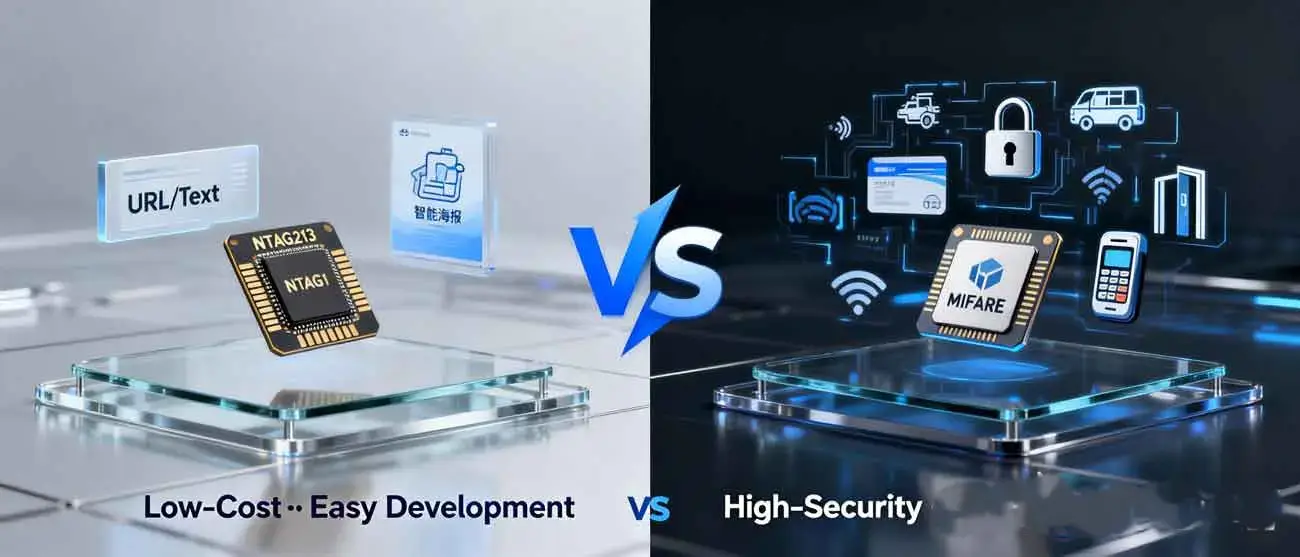
Core Needs of Consumer NFC Product Development Determine the Direction of Chip Selection
Diversified Scenarios of Consumer NFC Products Spur Differentiated Chip Demands
The rapid development of consumer NFC products in recent years has led to increasingly diversified application scenarios, ranging from daily wearable devices, retail payment tools, and smart home accessories to entertainment and interactive products. Each scenario has unique functional requirements, which in turn spur differentiated demands for NFC chips. For example, consumer NFC products used in retail payment require chips with high security and fast reading speed to ensure the safety and efficiency of transactions; wearable devices such as smart bracelets and NFC-enabled watches need chips with ultra-low power consumption and small size to adapt to the limited battery capacity and compact design of the devices; smart home accessories, such as NFC-enabled light switches and door locks, require chips with stable communication performance and long-term reliability to support daily frequent use. These diversified scenarios mean that there is no one-size-fits-all NFC chip, and developers must select chips according to the specific needs of their products. As the core component of consumer NFC products, the NFC chip directly determines the product’s performance, function, and user experience, making differentiated chip selection an inevitable requirement for the development of consumer NFC products. This trend has also promoted the continuous upgrading and iteration of NFC chips, with NTAG213 and MIFARE emerging as the mainstream choices to meet different scenario demands.
Chip Selection Directly Affects the Experience and Cost of Consumer NFC Products
In the development of consumer NFC products, chip selection is a crucial link that directly affects both the user experience and the overall cost of the product, and even determines the market competitiveness of the product. From the perspective of user experience, the performance of the NFC chip directly affects key indicators such as reading speed, communication stability, and operation convenience. A high-quality NFC chip can ensure fast and stable data transmission, enabling users to complete operations such as payment, data reading, and device connection in seconds, while a low-performance chip may lead to slow reading, frequent disconnection, and cumbersome operation, greatly reducing user satisfaction. From the cost perspective, NFC chips account for a significant proportion of the total production cost of consumer NFC products, and the price difference between different models of chips can be considerable. Choosing a chip that is too high-end may lead to unnecessary cost increases, making the product less competitive in pricing, while choosing a chip that is too low-end may fail to meet the functional requirements of the product, resulting in poor user experience and even product failure. Therefore, reasonable NFC chip selection is a balance between user experience and cost control, which is crucial for the success of consumer NFC products. For most consumer NFC product developers, NTAG213 and MIFARE chips have become the preferred choices because they can achieve an excellent balance between performance and cost.
Core Consideration Dimensions for Chip Selection in Consumer Product Development
When selecting NFC chips for consumer product development, developers need to consider multiple core dimensions to ensure that the selected chip is fully compatible with the product’s positioning and needs. The first dimension is performance indicators, including storage capacity, reading speed, communication distance, and stability. These indicators directly determine the functional scope and user experience of the product; for example, products that need to store a large amount of data (such as NFC-enabled membership cards with detailed user information) require chips with large storage capacity, while products that require fast interaction (such as contactless payment devices) need chips with high reading speed. The second dimension is power consumption, which is particularly important for battery-powered consumer NFC products such as wearable devices and portable smart accessories. Low-power NFC chips can effectively extend the battery life of the product, improving user experience. The third dimension is security, especially for consumer NFC products involving payment, personal information storage, and access control. Chips with advanced encryption technology can effectively protect user data and prevent information leakage and counterfeiting. The fourth dimension is compatibility, which ensures that the chip can work seamlessly with various NFC-enabled devices (such as smartphones, tablets, and card readers) on the market. The fifth dimension is cost, which needs to be matched with the product’s positioning and target market to avoid excessive cost or insufficient performance. These core dimensions together form the basis for NFC chip selection in consumer product development, guiding developers to make scientific and reasonable choices.
NTAG213 and MIFARE Become Mainstream Choices for Consumer NFC Chips
Against the backdrop of the increasing demand for consumer NFC products and the continuous upgrading of chip technology, NTAG213 and MIFARE have gradually become the mainstream choices for consumer NFC chips, favored by a large number of product developers and terminal manufacturers. The reason for their popularity lies in their excellent comprehensive performance, wide compatibility, and reasonable cost, which can meet the needs of most consumer NFC product scenarios. NTAG213, developed by NXP Semiconductors, is a high-performance, low-cost NFC chip that is widely used in consumer products such as NFC tags, membership cards, and small smart accessories. It has the advantages of small size, low power consumption, and fast reading speed, and supports a variety of data storage and transmission functions. MIFARE, also developed by NXP Semiconductors, is a classic NFC chip series with strong security performance and mature application cases, which is widely used in consumer products involving payment, access control, and high-security data storage, such as contactless payment cards, smart door locks, and high-end wearable devices. Both NTAG213 and MIFARE have passed strict market verification, with stable performance and wide device compatibility, making them the first choice for most consumer NFC product developers. Their popularity also reflects the market’s demand for high-performance, cost-effective NFC chips, and they will continue to dominate the consumer NFC chip market in the short term.
Comprehensive Comparison of Core Parameters Between NTAG213 and MIFARE Chips
Differences in Storage Capacity and Reading Speed Between the Two Chips
Storage capacity and reading speed are two core parameters of NFC chips, which directly affect the functional scope and user experience of consumer NFC products, and there are obvious differences between NTAG213 and MIFARE chips in these two aspects. In terms of storage capacity, NTAG213 has a storage capacity of 144 bytes, which is suitable for consumer NFC products that do not require a large amount of data storage, such as simple NFC tags, product anti-counterfeiting labels, and basic membership cards. This storage capacity can meet the needs of storing basic information such as product codes, user IDs, and simple text information. MIFARE chips, on the other hand, have a variety of storage capacity options, ranging from 1KB to 64KB, with the most commonly used MIFARE Classic 1K having a storage capacity of 1024 bytes. This larger storage capacity makes MIFARE chips more suitable for consumer NFC products that need to store a large amount of data, such as contactless payment cards (storing transaction records and user information), smart membership cards (storing detailed user preferences and consumption records), and high-end smart accessories. In terms of reading speed, NTAG213 has a reading speed of up to 106 kbps, which can meet the needs of most daily consumer scenarios, such as fast reading of product information and simple data transmission. MIFARE chips have a slightly higher reading speed, up to 106 kbps for MIFARE Classic and up to 424 kbps for MIFARE Ultralight, making them more suitable for scenarios that require faster data transmission, such as contactless payment and high-frequency data interaction.
Communication Distance and Stability of NTAG213 and MIFARE Chips
Communication distance and stability are crucial for the practical application of consumer NFC products, as they directly determine the convenience and reliability of the product in daily use. Both NTAG213 and MIFARE chips operate in the 13.56 MHz frequency band, which is the standard frequency band for NFC technology, but there are subtle differences in their communication distance and stability. In terms of communication distance, NTAG213 has a maximum communication distance of 10 cm, which is suitable for most consumer NFC scenarios that require close contact, such as tapping a smartphone to read product information, making contactless payments, and connecting smart devices. The communication distance of MIFARE chips is slightly longer, with a maximum distance of 15 cm, which is more suitable for scenarios that require a little more distance, such as smart door locks that can be unlocked by approaching, and NFC-enabled access control systems. In terms of stability, both chips have excellent performance, but there are differences in anti-interference ability. NTAG213 has strong anti-interference ability against external electromagnetic signals, which can ensure stable communication in complex environments (such as shopping malls, subway stations, and other places with dense electronic devices). MIFARE chips, especially the high-end models such as MIFARE DESFire, have higher stability and anti-interference ability, which can adapt to more harsh environments and ensure reliable data transmission even in high-interference scenarios. This makes MIFARE chips more suitable for consumer NFC products that require long-term stable operation, such as smart home control devices and high-security access control products.
Power Consumption Performance and Battery Life Adaptability of the Two Chips
Power consumption performance is a key consideration for battery-powered consumer NFC products, such as wearable devices, portable smart accessories, and battery-powered NFC tags, as it directly affects the battery life and user experience of the product. Both NTAG213 and MIFARE chips have excellent low-power performance, but there are differences in power consumption levels, making them suitable for different types of consumer NFC products. NTAG213 adopts an optimized low-power design, with a standby power consumption of less than 1 μA and an active power consumption of less than 5 mA during data transmission. This ultra-low power consumption makes NTAG213 very suitable for passive NFC products (such as NFC tags and product labels) that do not have their own power supply, as well as small wearable devices with limited battery capacity, such as NFC-enabled smart bracelets and key fobs. MIFARE chips have slightly higher power consumption than NTAG213, with a standby power consumption of about 2 μA and an active power consumption of about 6 mA during data transmission. However, MIFARE chips have better power management capabilities, which can adjust power consumption according to the working state, reducing unnecessary power loss. This makes MIFARE chips more suitable for active consumer NFC products that have their own power supply and require long-term stable operation, such as smart door locks, contactless payment terminals, and high-end wearable devices with more complex functions. In general, NTAG213 is more suitable for low-power demand scenarios, while MIFARE chips are more suitable for products that require a balance between power consumption and performance.
Chip Security Parameters Adapt to Different Consumer Scenarios
Security is a core concern for consumer NFC products, especially those involving payment, personal information storage, and access control, and the security parameters of NTAG213 and MIFARE chips are designed to adapt to different consumer scenarios. NTAG213 has basic security functions, including a unique serial number (UID) that cannot be copied, a read/write password protection function, and a lock function that can prevent unauthorized modification of data. These security functions are sufficient for most consumer NFC products that do not involve sensitive information, such as product anti-counterfeiting labels, basic membership cards, and NFC-enabled promotional tags. However, NTAG213 does not support advanced encryption algorithms, so it is not suitable for products that require high security, such as contactless payment cards and high-security access control products. MIFARE chips, on the other hand, have strong security performance, especially the MIFARE Classic and MIFARE DESFire series. MIFARE Classic uses a 48-bit key encryption algorithm, which can effectively protect data security and prevent information leakage and counterfeiting. MIFARE DESFire uses a more advanced 3DES or AES encryption algorithm, with a higher level of security, which meets the security requirements of financial payment and high-security access control. This makes MIFARE chips the preferred choice for consumer NFC products that involve sensitive information, such as contactless payment cards, smart door locks, and high-end membership cards with detailed user information. The security differences between the two chips make them suitable for different consumer scenarios, and developers need to select according to the security requirements of their products.
Compatibility and Device Adaptation Range of the Two Chips
Compatibility and device adaptation range are important factors affecting the market promotion of consumer NFC products, as they determine whether the product can work seamlessly with various NFC-enabled devices on the market. Both NTAG213 and MIFARE chips have wide compatibility, but there are differences in their adaptation ranges. NTAG213 is fully compatible with the NFC Forum Type 2 standard, which is the most common NFC standard, and can work with all NFC-enabled smartphones, tablets, and card readers on the market, including Android and iOS devices. This wide compatibility makes NTAG213 very suitable for consumer NFC products that need to be used by a large number of users, such as product tags, membership cards, and promotional devices. NTAG213 also supports NDEF (NFC Data Exchange Format), which can easily exchange data with other NFC-enabled devices, improving the flexibility and usability of the product. MIFARE chips are compatible with the ISO/IEC 14443 standard, which is widely used in contactless payment and access control systems. Most NFC-enabled devices on the market also support this standard, so MIFARE chips also have good compatibility. However, some low-end NFC devices may not support the advanced functions of MIFARE chips (such as high-speed data transmission and advanced encryption), which may affect the user experience. In addition, MIFARE chips have better compatibility with professional card readers and payment terminals, making them more suitable for consumer NFC products involving payment and access control, such as contactless payment cards and smart access control devices. In general, both chips have wide compatibility, but NTAG213 is more suitable for general consumer scenarios, while MIFARE chips are more suitable for professional and high-security scenarios.
Differentiated Product Adaptation Scenarios of NTAG213 and MIFARE Chips
Consumer NFC Product Scenarios Adapted to NTAG213 Chips
NTAG213 chips, with their advantages of low cost, small size, low power consumption, and wide compatibility, are widely adapted to a variety of consumer NFC product scenarios, mainly focusing on simple functions, low cost, and large-scale application scenarios. One of the most common scenarios is NFC product tags and anti-counterfeiting labels. Many consumer goods, such as cosmetics, food, clothing, and electronic products, use NTAG213 chips as anti-counterfeiting tags. Users can tap their smartphones to read the product’s authenticity information, production date, and origin, effectively preventing counterfeiting. Another important scenario is basic membership cards and loyalty program cards. Retail stores, supermarkets, cafes, and other businesses often use NTAG213 chips to make membership cards, which can store basic user information and points, enabling users to accumulate points and redeem rewards by tapping the card. NTAG213 chips are also suitable for small wearable devices, such as NFC-enabled smart bracelets, key fobs, and smart stickers. These devices have limited size and battery capacity, and the small size and low power consumption of NTAG213 chips can perfectly adapt to their design needs. In addition, NTAG213 chips are widely used in promotional and interactive consumer products, such as NFC-enabled posters, leaflets, and toys. Users can tap the product to access promotional information, videos, or interactive games, enhancing the promotional effect and user experience. These scenarios all have the characteristics of simple functions, low cost, and large-scale application, which are perfectly matched with the performance and cost advantages of NTAG213 chips.
Consumer NFC Product Scenarios Adapted to MIFARE Chips
MIFARE chips, with their advantages of large storage capacity, high security, and stable performance, are mainly adapted to consumer NFC product scenarios that require high security, large data storage, and long-term stable operation. The most typical scenario is contactless payment cards, such as credit cards, debit cards, and prepaid cards. These products need to store sensitive information such as user account information and transaction records, and require high security to prevent information leakage and counterfeiting. MIFARE chips, especially MIFARE Classic and MIFARE DESFire, can meet these security requirements with their advanced encryption technology. Another important scenario is smart home control devices, such as NFC-enabled smart door locks, light switches, and thermostats. These devices need to work stably for a long time, require reliable communication performance, and often need to store user access records and device settings, which can be well met by the large storage capacity and stable performance of MIFARE chips. MIFARE chips are also suitable for high-end wearable devices, such as smart watches and fitness trackers with payment functions. These devices need to balance performance, security, and battery life, and MIFARE chips’ excellent power management and security performance make them an ideal choice. In addition, MIFARE chips are widely used in high-security access control products, such as residential access cards, office access cards, and gym membership cards with access control functions. These products require high security to prevent unauthorized access, and MIFARE chips’ encryption technology can effectively ensure data security. These scenarios all have high requirements for security, storage capacity, and stability, which are perfectly matched with the advantages of MIFARE chips.
Selection and Adaptation Suggestions for the Two Chips Under Different Needs
When selecting between NTAG213 and MIFARE chips for consumer NFC product development, developers need to make targeted choices according to the specific needs of the product, including functional requirements, security requirements, cost budget, and application scenarios. For products with simple functions, low security requirements, and limited cost budget, such as product anti-counterfeiting tags, basic membership cards, small wearable devices, and promotional products, NTAG213 is the optimal choice. It has the advantages of low cost, small size, low power consumption, and wide compatibility, which can meet the basic functional needs of these products while controlling the production cost. For products that require large data storage, high security, and long-term stable operation, such as contactless payment cards, smart door locks, high-end wearable devices with payment functions, and high-security access control products, MIFARE chips are more suitable. Their large storage capacity, advanced encryption technology, and stable performance can fully meet the high requirements of these products. If the product is positioned in the mid-to-high-end market, with moderate security requirements and certain data storage needs, such as high-end membership cards and smart home accessories with basic control functions, developers can choose MIFARE Ultralight (a lightweight version of MIFARE chips), which has a balance between performance and cost. In addition, developers also need to consider the target user group and market positioning of the product: if the product is aimed at the mass market with low price sensitivity, NTAG213 is more suitable; if it is aimed at the high-end market with high requirements for security and experience, MIFARE chips are the better choice.
Analysis of Market Preferences and Selection Tendencies for Consumer NFC Chips
Overall Development Trend of the Global Consumer NFC Chip Market
The global consumer NFC chip market has maintained steady growth in recent years, driven by the continuous popularization of consumer NFC products and the continuous upgrading of NFC technology. According to market research data, the global consumer NFC chip market size is expected to reach $8.5 billion by 2027, with a compound annual growth rate of 12.3% from 2022 to 2027. The main driving factors of this growth include the increasing popularity of contactless payment, the rapid development of wearable devices and smart home products, and the growing demand for product anti-counterfeiting and interactive experiences. In terms of market structure, the consumer NFC chip market is dominated by a few major manufacturers, with NXP Semiconductors, STMicroelectronics, Infineon Technologies, and Texas Instruments being the main players, accounting for more than 80% of the global market share. Among them, NXP Semiconductors occupies the leading position with its mature NTAG and MIFARE chip series. The market is also showing a trend of diversification, with more and more manufacturers launching cost-effective NFC chips to meet the needs of different consumer scenarios. In addition, the development of 5G technology and the Internet of Things has also promoted the expansion of the consumer NFC chip market, making NFC technology widely used in more new consumer products, such as smart toys, smart clothing, and smart health products. The overall development trend of the global consumer NFC chip market is towards miniaturization, low power consumption, high security, and high integration, which will continue to drive the innovation and upgrading of consumer NFC products.
Market Recognition and Application Share of NTAG213 and MIFARE Chips
NTAG213 and MIFARE chips, as the mainstream products of NXP Semiconductors, have high market recognition and occupy a large share in the global consumer NFC chip market. According to market statistics, NTAG213 accounts for about 35% of the global consumer NFC chip market share, making it the most widely used consumer NFC chip. Its popularity is mainly due to its low cost, wide compatibility, and suitable performance for most general consumer scenarios, such as product tags, membership cards, and small wearable devices. NTAG213 is widely used by small and medium-sized enterprises and large brands alike, and its application scope covers retail, catering, electronics, and many other industries. MIFARE chips account for about 25% of the global consumer NFC chip market share, mainly focusing on high-security and high-performance scenarios. Among them, MIFARE Classic accounts for the largest share of the MIFARE series, widely used in contactless payment cards and access control products, while MIFARE DESFire is mainly used in high-end scenarios with extremely high security requirements, such as financial payment and government access control. The high market recognition of NTAG213 and MIFARE chips is due to their stable performance, mature technology, and wide compatibility, which have been verified by a large number of market applications. With the continuous growth of the consumer NFC product market, the application share of these two chips is expected to continue to increase in the future.
Chip Selection Preferences of Terminal Manufacturers and Developers
Terminal manufacturers and developers, as the direct users of NFC chips, have obvious selection preferences when choosing chips for consumer NFC products, which are mainly affected by product positioning, cost budget, functional requirements, and market demand. For most terminal manufacturers and developers of mass-market consumer products (such as product tags, basic membership cards, and low-end wearable devices), NTAG213 is their preferred choice. The main reasons are its low cost, wide compatibility, and simple application, which can help them control production costs while meeting the basic functional needs of the product. In addition, NTAG213 has a mature supply chain and technical support, which can reduce the development cycle and risk of the product. For terminal manufacturers and developers of mid-to-high-end consumer products (such as contactless payment cards, smart door locks, and high-end wearable devices), MIFARE chips are more popular. They value the high security, large storage capacity, and stable performance of MIFARE chips, which can help them improve the product’s competitiveness and user experience. Many large brands, such as Apple, Samsung, and Huawei, often choose MIFARE chips for their high-end consumer NFC products to ensure the security and reliability of the product. In addition, some developers also pay attention to the scalability of the chip, preferring chips that can support future function upgrades, and MIFARE chips have obvious advantages in this regard. Overall, the selection preferences of terminal manufacturers and developers are closely related to the product’s positioning and needs, with NTAG213 dominating the mass market and MIFARE chips leading the mid-to-high-end market.
Impact of Changes in Consumer Market Demand on Chip Selection
Changes in consumer market demand have a profound impact on the selection of NFC chips for consumer products, as terminal manufacturers and developers need to adjust their chip selection strategies according to changes in user needs to meet the market demand. In recent years, with the increasing awareness of consumers about data security, the demand for high-security consumer NFC products has been rising, which has led to an increase in the selection proportion of MIFARE chips with high security performance. For example, more and more consumers pay attention to the security of contactless payment, prompting banks and payment institutions to choose MIFARE chips with advanced encryption technology for their payment cards. At the same time, the popularity of wearable devices and smart home products has led to an increasing demand for low-power, small-sized NFC chips, which has further promoted the application of NTAG213 chips, as they have obvious advantages in low power consumption and small size. In addition, consumers’ demand for personalized and interactive consumer products has also affected chip selection. For example, products that require large data storage and fast interaction (such as smart toys with interactive functions) often choose MIFARE chips with large storage capacity and high reading speed, while products that require simple interaction and low cost (such as promotional tags) choose NTAG213 chips. With the continuous upgrading of consumer demand, the requirements for NFC chips will become more diversified, which will promote the continuous iteration of NTAG213 and MIFARE chips and the emergence of more new types of NFC chips to meet the changing market demand.
Practical Cases and Experience Summary of NFC Chip Selection in Consumer NFC Products
Analysis of Practical Application Cases of NTAG213 and MIFARE Chips
There are a large number of practical application cases of NTAG213 and MIFARE chips in consumer NFC products, which can provide valuable reference for terminal manufacturers and developers in chip selection. A typical case of NTAG213 application is a global cosmetics brand’s anti-counterfeiting project. The brand used NTAG213 chips to make anti-counterfeiting tags for its cosmetics products, with each tag having a unique serial number. Consumers can tap their smartphones to read the product’s authenticity information, production date, and origin, effectively preventing counterfeiting. This project covered millions of products, and the low cost and wide compatibility of NTAG213 chips ensured the feasibility of large-scale application, while the simple operation also improved the user experience. A typical case of MIFARE chip application is a European contactless payment card project. A large bank launched a contactless credit card using MIFARE Classic 1K chips, which can store user account information, transaction records, and security keys. The high security and fast reading speed of MIFARE chips ensured the safety and efficiency of transactions, and the large storage capacity also supported the card’s multiple functions, such as points accumulation and discount redemption. Another case is a smart home brand’s door lock project, which used MIFARE DESFire chips to realize NFC unlocking function. The high security and stable performance of MIFARE DESFire chips prevented unauthorized access, and the large storage capacity stored user access records, improving the safety and convenience of the door lock. These practical cases fully show the advantages of NTAG213 and MIFARE chips in different scenarios and provide valuable experience for chip selection.
Common Problems and Solutions in Chip Selection
In the process of selecting NFC chips for consumer NFC products, terminal manufacturers and developers often encounter some common problems, which may affect the product’s development progress and user experience if not solved properly. One common problem is the mismatch between chip performance and product needs. For example, some developers choose NTAG213 chips for products that require large data storage, resulting in insufficient storage capacity and failure to meet functional requirements; or choose MIFARE chips for low-cost products, leading to excessive cost and loss of market competitiveness. The solution is to clearly define the product’s functional requirements, security requirements, and cost budget before chip selection, and select chips that match these requirements. Another common problem is poor compatibility between the chip and the device. For example, some chips cannot work normally with certain models of smartphones or card readers, affecting the user experience. The solution is to select chips that are compatible with mainstream NFC standards (such as NFC Forum Type 2 and ISO/IEC 14443) and conduct sufficient compatibility tests before product launch. A third common problem is ignoring the scalability of the chip, resulting in the product being unable to support future function upgrades. The solution is to select chips with good scalability, such as MIFARE chips, which can support function upgrades through firmware updates. In addition, some developers may ignore the supply chain and technical support of the chip, leading to problems such as insufficient chip supply and difficulty in technical debugging. The solution is to choose chips from well-known manufacturers with mature supply chains and perfect technical support, such as NXP Semiconductors.
Core Experience and Mistake Avoidance Skills in Chip Selection
Through a large number of practical cases and industry experience, we can summarize the core experience and mistake avoidance skills in NFC chip selection for consumer NFC products, helping terminal manufacturers and developers make more scientific and reasonable choices. The core experience of chip selection is to adhere to the principle of “demand-oriented and cost-balanced”. Developers should first clarify the product’s functional requirements, security requirements, application scenarios, and cost budget, and select chips that can meet these requirements while achieving the best balance between performance and cost. It is not advisable to blindly pursue high-performance chips (which will increase cost) or blindly choose low-cost chips (which will affect performance and user experience). Another core experience is to pay attention to the compatibility and stability of the chip, as these directly affect the product’s market acceptance and user experience. Developers should select chips with wide compatibility and stable performance, and conduct sufficient tests to ensure that the chip can work normally in various scenarios. The mistake avoidance skills mainly include three aspects: first, avoid ignoring the security requirements of the product. For products involving sensitive information, do not choose chips with insufficient security (such as using NTAG213 chips for payment cards), to prevent information leakage and counterfeiting. Second, avoid ignoring the power consumption performance of the chip. For battery-powered products, do not choose chips with high power consumption, to avoid affecting the product’s battery life. Third, avoid ignoring the supply chain and technical support of the chip. Do not choose chips from small manufacturers with unstable supply chains and insufficient technical support, to avoid affecting the product’s production and after-sales service. By following these core experiences and mistake avoidance skills, developers can effectively reduce the risk of chip selection and improve the success rate of product development.
Technical Development Trends of Consumer NFC Chips Guide the Future Selection Direction
Miniaturization and Low Power Consumption Development Trend of Consumer NFC Chips
Miniaturization and low power consumption are important development trends of consumer NFC chips, driven by the continuous upgrading of consumer NFC products, especially wearable devices and small smart accessories. With the development of microelectronics technology, the size of NFC chips is becoming smaller and smaller, from the original several millimeters to less than 1 millimeter now, which can be embedded in smaller consumer products, such as smart stickers, smart jewelry, and micro-wearable devices. This miniaturization trend not only expands the application scope of NFC chips but also reduces the design difficulty of consumer products, making the product more compact and beautiful. At the same time, low power consumption has become a key pursuit of consumer NFC chip development. With the increasing popularity of battery-powered consumer NFC products, users have higher and higher requirements for battery life. Chip manufacturers are constantly optimizing the chip’s power management design, reducing standby power consumption and active power consumption. For example, the latest NTAG213 chip has a standby power consumption of less than 1 μA, which can greatly extend the battery life of the product. In the future, consumer NFC chips will continue to develop towards more miniaturization and lower power consumption, adapting to the development trend of lighter, thinner, and more portable consumer products.
Chip Security Upgrade Adapts to New Needs of Consumer Products
With the increasing popularity of consumer NFC products and the growing concern of consumers about data security, the security of NFC chips is facing higher requirements, and security upgrade has become an important development trend of consumer NFC chips. In the past, most consumer NFC chips only had basic security functions, but with the application of NFC technology in more sensitive scenarios (such as financial payment, personal information storage, and medical data transmission), the security requirements for chips have become more stringent. Chip manufacturers are constantly upgrading the security performance of NFC chips, introducing more advanced encryption algorithms (such as AES-256 encryption algorithm), adding multi-layer security protection mechanisms, and strengthening the anti-counterfeiting and anti-tampering capabilities of the chip. For example, the latest MIFARE DESFire EV3 chip uses a more advanced encryption algorithm and supports dynamic key update, which can effectively prevent information leakage and counterfeiting. In addition, chip manufacturers are also developing chips with biometric authentication functions (such as fingerprint recognition and facial recognition), which can further improve the security of consumer NFC products. In the future, the security of consumer NFC chips will continue to be upgraded, adapting to the new needs of consumer products for data security and privacy protection.
Technical Iteration Direction of NTAG and MIFARE Chip Series
As the mainstream consumer NFC chip series, NTAG and MIFARE chips are constantly iterating and upgrading to meet the changing needs of the consumer market. The NTAG chip series is mainly developing towards lower power consumption, larger storage capacity, and more convenient application. For example, the next-generation NTAG213 chip is expected to increase the storage capacity to 256 bytes while maintaining low power consumption, which can meet the needs of more consumer scenarios. In addition, NTAG chips will also add more intelligent functions, such as supporting dynamic data update and multi-device connection, improving the flexibility and usability of the product. The MIFARE chip series is mainly developing towards higher security, faster reading speed, and better compatibility. For example, the MIFARE DESFire EV3 chip has improved the reading speed to 848 kbps, which can meet the needs of high-frequency data interaction scenarios. At the same time, MIFARE chips will also strengthen compatibility with new NFC standards and new devices, ensuring that they can work seamlessly with future consumer products. In addition, both NTAG and MIFARE chips will integrate more functions, such as sensor integration and wireless charging, expanding their application scope and creating more value for consumer NFC products. The technical iteration of these two chip series will continue to lead the development of the consumer NFC chip market.
Prediction of Future Chip Selection Trends for Consumer NFC Products
Based on the technical development trends of consumer NFC chips and the changes in market demand, the future chip selection trends for consumer NFC products can be predicted. First, the demand for high-security NFC chips will continue to increase, and MIFARE chips will occupy a larger share in the mid-to-high-end consumer NFC product market, especially in scenarios such as payment, access control, and medical care. Second, with the popularization of wearable devices and small smart accessories, the demand for low-power, small-sized NFC chips will continue to rise, and NTAG213 and its upgraded versions will remain the mainstream choice for the mass consumer market. Third, the integration of NFC chips with other technologies (such as the Internet of Things, 5G, and biometrics) will become more closely, and developers will prefer chips with strong scalability and multi-functional integration to meet the needs of new consumer products. Fourth, cost-effectiveness will remain an important factor in chip selection, and chip manufacturers will launch more cost-effective products to meet the needs of small and medium-sized enterprises and mass-market products. Fifth, with the increasing emphasis on environmental protection, the demand for environmentally friendly NFC chips (such as chips made of recyclable materials) will gradually rise, which will also affect the chip selection strategy of developers. In general, the future chip selection for consumer NFC products will be more diversified and personalized, with NTAG and MIFARE chips continuing to dominate the market and new types of chips emerging to meet specific scenario needs.
Why Choose Mytopband?
- Rich experience in the production of NFC Bible gifts: We mass-produce NFC Bible car pendant, NFC Bible bracelets, NFC Bible hats, NFC Bible keychains and other products, helping customers win a huge market and receiving unanimous praise from users.
- Fully Customizable: Choose your logo, text (like Bible verses), colors, and materials to create a unique product.
- Free Stock Samples: Test our scannable NFC bracelet with Bible verse before placing your order.
- Low MOQ as 500pcs: Perfect for startups and small businesses.

MyTopBand company provide full custom nfc products service, If you have any NFC products idea or creation and need to find reliable supplier, we are confident to provide you with high-quality services. Please find us: www.mytopband.com, or send message to info@mytopband.com, we will reply you within 24 hours.