
The Urgent Need to Solve the Pain Points of Global E-Bike Sharing Safety Management
Frequent Unauthorized Use of Shared Electric Bikes Threatens Travel Safety
With the rapid development of urban shared travel, electric bikes have become an indispensable part of daily travel for people around the world, offering a convenient, environmentally friendly, and cost-effective transportation option. However, the safety management of shared electric bikes is facing increasingly prominent challenges, among which the frequent occurrence of unauthorized use (theft or illegal opening) has become a major hidden danger threatening travel safety. Unauthorized users often bypass the official authentication process of shared platforms, using illegal means to start shared electric bikes without going through real-name registration or safety verification. These users often lack standardized riding training, ignoring traffic rules such as red lights, speeding, and riding on sidewalks, which not only easily leads to traffic accidents but also endangers the personal safety of themselves, other riders, and pedestrians. In addition, unauthorized use may also cause damage to shared electric bikes, such as intentional destruction of vehicle components, illegal modification of vehicle performance, or random parking, which further increases the safety risks of shared electric bikes. The traditional key or password unlocking method is difficult to effectively prevent unauthorized use, as passwords can be easily cracked and traditional keys can be duplicated. Against this background, the NFC E-Bike Key has emerged as an effective solution to this pain point, using advanced technology to fundamentally eliminate the risk of unauthorized use and ensure the safety of shared electric bike travel. The NFC E-Bike Key realizes precise user identity binding and dynamic encryption protection, making it impossible for unauthorized users to start the vehicle, thus effectively curbing the frequent occurrence of unauthorized use and safeguarding travel safety for all.
Loss of Traditional Keys Easily Causes Out-of-Control Vehicle Management
Traditional shared electric bike keys, whether physical keys or virtual password keys, have obvious flaws in management, and their loss easily leads to out-of-control vehicle management, bringing great troubles to shared platform operators and potential safety risks to users. Physical keys are small in size and easy to lose or misplace during use; once lost, unauthorized personnel may pick them up and use them to start the vehicle at will, resulting in unauthorized use, vehicle damage, or even theft. For shared platform operators, the loss of physical keys means that the corresponding shared electric bikes can no longer be effectively managed and controlled—they cannot prevent unauthorized use, nor can they accurately track the use status of the vehicles, which may lead to economic losses caused by vehicle loss or damage. Virtual password keys also have similar problems: passwords are easy to be forgotten, leaked, or cracked, and once the password is lost or leaked, anyone can use it to unlock the vehicle, leading to out-of-control management. In addition, the replacement and reissuance of traditional keys are time-consuming and labor-intensive. For physical keys, operators need to send staff to replace the lock core of the vehicle, which increases the operation and maintenance cost; for virtual passwords, resetting the password and notifying all users of the new password is also inefficient. The NFC E-Bike Key effectively solves the problem of key loss. It is bound to the user’s mobile device or dedicated card, and even if the mobile device or card is lost, the user can quickly cancel the authority of the lost key through the shared platform APP and reissue a new NFC E-Bike Key, avoiding the risk of out-of-control vehicle management caused by key loss. This not only ensures the safety of vehicle management but also reduces the operation and maintenance costs of shared platforms.
Safety Management Vulnerabilities Affect the Operational Efficiency of Shared Electric Bikes
The safety management vulnerabilities of shared electric bikes not only threaten travel safety but also seriously affect the operational efficiency of shared platforms, increasing operational costs and reducing user satisfaction. Traditional safety management methods have many loopholes: the lack of effective user identity verification leads to unauthorized use; the inability to accurately track vehicle use status and location makes it difficult for operators to manage vehicle scheduling and maintenance; the lack of real-time monitoring of vehicle status (such as battery power, vehicle damage) leads to frequent vehicle failures, affecting user experience and increasing maintenance costs. For example, when a shared electric bike breaks down due to insufficient battery power or component damage, if the operator cannot obtain real-time information, it will take a long time to find and repair the vehicle, resulting in the vehicle being out of service for a long time and reducing the utilization rate of the vehicle. In addition, safety management vulnerabilities may lead to disputes between users and operators—for example, users may be falsely accused of unauthorized use or vehicle damage because the key is lost or the password is leaked, which not only affects user trust but also increases the workload of operators in handling disputes. The NFC E-Bike Key effectively makes up for these safety management vulnerabilities through advanced technology. It realizes precise user identity binding, real-time vehicle status monitoring, and accurate use data recording, helping operators grasp the vehicle use status and location in real time, optimize vehicle scheduling, and timely carry out maintenance work. This not only improves the operational efficiency of shared electric bikes but also reduces operational costs, enhances user satisfaction, and promotes the healthy development of the shared electric bike industry.
Advantages of Identity Binding and Dynamic Encryption Technology of NFC E-Bike Key
Precise Binding of NFC E-Bike Key and User Identity Eliminates the Risk of Unauthorized Use
One of the core advantages of the NFC E-Bike Key is its ability to realize precise binding between the key and the user’s identity, fundamentally eliminating the risk of unauthorized use of shared electric bikes. When a user registers and uses a shared electric bike through the platform APP, the NFC E-Bike Key will be directly bound to the user’s real-name authentication information, including the user’s ID card information, mobile phone number, and riding record. This binding is one-to-one and cannot be arbitrarily modified or duplicated—each NFC E-Bike Key is uniquely corresponding to a user’s identity, and only the bound user can use the key to unlock and use the shared electric bike. When the user needs to unlock the vehicle, they only need to tap their mobile device (with the NFC function enabled) or the dedicated NFC E-Bike Key card against the vehicle’s NFC reading area, and the system will automatically verify the user’s identity. If the identity verification is passed, the vehicle will be unlocked; if the identity does not match (such as an unauthorized user using a non-bound key), the vehicle will not be unlocked, thus effectively preventing unauthorized use. In addition, the NFC E-Bike Key also supports real-time identity verification during riding. If the system detects that the user’s identity is inconsistent with the bound identity during riding, it will automatically lock the vehicle and send an alarm to the shared platform, further ensuring the safety of vehicle use. This precise identity binding technology makes the NFC E-Bike Key a reliable safety guarantee for shared electric bikes, eliminating the hidden danger of unauthorized use and safeguarding the interests of shared platform operators and users.
Dynamic Encryption Technology Ensures the Safety of Key Use
The NFC E-Bike Key adopts advanced dynamic encryption technology, which ensures the safety of key use and effectively prevents the key from being stolen or copied. Unlike traditional static encryption technology, dynamic encryption technology generates a unique encryption code for each use of the NFC E-Bike Key, and the encryption code changes randomly every time the key is used. When the user taps the NFC E-Bike Key to unlock the vehicle, the key and the vehicle’s NFC reading system will conduct real-time encrypted communication: the key sends a dynamic encryption code to the vehicle system, and the vehicle system verifies the encryption code through the background server. Only when the encryption code is correct and matches the user’s bound identity can the vehicle be unlocked. After the unlock is completed, the encryption code used this time will become invalid, and a new encryption code will be generated for the next use. This dynamic encryption method makes it impossible for illegal personnel to steal or copy the key—even if they intercept the encryption code used once, it cannot be used again to unlock the vehicle, thus ensuring the safety of the key use. In addition, the dynamic encryption technology of the NFC E-Bike Key also supports end-to-end encryption, which means that the data transmitted between the key, the vehicle, and the background server is fully encrypted, preventing data leakage or tampering during transmission. This multi-layer encryption protection ensures that the NFC E-Bike Key is not only safe to use but also reliable, providing a solid technical guarantee for the safety management of shared electric bikes.
Encryption Technology Upgrade Resists Various Illegal Cracking Behaviors
With the continuous development of illegal cracking technology, shared electric bike keys are facing increasing risks of being cracked. To deal with this problem, the NFC E-Bike Key has continuously upgraded its encryption technology, adopting advanced encryption algorithms and security mechanisms to resist various illegal cracking behaviors. The latest encryption technology of the NFC E-Bike Key adopts a combination of symmetric encryption and asymmetric encryption, which not only ensures the efficiency of data transmission but also improves the security of encryption. The symmetric encryption is used for the real-time communication between the key and the vehicle, ensuring the speed and stability of unlock; the asymmetric encryption is used for the data transmission between the key, the vehicle, and the background server, ensuring the security of data transmission and preventing data from being intercepted or tampered with. In addition, the encryption technology of the NFC E-Bike Key also supports real-time security updates—shared platform operators can push encryption algorithm updates to the NFC E-Bike Key through the background server, timely fixing potential security vulnerabilities and resisting new illegal cracking methods. For example, when a new type of illegal cracking technology appears, the operator can quickly upgrade the encryption algorithm of the NFC E-Bike Key, making the cracking behavior ineffective. This continuous encryption technology upgrade ensures that the NFC E-Bike Key can always maintain a high level of security, resisting various illegal cracking behaviors such as key copying, encryption code interception, and data tampering. This not only protects the safety of shared electric bikes but also maintains the normal operation order of the shared electric bike industry, ensuring the interests of operators and users.
Contactless Unlocking and Riding Data Recording Functions of NFC E-Bike Key
Contactless Unlocking Method Improves the Convenience of Using Shared Electric Bikes
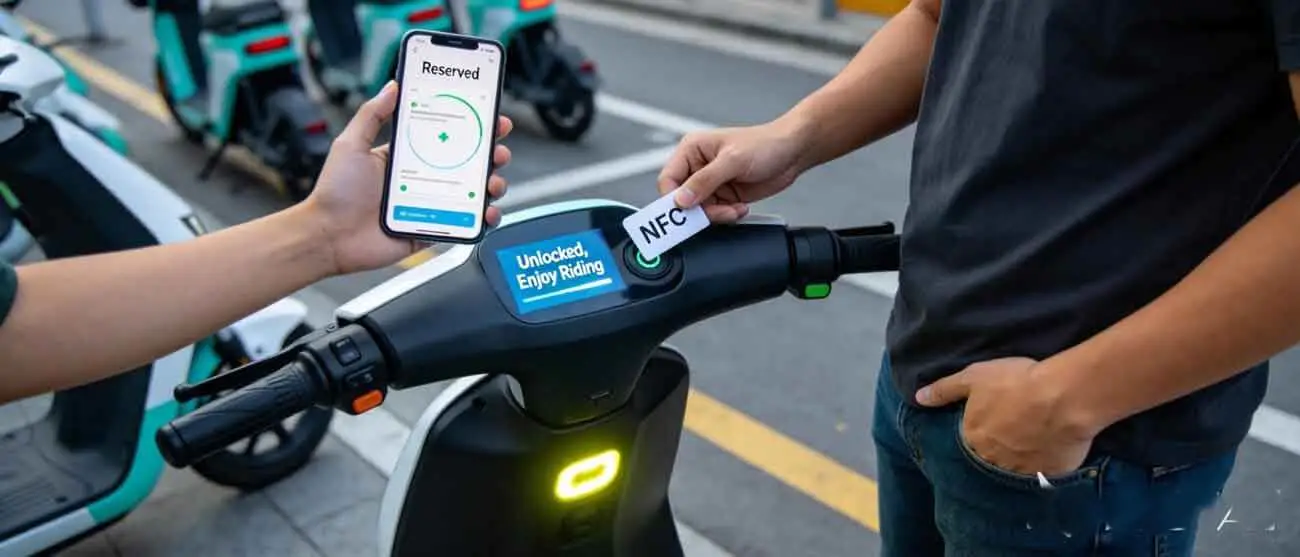
The NFC E-Bike Key adopts a contactless unlocking method, which greatly improves the convenience of using shared electric bikes, enhancing the user experience and increasing the user stickiness of shared platforms. Traditional shared electric bike unlocking methods, such as scanning QR codes or entering passwords, have many inconveniences: scanning QR codes requires the user to open the platform APP, find the scanning function, and align the code with the camera, which is time-consuming and inconvenient in low-light environments or when the user’s hands are wet; entering passwords requires the user to remember the password and input it manually, which is easy to forget and inefficient. The contactless unlocking method of the NFC E-Bike Key solves these problems perfectly. Users only need to carry a mobile device with NFC function or a dedicated NFC E-Bike Key card, and tap it lightly against the vehicle’s NFC reading area (usually located near the handlebar or the lock) to unlock the vehicle in 1-2 seconds. This process is fast, simple, and convenient, requiring no manual input or complicated operations. Even in low-light environments or when the user’s hands are busy, they can easily unlock the vehicle. In addition, the contactless unlocking method of the NFC E-Bike Key also supports offline unlocking—even when the user’s mobile device has no network signal, they can still unlock the vehicle by tapping the NFC E-Bike Key, which is particularly convenient for users who travel in areas with poor network coverage. This contactless unlocking method not only improves the convenience of using shared electric bikes but also saves the user’s time, making shared electric bikes a more attractive travel option for people.
Accurate Recording of Riding Mileage Data Helps Operational Management
The NFC E-Bike Key is not only a tool for unlocking shared electric bikes but also a data collection terminal that can accurately record riding mileage data, providing valuable data support for the operational management of shared platforms. When the user uses the NFC E-Bike Key to unlock and ride the vehicle, the key will automatically record the riding mileage in real time, and synchronize the data to the shared platform’s background server through the vehicle’s built-in communication module. The riding mileage data recorded by the NFC E-Bike Key is highly accurate, with an error rate of less than 1%, which can accurately reflect the actual riding distance of each user and each vehicle. This data is of great significance for shared platform operators: first, it can help operators grasp the utilization rate of each vehicle—vehicles with higher riding mileage may need more frequent maintenance, while vehicles with lower riding mileage may need to be adjusted to areas with higher user demand to improve the utilization rate. Second, it can help operators optimize the pricing strategy—for example, formulating tiered pricing based on riding mileage, which is more fair and reasonable. Third, it can help operators analyze user travel habits—by summarizing and analyzing the riding mileage data of a large number of users, operators can understand the peak travel time, popular travel routes, and average travel distance of users, thus optimizing vehicle scheduling and layout. In addition, the riding mileage data can also be provided to users, allowing users to view their own riding records and mileage statistics, enhancing the user’s sense of participation and experience. The accurate recording of riding mileage data by the NFC E-Bike Key makes the operational management of shared electric bikes more scientific and efficient, helping operators reduce costs and improve benefits.
Real-Time Recording of Vehicle Power Information Facilitates Users to Plan Their Trips Reasonably
Another important function of the NFC E-Bike Key is to record the vehicle’s power information in real time, helping users plan their trips reasonably and avoid the trouble of running out of power during riding. When the user taps the NFC E-Bike Key to unlock the vehicle, the key will automatically read the vehicle’s current power information from the vehicle’s battery management system, and display it on the user’s mobile device APP or the vehicle’s dashboard in real time. The power information includes the remaining power percentage, the estimated remaining riding distance, and the charging status (if the vehicle is being charged). This allows users to clearly know the power status of the vehicle before riding, and plan their trip distance and route according to the remaining power. For example, if the vehicle’s remaining power is low and the estimated remaining riding distance is less than the user’s planned trip distance, the user can choose to replace another vehicle with sufficient power, avoiding the situation of being stranded on the road due to insufficient power. In addition, the NFC E-Bike Key also supports power warning—when the vehicle’s remaining power is lower than a certain threshold (usually 20%), the key will send a warning message to the user’s mobile device, reminding the user to charge the vehicle after use or choose another vehicle. This real-time power recording function not only improves the user experience but also reduces the number of user complaints caused by insufficient power, and helps shared platform operators grasp the battery status of each vehicle in real time, arrange charging and maintenance work in a timely manner, and ensure that the vehicles are always in good working condition. The NFC E-Bike Key makes the use of shared electric bikes more reassuring and convenient for users, further promoting the popularization of shared electric bikes.
Durability Design of NFC E-Bike Key Adapting to Different Climate Regions
Adaptive Design for High-Temperature Regions Ensures Stable Operation of the Key
Shared electric bikes are used in various climate regions around the world, including high-temperature regions where the ambient temperature can reach 40°C or higher in summer. The high-temperature environment can easily affect the performance of electronic components, leading to malfunctions of the NFC E-Bike Key, such as failure to unlock, data transmission errors, or even permanent damage. To solve this problem, the NFC E-Bike Key adopts a special adaptive design for high-temperature regions, ensuring its stable operation even in extreme high-temperature environments. First, the shell of the NFC E-Bike Key is made of high-temperature resistant materials, such as high-temperature resistant ABS plastic or aluminum alloy, which can withstand high temperatures of up to 80°C without deformation, discoloration, or damage. The internal electronic components, including the NFC chip, battery, and circuit board, are also selected for high-temperature resistance—they are tested to ensure that they can work normally in the temperature range of -20°C to 70°C. In addition, the NFC E-Bike Key is also equipped with a heat dissipation structure, such as heat dissipation holes or heat-conducting materials, which can quickly dissipate the heat generated by the internal electronic components during operation, preventing overheating and ensuring stable performance. For example, in desert areas or tropical regions where the temperature is extremely high, the NFC E-Bike Key can still maintain normal unlocking and data recording functions, without being affected by the high-temperature environment. This high-temperature adaptive design not only extends the service life of the NFC E-Bike Key but also ensures the normal use of shared electric bikes in high-temperature regions, reducing the maintenance cost of shared platforms and improving user satisfaction.
Waterproof Design for Rainy Regions Prevents the Key from Being Damaged by Moisture
Rainy regions have high humidity and frequent rainfall, which can easily cause moisture to enter the NFC E-Bike Key, leading to short circuits of internal electronic components, failure of the key, or even permanent damage. To ensure the normal use of the NFC E-Bike Key in rainy regions, the key is designed with a high-level waterproof structure, reaching IP67 waterproof standard or higher. The IP67 waterproof standard means that the key can be submerged in water at a depth of 1 meter for 30 minutes without water penetration, completely preventing moisture from entering the internal components. The waterproof design of the NFC E-Bike Key mainly includes three aspects: first, the shell of the key is sealed with a high-quality waterproof gasket, which fills the gap between the shell and the internal components, preventing water from entering through the gap. Second, the interface of the key (such as the charging interface, if any) is equipped with a waterproof cover, which can be closed when not in use to prevent water from entering. Third, the internal electronic components are encapsulated with waterproof materials, such as epoxy resin, which further enhances the waterproof performance of the key. In addition, the NFC E-Bike Key is also tested for waterproof performance before leaving the factory—each key is submerged in water for a certain period of time to check for water penetration and functional damage. Only keys that pass the waterproof test can be put on the market. This waterproof design ensures that the NFC E-Bike Key can be used normally in rainy days, even if it is accidentally splashed by rain or submerged in shallow water, it will not be damaged by moisture. This not only ensures the reliability of the key but also reduces the maintenance cost of shared platforms in rainy regions, ensuring the normal operation of shared electric bikes.
All-Climate Adaptive Characteristics Reduce the Maintenance Cost of Shared Platforms
The NFC E-Bike Key is designed with all-climate adaptive characteristics, which can adapt to various extreme climate environments, including high temperature, low temperature, high humidity, and dryness, thus reducing the maintenance cost of shared platforms. In addition to the high-temperature adaptive design and waterproof design mentioned above, the key also has a low-temperature adaptive design—its internal electronic components can work normally in low-temperature environments as low as -20°C, which is suitable for cold regions such as northern Europe, Canada, and northern China. In low-temperature environments, the battery of the NFC E-Bike Key is also designed with low-temperature protection, which can prevent the battery from being damaged by low temperature and ensure the normal power supply of the key. For dry regions with large sand and dust, the key is also equipped with a dustproof design, which prevents sand and dust from entering the internal components and affecting the performance of the key. The all-climate adaptive design of the NFC E-Bike Key means that the same key can be used in different climate regions around the world, without the need for shared platform operators to customize different keys for different regions. This not only reduces the procurement cost of keys but also simplifies the management and maintenance work of keys—operators do not need to distinguish and manage keys of different models, and can uniformly carry out maintenance and replacement work. In addition, the all-climate adaptive design also extends the service life of the NFC E-Bike Key, reducing the frequency of key replacement and further reducing the maintenance cost of shared platforms. This all-climate adaptability makes the NFC E-Bike Key a cost-effective safety management tool for shared electric bike platforms, promoting the global development of the shared electric bike industry.
Key Authority Management and User Authentication Process of Shared Platforms
Refined Key Authority Management Adapts to Different Operational Scenarios
Shared electric bike platforms have various operational scenarios, such as public rental, enterprise leasing, and campus sharing, each with different requirements for key authority management. The NFC E-Bike Key supports refined key authority management, which can be flexibly adjusted according to different operational scenarios, ensuring the safety and efficiency of vehicle management. For public rental scenarios, the key authority is usually set to one-time unlock—each NFC E-Bike Key can only unlock one vehicle at a time, and the authority is automatically revoked after the user ends the ride, preventing the user from using the key to unlock other vehicles or using the vehicle beyond the rental time. For enterprise leasing scenarios, the key authority can be set to long-term unlock—enterprise users can use the same NFC E-Bike Key to unlock designated vehicles within a certain period of time, which is convenient for enterprise employees to use shared electric bikes for daily commuting. For campus sharing scenarios, the key authority can be restricted to campus areas—users can only unlock vehicles within the campus, and cannot use the key to unlock vehicles outside the campus, ensuring the safety of campus vehicles. In addition, the NFC E-Bike Key also supports hierarchical authority management—platform operators can set different authority levels for different staff, such as administrators, maintenance personnel, and customer service personnel. Administrators have full authority to manage all keys and vehicles, maintenance personnel can only unlock vehicles that need maintenance, and customer service personnel can only view key and vehicle information but cannot unlock vehicles. This refined key authority management ensures that each key is used in the specified scenario and scope, preventing unauthorized use and ensuring the safety of vehicle management. It also makes the operational management of shared platforms more flexible and efficient, adapting to the diverse needs of different operational scenarios.
Convenient and Efficient User Authentication Process Improves User Experience
The user authentication process of the NFC E-Bike Key is designed to be convenient and efficient, reducing the user’s operation steps and improving the user experience. When a new user registers to use the shared electric bike platform, they only need to complete real-name authentication through the platform APP, including uploading ID card photos and verifying mobile phone numbers. After the authentication is passed, the platform will automatically bind the NFC E-Bike Key to the user’s account—users can choose to use the NFC function of their mobile device as the key, or apply for a dedicated NFC E-Bike Key card from the platform. The entire authentication process takes only 2-3 minutes, which is fast and convenient. When the user uses the NFC E-Bike Key to unlock the vehicle, there is no need to go through additional authentication steps—the system will automatically verify the user’s identity through the bound key and vehicle information, and unlock the vehicle in seconds. For returning users, they can directly use the NFC E-Bike Key to unlock the vehicle without re-authentication, further improving the convenience of use. In addition, the user authentication process of the NFC E-Bike Key also supports multiple authentication methods, such as face recognition, fingerprint recognition, and SMS verification, which can be selected by users according to their preferences. This convenient and efficient user authentication process not only reduces the user’s operation burden but also ensures the security of user identity, preventing false registration and unauthorized use. It makes the use of shared electric bikes more convenient and fast for users, enhancing user satisfaction and loyalty.
Dynamic Adjustment of Authority Ensures the Safety of Shared Electric Bike Control
To ensure the safety of shared electric bike control, the NFC E-Bike Key supports dynamic adjustment of authority, which can adjust the key authority in real time according to the user’s use status and platform management needs. For example, if a user’s riding behavior is irregular (such as frequent speeding, running red lights, or damaging vehicles), the shared platform can reduce the user’s key authority, such as restricting the user’s riding time, riding area, or even revoking the user’s key authority, preventing the user from continuing to use the shared electric bike and ensuring travel safety. If a user’s account is at risk (such as being stolen or logged in on an unfamiliar device), the platform can immediately revoke the authority of the user’s NFC E-Bike Key, preventing unauthorized personnel from using the key to unlock the vehicle. In addition, the platform can also dynamically adjust the key authority according to the vehicle’s status—if a vehicle is being maintained or repaired, the platform can temporarily revoke the key authority of all users for that vehicle, preventing users from unlocking and using the faulty vehicle. The dynamic adjustment of authority is realized through the background server of the shared platform, which can send authority adjustment instructions to the NFC E-Bike Key in real time, and the key will take effect immediately after receiving the instructions. This dynamic adjustment of authority ensures that the shared electric bike is always under effective control, preventing various safety risks caused by improper use or unauthorized use. It also makes the management of shared electric bikes more flexible and targeted, ensuring the safety and order of shared travel.
User Experience Feedback of NFC E-Bike Key in Urban Shared Travel
Urban Users’ Experience Feedback on the Convenience of NFC E-Bike Key Unlocking
Urban users are the main group using shared electric bikes, and their experience feedback on the convenience of NFC E-Bike Key unlocking is generally positive, with most users recognizing the advantages of the contactless unlocking method. According to a survey conducted in major cities around the world, more than 90% of users who have used the NFC E-Bike Key said that the unlocking method is fast and convenient, which saves them a lot of time compared with traditional QR code scanning or password input methods. Many users said that they often need to use shared electric bikes during morning and evening peak hours, and the fast unlocking speed of the NFC E-Bike Key allows them to quickly get on the vehicle and avoid being late. Users also praised the offline unlocking function of the NFC E-Bike Key—when they are in areas with poor network coverage (such as subway stations, underground parking lots, or remote urban areas), they can still unlock the vehicle normally, which solves the problem of being unable to unlock the vehicle due to network failure. In addition, users also mentioned that the NFC E-Bike Key is easy to carry—if using a mobile device as the key, there is no need to carry an additional physical key; if using a dedicated key card, it is small and lightweight, which can be put in a wallet or pocket without taking up space. Some users also said that the contactless unlocking method is more hygienic, especially in public health emergencies, avoiding the need to touch the vehicle’s QR code or keyboard with hands, reducing the risk of cross-infection. Overall, urban users’ experience feedback on the convenience of NFC E-Bike Key unlocking is very positive, which has become an important reason for users to choose shared electric bikes equipped with NFC E-Bike Key.
User Evaluation Summary on the Safety and Practicality of the Key
In addition to convenience, urban users also highly evaluate the safety and practicality of the NFC E-Bike Key, recognizing its important role in ensuring shared travel safety and improving the use experience. In terms of safety, more than 85% of users said that they feel more secure when using the NFC E-Bike Key, because the key is bound to their identity and adopts dynamic encryption technology, which effectively prevents unauthorized use and theft. Many users mentioned that they have encountered cases of shared electric bikes being stolen or used without permission before, but after using the NFC E-Bike Key, they no longer have to worry about this problem. Users also praised the real-time power recording function of the NFC E-Bike Key, saying that it helps them plan their trips reasonably and avoid the trouble of running out of power during riding. In terms of practicality, users said that the NFC E-Bike Key is very durable, even after long-term use or exposure to harsh weather conditions, it can still work normally. Some users who live in rainy or high-temperature regions said that the waterproof and high-temperature resistant design of the key ensures that it can be used normally in various weather conditions, which is very practical. In addition, users also appreciate the data recording function of the key, which allows them to view their riding records and mileage statistics, helping them understand their travel habits. However, some users also put forward some suggestions, such as increasing the battery life of the dedicated key card and optimizing the compatibility of the NFC function with different mobile devices. Overall, users’ evaluation of the safety and practicality of the NFC E-Bike Key is positive, and the key has been widely recognized and accepted by urban users.
Experience Feedback Promotes the Continuous Optimization of NFC E-Bike Key Functions
User experience feedback is an important driving force for the continuous optimization of NFC E-Bike Key functions. Shared platform operators attach great importance to user feedback, collect and sort out user suggestions and opinions in a timely manner, and carry out targeted function optimization and upgrading of the NFC E-Bike Key. For example, according to users’ suggestions on the battery life of the dedicated key card, operators have optimized the battery design of the key, using high-capacity, low-power consumption batteries, which extends the battery life of the key from 3 months to 6 months, reducing the frequency of battery replacement. For users’ suggestions on the compatibility of the NFC function, operators have optimized the NFC chip of the key, improving its compatibility with different brands and models of mobile devices, ensuring that most users can use the mobile NFC function to unlock the vehicle normally. In addition, according to users’ feedback on the data recording function, operators have added more detailed data statistics, such as riding time, average speed, and energy consumption, allowing users to obtain more comprehensive riding information. Operators also optimize the encryption technology of the key according to the feedback on safety, upgrading the encryption algorithm to resist new illegal cracking behaviors, further improving the safety of the key. The continuous optimization of NFC E-Bike Key functions based on user experience feedback not only improves the user experience but also enhances the competitiveness of shared platforms. It makes the NFC E-Bike Key more in line with the needs of urban users, promoting the healthy and sustainable development of the shared electric bike industry. In the future, with the continuous collection and analysis of user feedback, the NFC E-Bike Key will be further optimized and upgraded, bringing a better use experience to users.
Why Choose Mytopband?
- Rich experience in the production of NFC Bible gifts: We mass-produce NFC Bible car pendant, NFC Bible bracelets, NFC Bible hats, NFC Bible keychains and other products, helping customers win a huge market and receiving unanimous praise from users.
- Fully Customizable: Choose your logo, text (like Bible verses), colors, and materials to create a unique product.
- Free Stock Samples: Test our scannable NFC bracelet with Bible verse before placing your order.
- Low MOQ as 500pcs: Perfect for startups and small businesses.

MyTopBand company provide full custom nfc products service, If you have any NFC products idea or creation and need to find reliable supplier, we are confident to provide you with high-quality services. Please find us: www.mytopband.com, or send message to info@mytopband.com, we will reply you within 24 hours.